




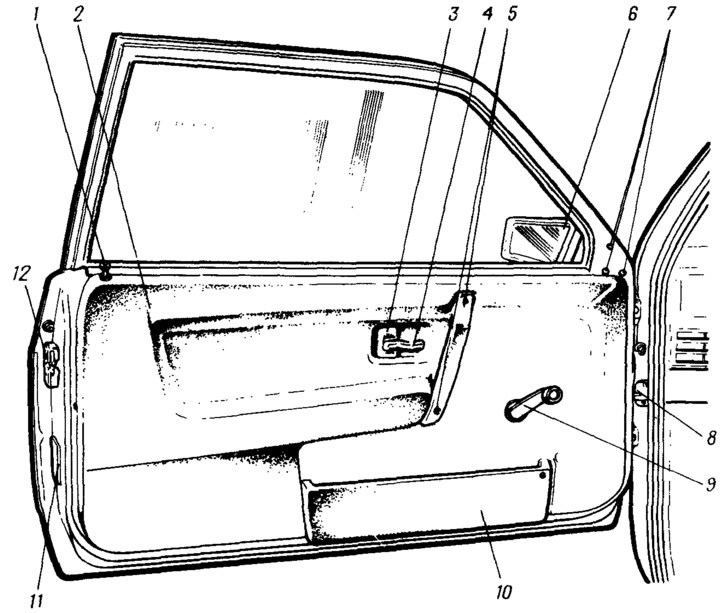
Figure 138. View of the front door from the inside:
1 - lock release button; 2 - door trim; 3 - inner handle lining; 4 - inner door handle; 5 - armrest handle mounting screws; 5 - outside rear view mirror; 7 screws for mounting the rear view mirror; 8 - door opening limiter; 9 - window lift handle; 10 - door trim pocket; 11 - reflector; 12 - external door lock.
The doors consist of stamped steel external and internal panels, profiled door window frames and reinforcements, which are connected to each other by bending the flanges of the external panels and by contact welding.
The doors are equipped with cable window lifters, locks with lock switches, door opening limiters 8. The upholstery of 2 doors is made of non-flammable polyurethane foam covered with polyvinyl chloride film (PVC) and is attached with plastic holders that fit into the holes of the inner door panel. The left door is equipped with a rear-view mirror 6.
Door opening limiter does not allow the stop to be opened against the body pillar. The flat rod of the limiter 8 is attached to the pillar with one end by means of a finger, the other end has a pin that limits the maximum opening of the door. The rod has stampings on both sides. Steel rollers are pressed against it on both sides, which are inserted into a cracker made of polyamide. The rollers fix the open position of the door by the stampings of the rod.
[The text is copied from the online resource: VAZbook]
Window lifter (figure 139) door - cable, fastened to the inner door panel with nuts to welded bolts. Cable 3 covers two rollers 4, mounted on the upper and lower brackets of the window lifter guide pipe. In housing 11 (figure 140) the cable is wound onto a drum 10, the driven gear of which is engaged with the leading gear 9. A spring brake is located on the leading shaft 2, preventing the glass from lowering spontaneously. The drum with the driven gear is installed in the housing 11 and cover 4 with its hub in two plastic bushings 8.
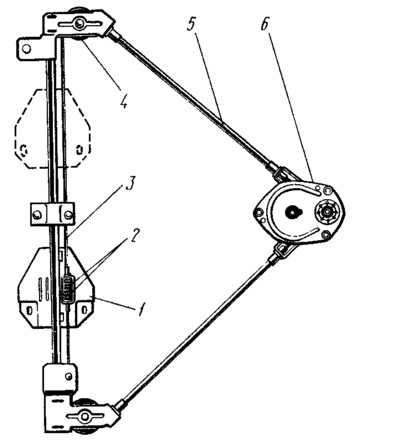
Figure 139. Window lifter:
1 - mounting plate for the drop glass; 2 - spring for selecting the slack of the cable when it is pulled out; 3 - cable; 4 - roller; 5 - cable sheath; 6 - window lift mechanism.
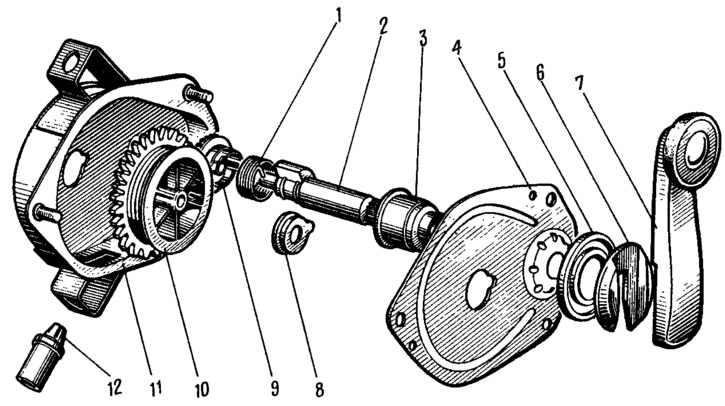
Figure 140. Window lift mechanism:
1 - brake spring; 2 - leading roller; 3 - glass; 4 - lid; 5 - socket; 6 - handle lining; 7 - window lift handle; 8 - drum support; 9 - leading gear; 10 - drum with driven gear; 11 - body; 12 - cable sheath tip.
Plate 1 can move along the window lifter guide tube (see figure 139) glass lifting. The plate bracket contains springs 2, which provide tension to the cable as it is pulled out. The cable is attached to the drum with its middle part.
Lever 7 (see figure 140) the window lifter is installed on the splines of the drive shaft 2 and is secured with the help of the handle trim 6, which, when installed on the handle, enters the annular groove of the drive shaft. A plastic socket 3 is placed under the handle, pressed by the door trim to the window lifter handle.
The glass drop frame is secured to the glass lift plate with two bolts. The glass guides are secured to the inner door panel.
This design of the window lifter excludes its adjustments. During operation, only checking of the fastening of the parts is required.
Door lock (figure 141) — rotary type, consists of external and internal locks and a retainer on the central pillar. The locks are attached with screws to the end of the door.
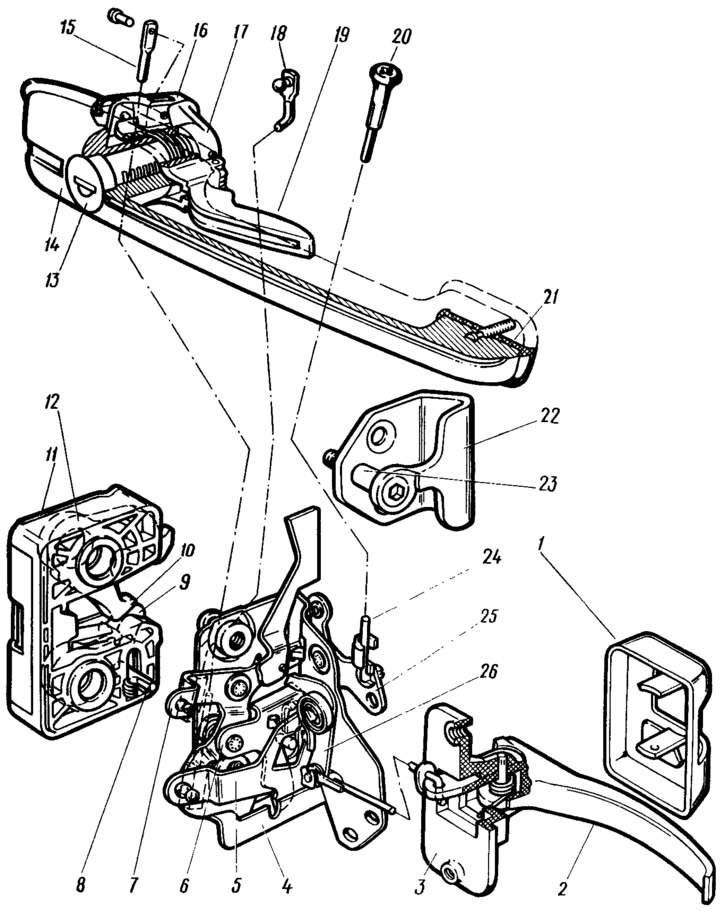
Figure 141. Front right door lock:
1 - inner handle lining; 2 - inner door handle; 3 - inner handle bracket; 4 - inner lock body; 5 - lever of the external drive of the lock; 6 - intermediate lever; 7, 25 - release levers; 8 - lock drive finger; 9 - dog; 10 - ratchet; 11 - outer lock cover; 12 - outer lock body; 13 - lock switch; 14 - outer handle; 15 - external drive lever rod; 16 - key lead; 17 - key switch leash; 18 - shutdown rod; 19 - key; 20 - lock release button; 21 sealing gaskets; 22 - retainer body; 23 - retainer finger; 24 - off button pull; 26 - internal drive lever.
When the door is closed, the pin 23 of the locking device acts on the ratchet 10. The ratchet turns and the pawl 9, under the action of the spring, locks the ratchet by the tooth of one or the other end of the ratchet. The teeth of the ratchet ensure preliminary and complete locking of the door. Preliminary locking prevents the spontaneous opening of the door if it is accidentally incompletely closed. Incomplete closing of the door can be easily determined by the knock of the pin of the locking device in the ratchet or by the possibility of some movement of the door when it is pulled up. The ratchet 10 and the pawl 9 are mounted on the axes of the outer lock. The pin 8 of the lock drive enters the inner lock with its front end.
The outer door handle 14 with a spring-loaded key 19 and a lock switch 13 is attached to the outer door panel through a sealing gasket 21 with two nuts. The leads 16 and 17 of the key and the lock switch are connected by rods to the levers 5 of the outer drive and the intermediate lever 7 for disengaging the lock, respectively.
When pressing the key 19 of the outer handle, its leash 16 presses on the rod 15 and acts on the lever 5 of the outer drive, which in turn acts on the finger of the intermediate lever 6. The intermediate lever 6 presses on the finger 8 of the lock drive, which moves the pawl 9 and releases the ratchet 10. Under the pressure of the compressed seal, the door opens.
When pulling the inner handle 2 of the door, the rod of the inner drive turns the lever 26 of the inner drive, which with its second end presses on the intermediate lever 6 and through the finger 8 releases the ratchet 10. The door opens.
To prevent access to the car interior from the outside, the lock is switched off, which blocks the action of the outer handle. When pressing the lock switch 20, the button rod 24 turns the two-arm lever 25, which with its second arm presses the lever 7. The lever 7 moves the intermediate lever 6 to the side, thereby eliminating the possibility of affecting the pawl 9, and therefore releasing the lock ratchet.
The lock can be switched off and on by means of the switch button or the door lock switch. When the lock key is turned, the switch rod 17 acts directly on the lock switch lever 7 via the switch rod 18.
When the door is closed, the cover 11 of the outer lock goes beyond the edges of the body 22 of the retainer and does not allow the door to open spontaneously in the event of a collision or rollover of the vehicle, when, due to deformation of the door or the opening of the body, the ratchet of the lock tends to disengage from the retainer pin in the direction of the longitudinal axis of the vehicle.
The position of the latch can be adjusted due to the increased size of the holes on the pillar. Before adjusting, it is recommended to outline the contours of the lock latch on the body pillar. If the door closes too tightly, loosen the latch mounting screws, move it outward and tighten the screws. If the door closes weakly, move the latch inward. In this case, the door should not sink or protrude relative to the body. If the door drops when closing, the latch should be raised. If the door rises when closing (sag in open position), the retainer is lowered. The adjustment also ensures alignment with the lock and the door is flush with the body surface. To ensure that the retainer adjustment is not disturbed, a pad made of abrasive waterproof sandpaper is installed under it. The pads under the retainer adjust the distance of the retainer from the rack so that the retainer pin does not touch the cover of the outer lock.
The design and strength of the lock and latch mechanisms comply with safety requirements. For safety reasons, the location of the internal handles on the door and their shape are chosen so as to exclude the possibility of opening the door if the handle is accidentally touched. The axis of the internal handle 2 is located in the plastic bracket 3, which is fastened with two screws to the inner door panel and covered with plastic trim 1, held on the ends of the handle axis protruding from the bracket. The position of the internal handle is adjusted by moving its bracket due to the oval holes on the inner door panel for the fastening screws. If the door is difficult to unlock with the internal handle, then the bracket fastening screws are loosened and the handle together with the bracket are moved to the desired position. Then the screws are tightened.
Due to the oval holes in the hinges for the bolts fastening the door to the A-pillar, it is possible to adjust the gap between the door and the body by a small amount. The gaps between the door and the body at the top and bottom should be the same. When adjusting, the hinge bolts are loosened, the gaps are set taking into account the door settlement after the load on it, and the bolts are tightened. The amount of displacement of the hinges relative to the initial position is easily determined by the previously outlined contours of the hinges on the A-pillar. To settle the door, load it with a weight of 100 kg, applied in the lock area. The load is applied to the door, slightly open at an angle of 5°, with a uniform increase in the load from 0 to 100 kg and then a uniform decrease to 0. After the door has settled, check the gaps again and, if necessary, repeat the adjustment.