




- a) no extraneous sounds are heard from the engine (knocking, grinding), indicating that the connecting rod or main bearings are turning or that the oil pump is faulty;
- b) the engine is filled with oil in accordance with the manufacturer's operating instructions;
- c) the oil level in the engine oil pan is within the norm (see "Lubrication system - checking the oil level");
- d) the oil pressure sensor is in good condition and its wire is not shorted to ground. We visually check the integrity of the sensor wire insulation. To check the sensor itself, we replace it with a known good one and start the engine. If the control lamp continues to light, then the sensor is in good condition.
Checking engine oil pressure using a device
To perform the work you will need a pressure gauge (see "Tools, accessories and operating materials").
1. On engines 2112, 21124 and 21114 remove the decorative engine cover (see "Engine trim - removal and installation").
2. Loosen the tightening with a socket wrench by 21 mm, we unscrew the emergency oil pressure sensor (shown on a 16-valve engine).
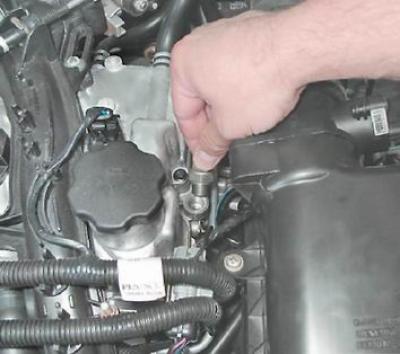
Note: On an 8-valve engine, the operation is as follows:
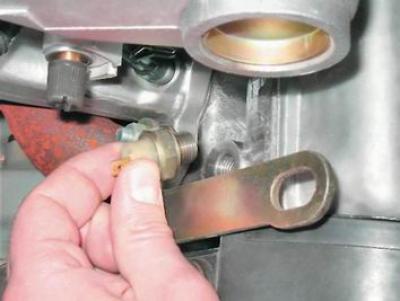
3. Screw the pressure gauge tip into the sensor seat.
4. Start the engine and check the oil pressure. In a serviceable engine warmed up to operating temperature, the oil pressure at idle speed should be at least 200 kPa (2.0 kgf/cm²).
If the pressure is low, the engine needs repair.