




Attention! Work is carried out on a cold engine.
We check the pressure in the fuel rail with a regular pressure gauge (for example, from a tire pump).
We put an oil-resistant hose on the threaded fitting of the pressure gauge (with an internal diameter of 12 mm) and secure it with a clamp.
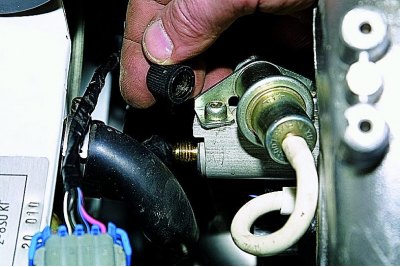
We unscrew the protective cap on the rear end of the fuel rail.
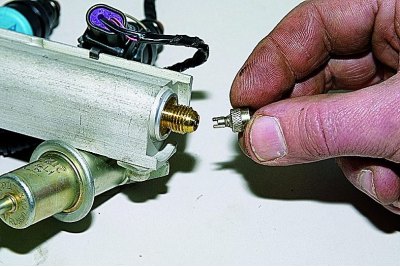
Using the wheel valve cap, unscrew the valve core from the fuel rail fitting (for clarity, we show the operation on a removed ramp)...

...and, having gradually released the fuel pressure, we remove the valve.
We put the pressure gauge hose on the ramp fitting and secure it with a clamp.
We start the engine and when it is idling...
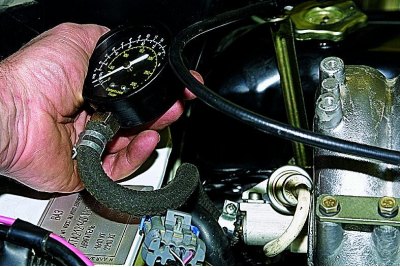
...we check the fuel pressure, which should be 2.8–3.2 bar (2.8–3.2 atm).
Remove the vacuum hose from the fuel pressure regulator.
If the regulator is in good working order, the fuel pressure should increase by 0.2–0.7 bar (0.2–0.7 atm).