

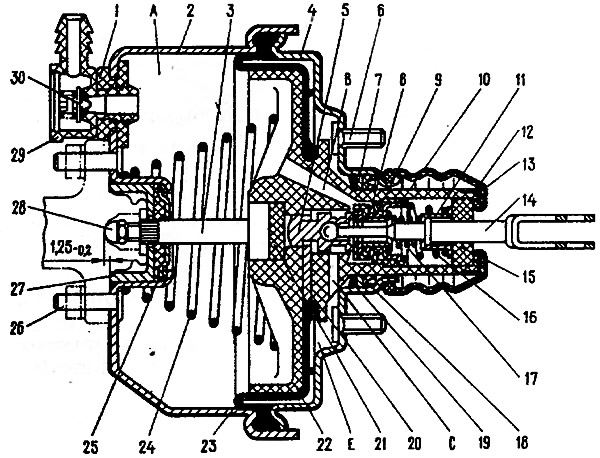
Pic. 6-2. Vacuum brake booster: 1 - flange for fastening the tip; 2 - amplifier housing; 3 - stock; 4 - cover; 5 - piston; 6 - amplifier mounting bolt; 7 - remote ring; 8 - support cup of the valve spring; 9 - valve; 10 - valve support cup; 11 - support cup of the return spring; 12 - protective cap, 13 - holder of the protective cap; 14 - pusher; 15 - air filter; 16 - valve return spring; 17 - valve spring; 18 - housing cover seal; 19 - retaining ring seal; 20 - thrust plate; 21 - buffer; 22 - valve body; 23 - diaphragm; 24 - return spring of the valve body; 25 - rod seal; 26 - a bolt of fastening of the main cylinder; 27 - holder of the stem seal; 28 - adjusting bolt; 29 - hose tip; 30 - valve, A - vacuum cavity; B - channel connecting the vacuum cavity with the internal cavity of the valve; C - channel connecting the internal cavity of the valve with the atmospheric cavity; E - the atmospheric cavity of the engine, since loosening or damage to the hose and flange 1 sharply reduces the vacuum in cavity A and the efficiency of the amplifier.
With the brake pedal stopped in the middle of its travel, start the engine. With a working vacuum booster, the brake pedal after starting the engine should «go ahead».
If the pedal «does not move forward», check the fastening of the tip 29, the condition and fastening of the flange 1, the hose to the tip and the fitting of the engine inlet pipe, since loosening or damage to the hose and flange 1 sharply reduces the vacuum in cavity A and the efficiency of the amplifier.
In the event of spontaneous braking of the car, with the engine running, check the vacuum booster for leak tightness with the stationary brake pedal released and then pressed «Suction» protective cap 12 to the shank of the valve body and the hiss of sucked air indicates insufficient tightness of the amplifier.
Even in the absence of suction of the protective cap, check the condition of the seal 18, for which:
- carefully remove and then slide the protective cap 12 from the flanging of the hole on the cover 4;
- with the engine running, swing the protruding shank of the valve body in the transverse direction with a force of 29.4-39.2 N (3-4 kgf), while there should not be a characteristic hiss of air passing inside the amplifier through the seal 18 of the cover.
If the vacuum booster is leaking, disconnect the pusher 14 from the brake pedal, remove the protective cap 12 and put 5 g of TsIATIM-221 grease between the seal and the flange of the cover and valve body, then check the condition of the air filter 15, if necessary, replace it and install the protective cap in place.
If in this way it is not possible to eliminate air leakage, then it is necessary to replace the vacuum booster.