




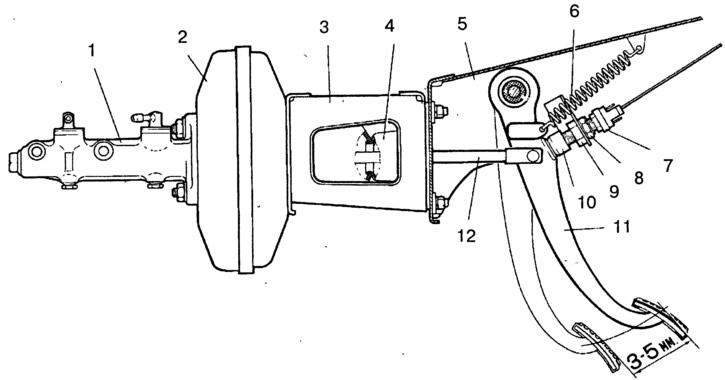
Fig. 6-3. Brake pedal:
1 - master cylinder; 2 - vacuum booster; 3 - vacuum booster bracket; 4 - seal glass; 5 - clutch and brake pedal mounting bracket; 6 - brake pedal release spring; 7 - brake light switch; 8, 9 - nuts; 10 - brake light switch buffer; 11 - brake pedal; 12 - pusher.
If the brake light switch is too close to the pedal, it does not return to its original position, valve 18 (fig. 6-2), pressing against the body 21, separates cavities A and B, and incomplete release of the wheels occurs when the pedal is released.
The position of the brake light switch is adjusted by moving it with nut 8 loosened (Fig. 6-3). Set it so that the brake light switch buffer slightly touches the pedal stop, while the free pedal travel should be 3-5 mm. After completing the adjustment, tighten nut 8.
Warning: Adjust the brake pedal free play with the engine not running.
If moving the brake light switch does not eliminate the release of the brake mechanisms, then disconnect the brake master cylinder from the vacuum booster and check the protrusion of the adjusting bolt 4 (fig. 6-2) relative to the plane of the main cylinder flange mounting (size 1.25-0,2). This size can be set by holding the end of rod 1 with a special key and tightening or loosening bolt 4 with another key.