




Contents: Removal and installation ↓ Disassembly and assembly ↓ Checking the details ↓ Checking the tightness of the master…↓
The structure of the master cylinder is shown in Fig. 6-9.
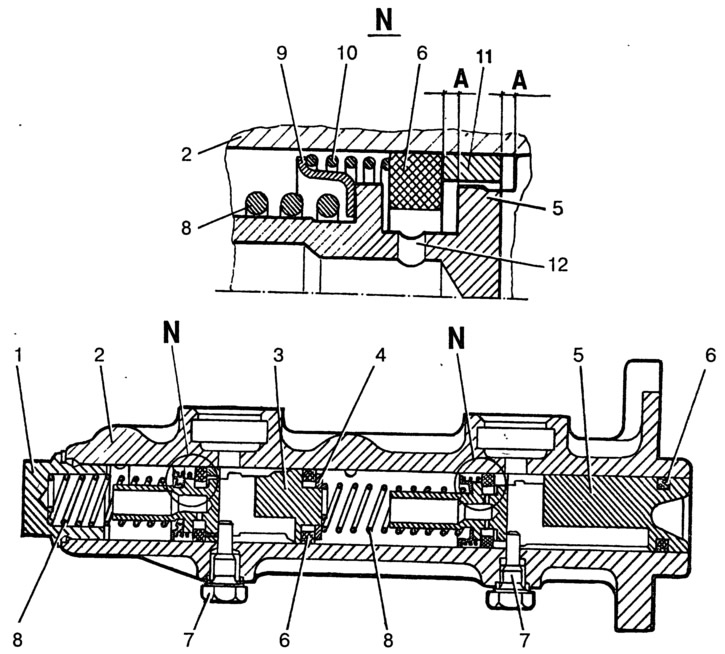
Fig. 6-9. Master cylinder:
1 - cork; 2 - cylinder body; 3 - front brake actuator piston; 4 - washer; 5 - piston for rear brake drive and additional front brake drive; 6 - sealing ring; 7 - locking screws; 8 - piston return springs; 9 - spring plate; 10 - seal pressure spring; 11 - spacer ring; 12 - inlet; A - compensation hole (gaps between seal 6, ring 11 and piston 5).
Removal and installation
Disconnect the flexible hoses from the master cylinder and plug the hose openings and fittings on the cylinder to prevent fluid from leaking from the reservoir and dust, dirt or foreign matter from entering the cylinder.
Disconnect the steel pipes from the master cylinder that carry fluid to the front and rear brake wheel cylinders, having first unscrewed the pipe nuts.
Remove the cylinder by unscrewing the nuts that secure it to the vacuum booster.
Install the smooth cylinder in the reverse order of removal. After installing the cylinder, bleed the hydraulic drive system to remove air from it.
Disassembly and assembly
Remove fittings 2 (Fig. 6-10) with connecting sleeves 3, unscrew lock bolts 5 and remove all parts in the order shown in Fig. 6-10.
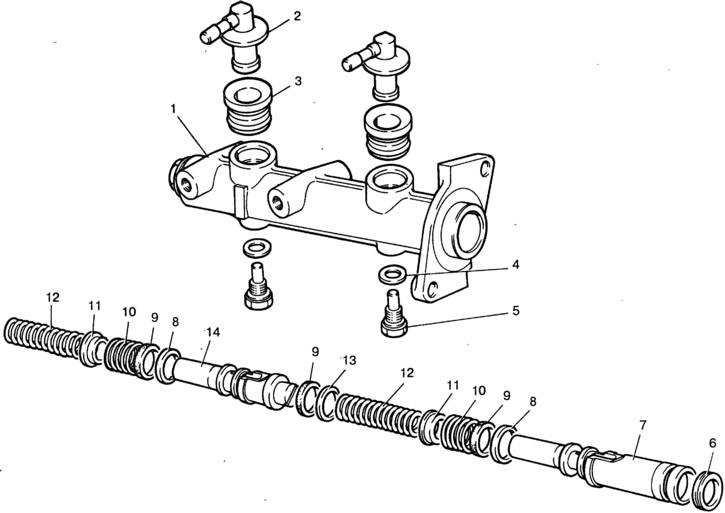
Fig. 6-10. Master cylinder parts:
1 - cylinder body; 2 - nipple; 3 - connecting sleeve; 4 - sealing washer; 5 - lock bolt; 6, 9 - sealing rings; 7 - piston of the rear brake drive and additional drive of the front brakes; 8 - spacer ring; 10 - sealing ring pressure spring; 11 - spring plate; 12 - piston return spring; 13 - washer; 14 - front wheel brake drive piston.
Assemble the cylinder in the reverse order of disassembly. Lubricate the parts with brake fluid. Use tool 67.7853.9543 for assembly.
Checking the details
Before assembly, wash all parts with isopropyl alcohol; dry them with a jet of compressed air or wipe them with a clean cloth, avoiding contact with mineral oil, kerosene or diesel fuel, which may damage the seals.
Note: The time for washing the sealing rings in isopropyl alcohol is no more than 20 seconds, followed by blowing with compressed air.
The cylinder mirror and the working surface of the pistons must be completely clean, without rust, scratches and other defects. An increased gap between the cylinder and the pistons is unacceptable.
Each time you disassemble the cylinder, replace the seals with new ones, even if they appear to be in good condition.
Check the elasticity of the piston spring, the length of which should be 41.7 mm under a load of 42.18±3.92 N (4.3±0.4 kgf), 21 mm under a load of 90.64±8.83 N (9.24±0.9 kgf), in a free state - 59.7 mm.
Checking the tightness of the master cylinder
Install the master cylinder on the stand and connect it to the stand elements as shown in Fig. 6-11.
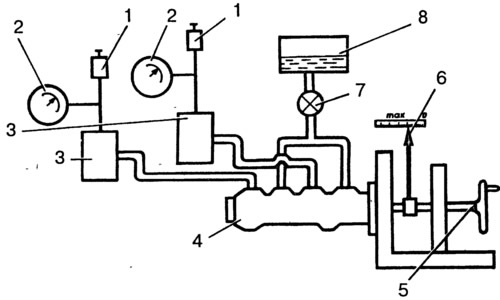
Fig. 6-11. Master cylinder tightness test diagram:
1 - valve for bleeding the stand; 2 - pressure gauge; 3 - absorption cylinder; 4 - master cylinder; 5 - flywheel; 6 - Pusher offset indicator; 7 - crane; 8 - vessel.
Open valves 1 to bleed the stand and, moving the master cylinder pistons several times to the full length of their stroke, bleed the system. Then close valves 1. Rotating flywheel 5, slowly move the master cylinder pistons until the pressure monitored by pressure gauges 2 reaches 12.5 MPa (125 kgf/cm²). In this position, lock the master cylinder pushrod. The specified pressure should remain constant for at least 5 sec.
In case of fluid leakage or decrease in the set pressure within 5 seconds, replace the cylinder piston seals.