




The mechanical drive includes a manual lever 9 (see fig. 135), which is connected via the return lever and pin to the front cable 19, guide roller 18, guide 2 (Fig. 149), rear cable 17 (see fig. 135) with shell, lever 1 (see fig. 146) manual drive of the pads and spacer bar 13.
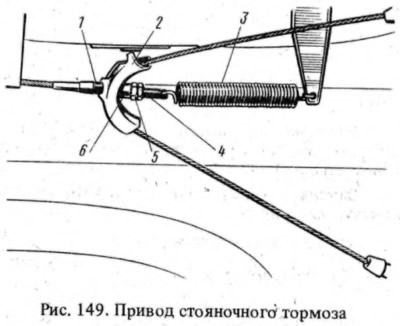
Front cable 1 (see fig. 149) has a threaded tip that passes through the hole in the guide 2 of the rear cable. The tip of the front cable is connected to the body bracket via a spring 3. This connection ensures that the drive cables return to their original position when the parking brake lever is released.
The middle part of the rear cable passes through the groove of the guide 2, the tension of which is adjusted by nut 5, which is fixed by lock nut 4. Between the guide 2 and nut 5, a spacer sleeve 6 is installed. The ends of the rear cable pass through a casing, each branch of which is attached at one end to the brake shield, and the other is installed in the grooves of the body brackets. At the rear ends of the cable there are tips, each of which is connected to the hook of lever 1 (see fig. 146) manual drive of the brake shoes. This lever is hinged to the brake shoe with a finger and rests against the groove of the spacer bar 3. The rib of the brake shoe enters the opposite groove of the bar.
When the lever 9 is raised (see fig. 135), the front and rear parking brake drive cables are tensioned. In this case, lever 1 (see fig. 146), turning on the pin, through the spacer bar 3, it will first press one shoe to the brake drum, and then, turning relative to the point of contact with the spacer bar and acting as a two-arm lever, it will press the other shoe to the drum.
(The original can be viewed on the portal: «VazBook.ru»)