




Open large image in new tab »
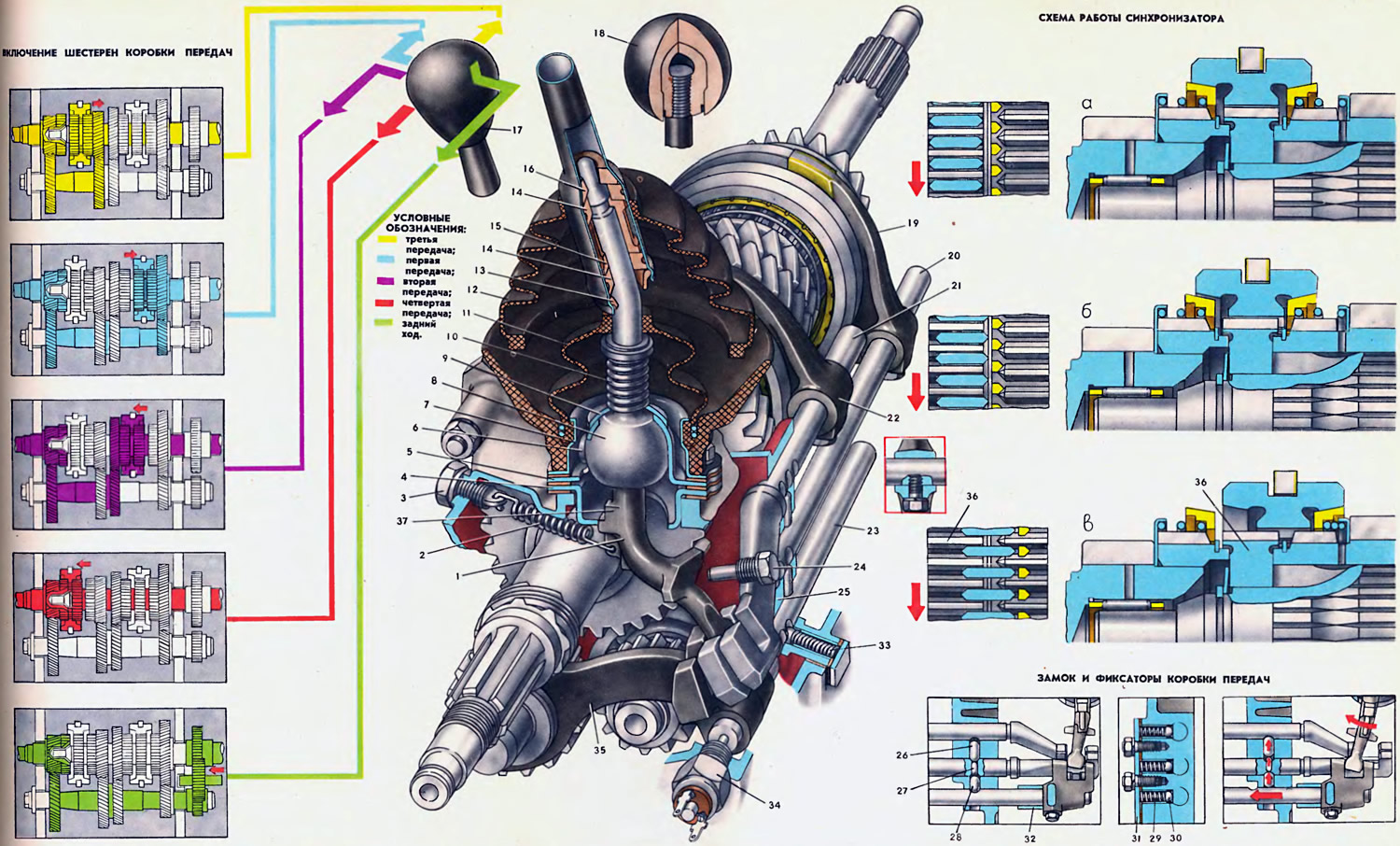
1. Gear shift lever. 2. Gear shift return spring. 3. Bolt. 4. Gear shift guide cup. 5. Gear shift ball joint. 6. Gear shift guide pin. 7. Gear shift seal mounting flange. 8. Gear shift ball. 9. Spherical washer. 10. Spring. 11. Inner boot. 12. Outer boot. 13. Damper locking sleeve. 14. Damper sleeve. 15. Spacer sleeve. 16. Damper thrust pad. 17. Gear shift lever handle. 18. Gear shift lever handle (vAZ-2103 car). 19. Third and fourth gear shift fork. 20. Third and fourth gear shift fork rod. 21. First and second gear shift fork rod. 22. First and second gear shift fork. 23. Reverse fork stem. 24. Restriction bolt. 25. Gearbox housing. 26, 27, 28. Blocking breadcrumbs. 29. Front gear lock spring. 30. Retainer ball. 31. Retainer cover. 32. Remote sleeve of the reverse fork stem. 33. Reverse gear lock spring. 34. Reverse light switch. 35. Reverse power plug. 36. Synchronizer clutch hub. 37. Limiting protrusion of the gearshift lever.
The four-speed gearbox of the Zhiguli cars is a three-way one, since the gears in it are engaged and disengaged with the help of three forks, which move two synchronizer clutches and one gear. Fork 22, secured to the rod 21 with a bolt with a spring washer, serves to shift the first and second gears, and fork 19, secured to the rod 20 with a bolt with a spring washer, serves to shift the third and fourth gears. Reverse is engaged by a third special fork 35, secured to the rod 23 with a bolt. The fastening bolts and their spring washers are the same for all forks. At the ends of the rods of the forward and reverse gear forks there are grooves into which the lower end of the gear shift lever 1 enters.
The forward gear engagement forks fit into the annular grooves of the synchronizer clutches, and the reverse gear engagement fork fits into the groove of the intermediate gear.
The rods of the forward gear forks have three notches: the middle one is used to fix the neutral position, the outer ones are used to fix the engaged gear. The rod of the reverse gear fork has two notches: one fixes the intermediate gear in the neutral position, the other - when the reverse gear is engaged.
To fix the rods in the neutral or engaged position, balls 30 are used, which enter the recesses on the rods and are pressed against them by springs 29 and 33. The retainer, consisting of a ball with a spring, is located in a steel bushing pressed into the box housing on the right side. Under the action of the spring, the retainer ball, having entered the recess, fixes the rod in a certain position. To move the rod when changing gears, a force is applied that is necessary to push the ball out of the recess.
The gear shift mechanism is provided with a lock to prevent the simultaneous engagement of two gears, which may occur during shifting if the lower end of lever 1, standing at the junction between the two rods, moves them together.
The lock consists of cracker 27 installed in the hole of the third-fourth gear engagement rod, and two crackers 26 and 28 of large diameter installed in the channel of the rear wall of the crankcase between the rods. The length of each cracker 26 and 28 is equal to the corresponding distance between rods 20, 21 and 23 - plus one notch, and the length of cracker 27 is equal to the diameter of the rod minus one notch. Thus, the length of three crackers is equal to the distance between rods 20 and 23 plus one notch.
The text is copied from the online portal www.vazbook.ru
When the first-second gear engagement rod moves, cracker 26 comes out of the recess of this rod, enters the recess of the third-fourth gear engagement rod and through cracker 27 introduces cracker 28 into the recess of the reverse gear engagement rod. Rods 20 and 23 are locked in the neutral position. When the reverse gear engagement rod moves, rods 20 and 21 are locked.
If the third-fourth gear engagement rod moves, crackers 26 and 28 come out of its recess, enter the recesses of rods 21 and 23 and lock them in the neutral position.
To engage reverse gear, first press handle 17 down (compressing spring 10) so that the projection 37 of the shift lever goes below the edge of the guide cup 4, and then move the lever handle to the right and back. In the normal position of the lever, due to the stop of the projection 37 of the lever against the edge of the cup 4, the possibility of accidental engagement of reverse gear is eliminated.
When the gear shift lever is moved to the neutral position, the spring 10 lifts the lever upward. The gear shift lever 1 has a thickening in the form of a ball head, on which it swings in the spherical part of the stamped support 5. The spring 10, resting on the spherical washer 9 and the support washer, locked on the lever by a ring, presses the lever 1 to the surface of the support and holds it. The lever 1 in the support is held from turning by the guide pin 6, the end of which enters the hole of the ball support.
When engaging first or second gear, the handle of the rod of gear shift lever 1 is moved to the left until the lower end of the lever stops against limit bolt 24. In this position, release spring 2 is stretched.
If the gears are not engaged and the handle 17 of the shift lever is released, then the spring 2 pulls the lever to the extreme position until the limiting protrusion stops in the guide cup. In this case, the lower end of the lever 1 is in the groove of the head of the rod for engaging the third-fourth gears.
A rod is placed on the upper end of the lever 1, in which a damper is installed, consisting of a rubber thrust pad 16, two rubber bushings 14, a plastic spacer bushing 18 and an elastic plastic locking bushing 13. The damper eliminates vibration of the handle and rod when the car is moving.
The ball joint of the gearshift lever is protected from dust and dirt by a rubber cover 11.
The opening for the passage of the gearshift lever into the car interior is sealed from below with a special cuff, which is placed on flange 7 and rests from below against the bottom of the car body.
Gearbox operation diagram. In the neutral position, the lower end of the gearshift lever 1 is pulled by the spring 2 until the limiting ledge stops in the guide cup and is located in the head of the third-fourth gear engagement rod. The synchronizer clutches and the reverse gear are not engaged with the corresponding gears and torque is not transmitted to the driven shaft.
In first gear, the synchronizer clutch of first and second gears moves backwards (in the direction of the arrow), engages with a special toothed rim of the driven gear of the first gear and connects it with the hub, which is fixedly seated on the driven shaft. In this case, the torque from the drive shaft through the constant mesh gear will be transmitted to the intermediate shaft and through the first gear gears of the intermediate and driven shafts to the driven shaft.
In second gear, the same synchronizer clutch moves forward and connects the free-seated second gear pinion to the driven shaft. Torque is transmitted from the drive shaft through a pair of constant-mesh gears to the intermediate shaft and from it through the second gear pinions of the intermediate and driven shafts to the driven shaft.
In third gear, the third and fourth gear synchronizer clutch moves backward and connects the third gear pinion to the driven shaft.
In fourth gear, the synchronizer clutch, moving forward, connects the driven and driving shafts and the transmission of torque occurs directly from the driving shaft to the driven shaft.
Reverse gearing is achieved by engaging the intermediate reverse gear pinion simultaneously with the reverse gear pinions of the intermediate and driven shafts. Since the intermediate gear is involved in transmitting torque from the intermediate shaft to the driven shaft, the latter rotates in the opposite direction. To ensure smooth engagement, the ends of the reverse gear teeth are rounded.
Reverse gear should be engaged only after the vehicle has come to a complete stop.
Smooth and shock-free engagement of forward gears is ensured by synchronizers.
The diagram of the synchronizer operation in position a shows the neutral position of the synchronizer of the third and fourth gears.
When the third gear is engaged, the sliding clutch of the synchronizer moves along the splines of the hub, rigidly connected to the driven shaft. Having moved, the clutch is pressed by the inner cone against the outer conical surface of the locking ring. Friction occurs between the cones, as a result of which the locking ring rotates until its teeth stop at the ends of the synchronizer ring of the driven gear of the third gear.
Diagram b shows the position of the parts at the beginning of the third gear engagement.
The coupling together with the locking ring cannot move further in the axial direction until the rotation speeds of the driven and intermediate shafts are equalized (driven gear of the third gear with a locking ring and a synchronizer clutch with a hub on the driven shaft).
The alignment of rotation speeds leads to the disappearance of the friction force between the cones of the locking ring and the clutch, and under the action of the axial force of the engagement fork, the locking ring, having slipped off the bevels of the toothed rim, will move further together with the clutch, rigidly connecting the driven gear of the third gear with the hub 36 with the splines of the clutch. Thus, the third gear will be engaged.
The diagram in shows the arrangement of the parts with the third gear engaged. In this position, the synchronizer clutch will disengage from the five short but fuller teeth of hub 36. On the remaining teeth, the clutch will turn by an amount equal to the difference in the lateral clearance of the full teeth that have disengaged and those that remain engaged, and the beveled ends of the disengaged teeth will rest against the ends of the short teeth of hub 36. In this way, the clutch is additionally fixed in the engaged position.
The synchronizer works similarly when engaging other forward gears. When disengaging the gear, the parts return to the neutral position, and the locking ring is thrown back by the spring until it stops against the locking ring.