




Camshaft
Cast, cast iron, the same for engines 2101 and 21011. It rests on 5 journals and rotates in an aluminum bearing housing mounted on the cylinder head. A driven sprocket is attached to the front end of the camshaft. The camshaft is held from axial movements by a thrust flange placed in the groove of the front support journal of the shaft.
On VAZ cars manufactured before April 1982, camshafts with cams and bearing journals hardened by high-frequency currents were installed. Since April 1982, nitrided camshafts have been installed. Since 1984, the year of manufacture has been marked on the shafts. Since 1985, camshafts with cam whitening have been installed. These shafts have a distinctive hexagonal belt between the 3rd and 4th cams.
Camshaft drive. The same on engines 2101 and 21011. It is carried out from the drive sprocket 5 (Fig. 16) of the crankshaft by a double-row roller chain 2. The same chain also drives the sprocket 4 of the oil pump drive shaft. The chain drive has a semi-automatic tensioner 8 with a shoe 7 and a chain damper 3 with rubber pads.
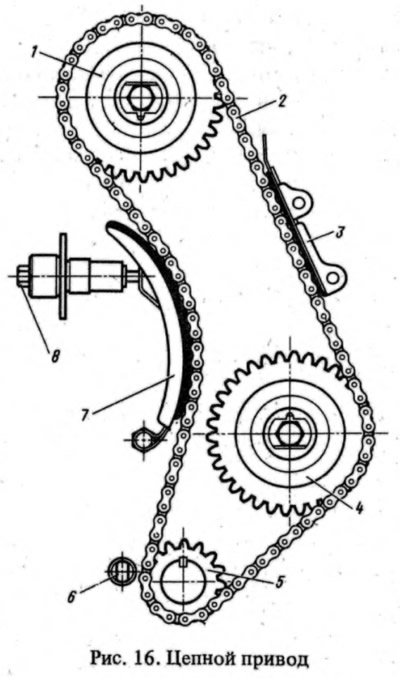
A limiting pin 6 is installed at the bottom of the cylinder block, preventing the chain from falling into the crankcase when the camshaft sprocket 1 is removed from the vehicle.
For the correct mutual arrangement of the sprockets, i.e. for setting the valve timing, there are upper and lower installation marks. The upper ones are located on the camshaft sprocket and the bearing housing (see fig. 56). The lower marks are on the crankshaft sprocket and cylinder block (see fig. 54). When the chain drive is closed with a cover (the engine is installed on the car), then you can use the marks to set the ignition timing (see fig. 57). In this case, mark 4 on the generator drive pulley must be set opposite the long mark 3 on the camshaft drive cover.