




Contents: Adjusting the timing chain tension ↓ Adjusting the tension of the pump…↓ Setting the ignition timing ↓ Adjusting the carburetor drive ↓ Adjusting engine idle speed ↓
Adjusting the timing chain tension
The chain tension is adjusted in the following order: Loosen the cap nut 1 (see fig. 17) tensioner. Turn the crankshaft 1-1.5 turns in the direction of rotation. In this case, the tensioner springs will automatically set the correct chain tension. After this, tighten the tensioner cap nut.
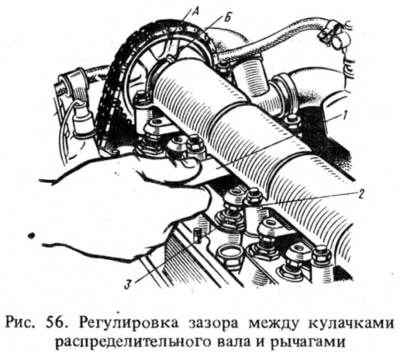
Adjusting the clearance between the levers and the camshaft cams. The clearance adjustment must be done very carefully. The clearance is adjusted on a cold engine, after adjusting the chain tension. After adjustment, the clearance should be 0.14-0.17 mm. Adjustment is performed after tensioning the chain in the following order:
- turn the crankshaft clockwise until mark A (Fig. 56) on the camshaft sprocket aligns with mark B on the bearing housing, which corresponds to the end of the compression stroke in the 4th cylinder. In this position, adjust the clearance at the exhaust valve of the 4th cylinder (8th cam) and the intake valve of the 3rd cylinder (6th cam);
- holding the adjusting bolt 2 of the lever with a wrench, with another wrench;
- loosen lock nut 3, insert a flat feeler gauge A.95111 (7) 0.15 mm thick and 30 mm wide between the lever and the camshaft cam and tighten the bolt, then tighten the lock nut until the feeler gauge enters with a slight pinch when the lock nut is tightened;
- sequentially rotate the crankshaft by 180°, adjust the clearances at the intake valve of the 4th and exhaust valve of the 2nd cylinder, then at the intake valve of the 2nd and exhaust valve of the 1st cylinder, and finally at the intake valve of the 1st and exhaust valve of the 3rd cylinder.
Adjusting the tension of the pump drive belt
With normal belt tension, its deflection under a force of 10 kgf between the pulleys of the generator and the pump should be within 10-15 mm or 12-17 mm between the pulleys of the pump and the crankshaft. To increase the tension, it is necessary to loosen the nuts securing the generator, move it away from the engine and tighten the nuts.
Setting the ignition timing
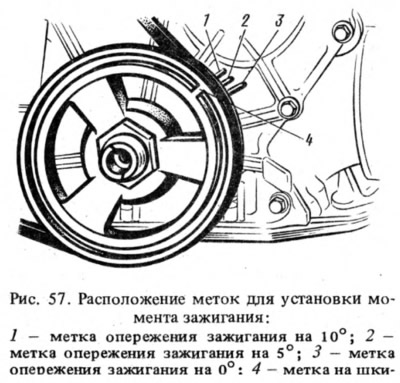
To check the ignition timing, there are three marks 1, 2, 3 (Fig. 57) on the timing mechanism drive cover and mark 4 on the crankshaft pulley, corresponding to the TDC of the piston in the 1st and 4th cylinders.
It is convenient to check and set the ignition timing using a stroboscope. In this case:
- install the octane corrector eccentric (if it exists) ignition distributor to zero position;
- connect the "+" terminal of the stroboscope to the "+B" terminal of the ignition coil, and the ground (housing) terminal to the "-" terminal of the battery;
- insert an adapter for connecting a strobe lamp between the spark plug wire of the 1st cylinder and the spark plug, mark mark 4 on the crankshaft pulley with chalk for greater visibility and start the engine, directing the flashing light from the strobe light to the mark on the pulley, which, when the ignition timing is set correctly at idle speed of the engine, should be opposite mark 2 on the timing mechanism drive cover.
If the marks do not match, then you should stop the engine, loosen the nut and set it to the desired angle. To increase the ignition advance angle, the distributor housing should be turned counterclockwise, and to decrease it, clockwise. Then check the ignition timing again.
If you have a diagnostic stand with an oscilloscope, you can also easily check the ignition timing using it, following the instructions for the stand.
Adjusting the carburetor drive
With the pedal fully depressed 9 (see fig. 36) the primary chamber throttle valve must be fully open and its lever must not have any additional travel. When the pedal is released, the valve must be fully closed. Adjustment is made by changing the length of rod 2 by rotating its tip. At the same time, the length of rod 1 is checked and, if necessary, adjusted; the center-to-center distance of the tips must be 80 mm.
The air damper control drive is adjusted by changing the cable and casing fastening so that when the handle 6 is fully extended (see fig. 36) the air damper was completely closed, and with the handle recessed, it was completely open.
Adjusting engine idle speed
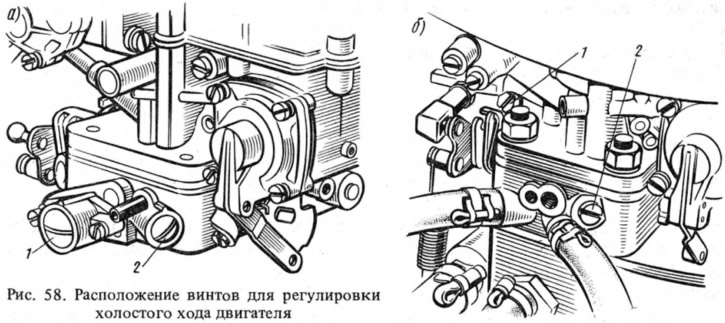
The elements that regulate the engine idle speed include screw 2 (Fig. 58), which determines the composition of the mixture (the "quality" screw), and screw 1, which determines the quantity of the mixture (for carburetors 2101-1107010, 2101-1107010-02 and 2101-1107010-03, when screw 1 is tightened, the throttle valve opens slightly).
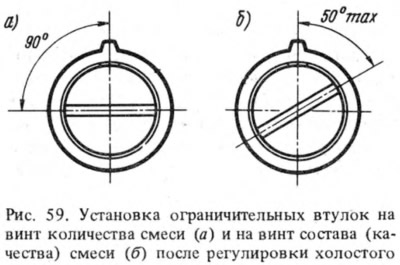
To prevent the factory adjustment of the carburetor from being violated, a limiting sleeve is pressed onto screw 2 (for carburetors 2105-1107010-20 and 2105-1107010-10, the limiting bushings are pressed onto both screws). The bushings are blue at the factory, and red at service stations. If the bushings fail to regulate the carbon monoxide (CO) content in the exhaust gases, then it is necessary to break the heads of the bushings by unscrewing the screws, unscrew the screws, remove the bushings from them, and screw the screws back into place.
Idle speed adjustment is carried out on a warmed-up engine (coolant temperature 90-95°C and oil 75-85°C) with adjusted clearances in the valve timing mechanism and with the ignition timing angle set correctly.
For carburetors 2105-1107010-20 and 2105-1107010-10 screw 1 (fig. 58, a) the amount of mixture on the stand tachometer sets the crankshaft speed within the range of 820-900 rpm, then screw 2 of the mixture composition achieves a CO concentration in the exhaust gases within the range of 0.5-1.2% at the given position of screw 1.
[The text is on the website VAZBOOK.ru]
Screw 1 is used to restore the rotation speed within the range of 820-900 rpm. If necessary, screw 2 is used to restore the CO concentration to 0.5-1.2% and the limiting bushings are pressed onto the screws, orienting the splines of the bushings relative to the projections, as shown in Fig. 59.
For carburetors 2101-1107010-03 screw 1 (fig. 58, b)the crankshaft rotation speed is set within 720-800 rpm using the stand tachometer. Then, using screw 2, the CO concentration in the exhaust gases is achieved at 1.5-2.5% for the given throttle position.
Screw 1 is used to restore the crankshaft speed to 720–800 rpm. If necessary, screw 2 is used to restore the CO concentration to 1.2–2.5% and a limiting sleeve is pressed onto it, as shown in Fig. 59.6.
Adjustment of the engine idle speed can be performed even without a gas analyzer. However, after adjustment, the carbon monoxide content in the exhaust gases is not guaranteed when the engine is idling.
When adjusting the mixture quantity with screw 1, the minimum stable crankshaft rotation speed is set, then using the mixture quality screw 2, the engine is operated at the maximum crankshaft rotation speed at a given screw position.
Using screw 1, reduce the crankshaft speed to the minimum stable engine operation, and then tighten screw 2 until the engine starts to run with noticeable interruptions. Then unscrew the screw by 30-60° (no more) until stable engine operation is achieved.
Check the correctness of the adjustment by sharply pressing the accelerator and releasing it. The engine should not stop.