




- a special template or a wide metalworking ruler;
- set of flat feeler gauges.
Sequence of execution of the check
1. Remove the head from the car (see "Cylinder head - removal and installation").
2. We clean the head and bearing housing from dirt and carbon deposits, wash it from oil deposits, and remove carbon deposits from the walls of the combustion chambers with a metal brush.
3. Carefully inspect the cylinder head and bearing housing. There should be no cracks on them. There should be no scoring or metal drag on the working surfaces of the camshaft supports, bearing housing and the walls of the hydraulic compensator seats.
The valve guides and seats should fit tightly in the head body, without any signs of displacement during the operation of the timing system. The valves and their seats should not have cracks or signs of burning. We check the valve play in the guides, the maximum permissible gap is 0.30 mm.
4. Check the flatness of the cylinder head. We carry out the work in two stages.
This requires a special template, but if you don't have one, you can check the lower mating plane of the cylinder head with sufficient accuracy using a wide metalworking ruler.
We apply the ruler with its edge diagonally to the plane of the head.
We make sure that there is no gap between the ruler edge and the head plane. The gap can be observed both in the middle part of the plane and along its edges. We measure the gap along both diagonals using a set of flat feeler gauges.
The text is taken from the online resource: VazBook.ru
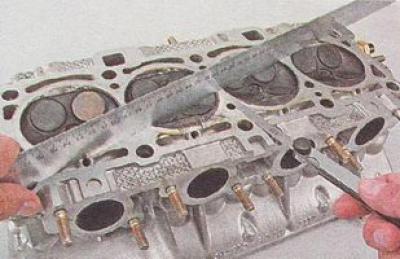
The maximum allowable gap is 0.1 mm.
If the gap is greater than the permissible value, the cylinder head must be milled (mating plane) or replacement.
Warning: The head should only be replaced as a complete set with the bearing housing.