




The suspension design creates a negative roll arm, i.e. the intersection point of the wheel's pivot axis with the road surface is on the outside relative to the center of the tire's contact patch with the road. In combination with the diagonal brake hydraulic drive division scheme, this makes the car more stable when braking on a slippery road.
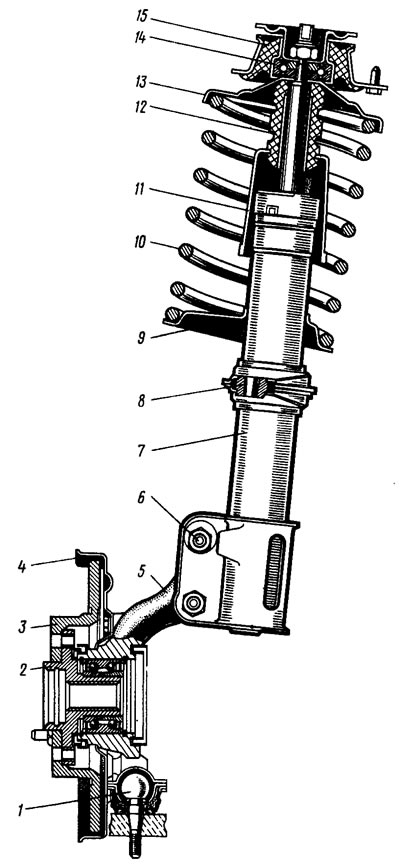
Figure 81. Telescopic suspension strut assembly with steering knuckle and wheel hub
The main element of the suspension is a telescopic hydraulic shock absorber strut 7 (figure 81), which combines the functions of the suspension guide and damping devices. The lower part of the telescopic strut is connected to the steering knuckle 5 with two bolts. The upper bolt 6, passing through the oval hole of the strut bracket, has an eccentric belt and washer. When the upper bolt is turned, the camber of the front wheels changes. In the steering knuckle, the front wheel hub 2 is mounted on a ball bearing in assembly with the brake disc 3, protected by the casing 4. On the telescopic strut, the following are installed: between the support cups 9 and 13, a coiled cylindrical spring 10, a polyurethane foam buffer 12 of the compression stroke with a protective casing 11, as well as an upper support 15 of the strut in assembly with a bearing 14. The telescopic strut is connected to the steering linkage rod via the pivot arm 8. The lower support for the strut is the ball joint 1.
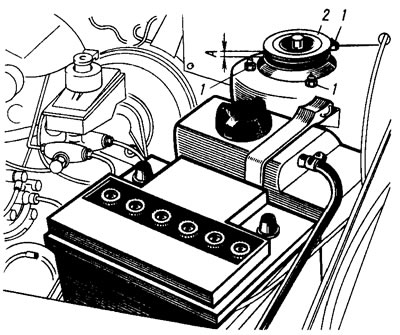
Figure 82. Fastening the upper suspension support
The upper support of the rack is secured with three self-locking nuts 1 (figure 82) to the mudguard pillar of the body. Due to its elasticity, the support ensures "swinging" of the pillar during suspension movements and dampens high-frequency vibrations. The bearing built into it allows the pillar to turn together with the steered wheels.
The body of the rack contains parts of a telescopic hydraulic shock absorber (figure 83 and 84). A hydraulic recoil buffer is installed in the upper part of the cylinder, consisting of a plunger 15 and a spring 16. It limits the movement of the rod during the recoil stroke.
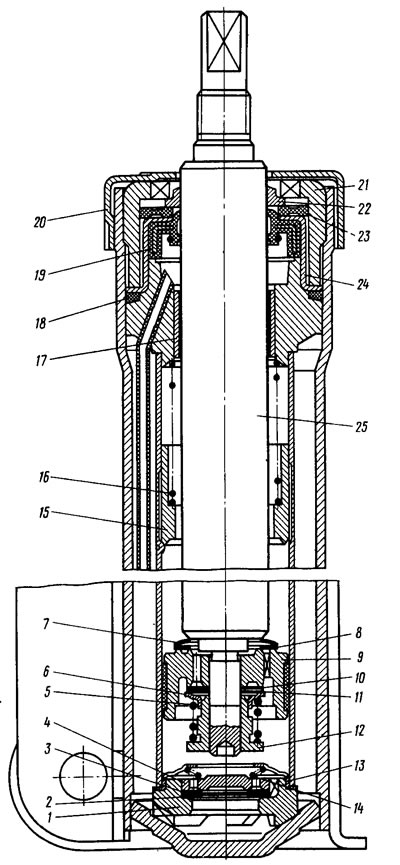
Figure 83. Telescopic stand: 1 - compression valve body; 2 - compression valve discs; 3 - compression valve throttle disc; 4 - compression valve plate; 5 - spring; 6 - recoil valve plate; 7 - bypass valve spring; 8 - bypass valve plate; 9 - piston with ring; 10 - throttle disc of the return valve; 11 - recoil valve discs; 12 - recoil valve nut; 13 - compression valve holder; 14 - spring; 15 - plunger; 16 - plunger spring; 17 - guide bushing of the rod with a drain pipe; 18 - sealing ring; 19 - oil seal; 20 - compression buffer support; 21 - body nut; 22 - stem protective ring; 23 - reservoir sealing ring; 24 - oil seal cage; 25 - rod |
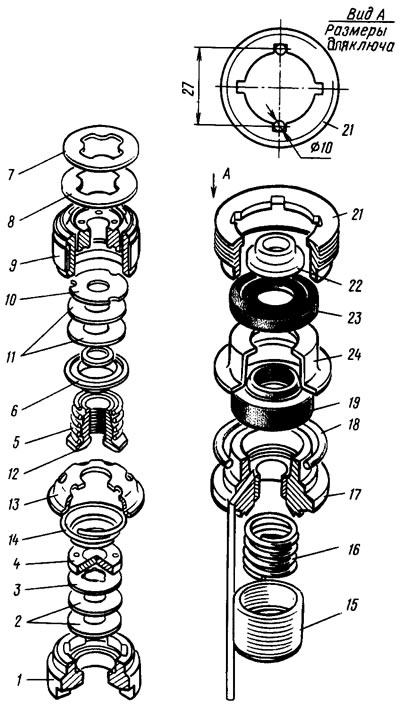
Figure 84. Details of valves and seals of the telescopic rack. Digital designations correspond to Figure 83 |
Lower part of steering knuckle 12 (figure 85) is connected by a ball joint 13 to the transverse arm 1 of the suspension. The braking and traction forces are perceived by longitudinal tensioners 8, which are connected through rubber-metal hinges to the transverse arms 1 and to the brackets 10. Adjusting washers 9 are installed at the junction of the tensioner with the arm and with the bracket, which regulate the angle of the longitudinal inclination of the steering axis. A double-row closed-type radial-thrust bearing is installed in the steering knuckle, on the inner rings of which the hub 2 is installed with tension (see figure 81). The bearing is tightened with a nut on the tailpiece of the outer joint housing of the wheel drive and is not adjustable. All nuts of the front and rear wheel hubs are the same and have a right-hand thread.
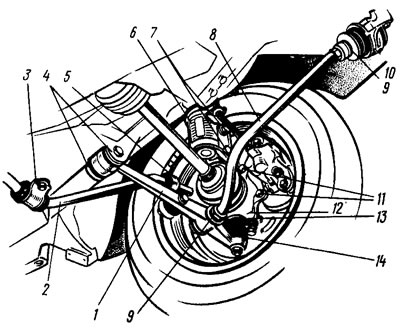
Figure 85. Right front wheel suspension
The anti-roll bar is a rod 2 (see figure 85), the ends of which are connected to the transverse levers 1 of the suspension through struts 5 with rubber and rubber-metal hinges. Average (torsion) part of the rod is attached to the body with brackets 3 through rubber cushions.
Possible faults of the front suspension, their causes and methods of elimination are given in Table 10.