




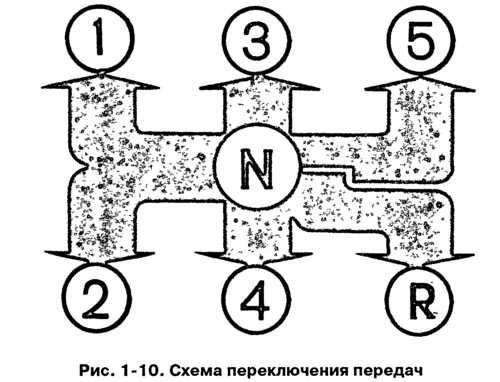
Start the car in first gear and, as the crankshaft speed increases, shift to higher gears in a timely manner. The gear shifting diagram is shown in Fig. 1-10.
At very low ambient temperatures and after a long period of parking, it is recommended to drive at least 1 km in first gear with the differential lock engaged and the lowest gear in the transfer case. In this case, the engine should run at an average crankshaft speed so that the oil in the gearbox, transfer case, front and rear axles warms up and becomes less viscous, which is necessary for normal lubrication of the gears.
To move in reverse, press the gearshift lever all the way down and move it to the position corresponding to the reverse gear engagement. Engage the reverse gear only when the vehicle is completely stopped.
To overcome steep climbs, when driving on soft soils, and to obtain a minimum stable speed on hard-surface roads, first engage the lowest gear in the transfer case. It is recommended to engage the lowest gear in the transfer case after the vehicle has come to a complete stop.
To overcome difficult road sections, lock the differential in advance. Do not lock the differential when both wheels of one of the vehicle's drive axles are slipping. After overcoming such sections, unlock the differential - driving the vehicle on good roads with a locked differential reduces the service life of the power transmission mechanisms, increases tire wear and fuel consumption, and can cause skidding when braking the vehicle. If unlocking the differential is difficult while driving, do it with the vehicle stopped.
Shifting from a lower gear to a higher gear and locking the differential can be done while the vehicle is moving.
After crossing fords, as well as after washing the car or during prolonged driving on a wet road, when water gets into the brake mechanisms of the wheels, perform several smooth braking movements while driving to dry the discs, drums and brake linings.
If possible, drive at moderate, constant speeds. Sharp acceleration and deceleration, driving at high speeds lead to excessive fuel consumption. In addition, excessive fuel consumption is also caused by insufficient air pressure in the tires, worn or dirty spark plugs, and the use of engine oils with a higher viscosity than recommended.
While driving, monitor the operation of various systems using the corresponding instruments and control lamps. Under normal conditions, the red light lamps should not light - their inclusion signals the need to check the corresponding system.