
Regularly every 500-600 km (or before each departure) check the oil levels in the engine crankcase, coolant in the expansion tank, brake fluid in the master cylinder reservoir, electrolyte in the battery, and air pressure in the tires.
Engine oil level in the crankcase
The oil level in the engine crankcase must be checked on a cold, non-running engine. The level must be between the "MIN" and "MAX" marks on the indicator.
The oil is changed on a warm engine. To drain the used oil, unscrew the plug in the oil pan.
The oil filter is changed by unscrewing it from the cylinder block. Before installing a new oil filter, it is recommended to first fill it with engine oil and lubricate its sealing ring with it. The new filter is screwed in until it touches the cylinder block sealing ring, and then manually tightened by 3/4 of a turn.
Brake fluid level
With the cover installed and new brake linings, the brake fluid level should reach the lower edge of the filler neck.
At the same time, the operation of the emergency level indicator should be checked. To do this, press the central part of the protective cap from above - the control lamp in the instrument cluster should light up if the ignition is on.
The warning light of the emergency brake system signaling lights up when the fluid level in the reservoir has dropped below the "MIN" mark, which, in the case of partially worn or new brake pads, indicates a loss of tightness of the system and a fluid leak. In this case, fluid is added only after the tightness of the system is restored.
If the brake hydraulic drive is in good order, the decrease in the fluid level in the reservoir is due to wear of the brake pad linings. A decrease in the fluid level to the "MIN" mark indirectly indicates their extreme wear. In this case, it is necessary to directly monitor the condition of the pads.
When checking the technical condition of the brakes, first clean the front and rear brakes from dirt, wash with warm water and dry with compressed air. It is not allowed to use any mineral solvents, as they can cause damage to the protective caps and seals of the hydraulic cylinders.
Contaminated brake pad linings, discs and drums are cleaned with a metal brush and washed with detergents. If traces of brake fluid are found on the linings, it is necessary to find and eliminate the causes of its appearance. During maintenance, protect the brake pads, discs and drums from oil or grease.
Coolant level
The coolant level in the expansion tank should always be 3-4 cm above the "MIN" mark. Check the level and open the tank cap to add fluid only on a cold engine. After adding fluid, the tank cap should be tightly screwed in, since the expansion tank is under pressure when the engine is running and warmed up.
In extreme cases, pure water can be added to the cooling system. However, this increases the freezing temperature of the mixture and reduces the corrosion resistance of the aluminum radiator. Therefore, at the first opportunity, it is necessary to repair the system and fill it with coolant.
Checking the level and density of electrolyte in the battery is described in the chapter "Battery".
Tire pressure
The air pressure in the tires, including the spare tire, is checked with a pressure gauge. We recommend that you have the pressure gauge checked periodically at a service center.
If you notice a constant drop in air pressure in your tire, check with a soap solution to see if there is any air leakage through the valve core. If there is an air leak, tighten the core with the key on the end of the cap, and if that doesn't help, replace it with a new one.
If the pressure drops even though the valve is in good working order, then the tire must be dismounted and the tube repaired or replaced.
To avoid disturbing the wheel balance, before removing the tire, make a mark with chalk on the tire opposite the valve, and when installing the tire, install it according to this mark.
After installing new tires, be sure to have the wheels balanced at a service facility.
When operating your vehicle, avoid rubbing the wheels against road curbs and driving fast on roads with damaged surfaces (potholes, bumps, etc.). If vibrations occur while driving, it is necessary to check the wheel balancing.
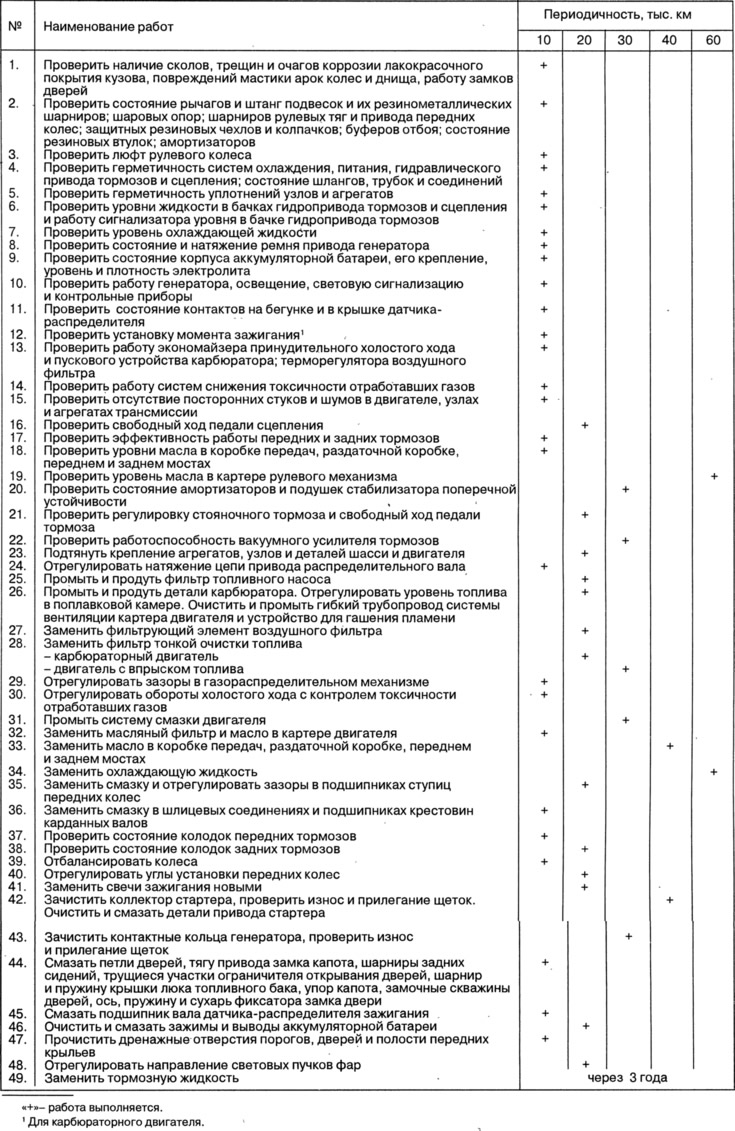
Table 1-4. Maintenance Operations