

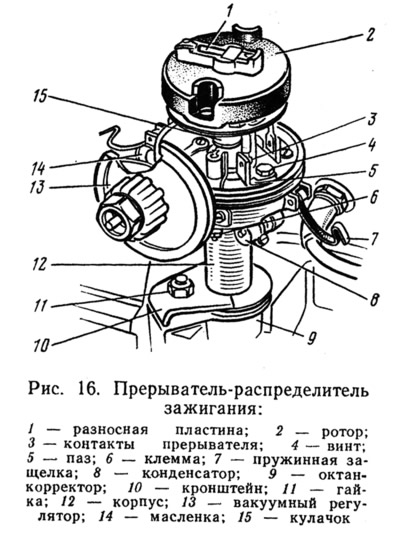
Ensuring such discontinuity is performed by the contacts of the breaker-distributor (pic. 16).
Contacts work well only with normal gaps between them (0.37-0.43 mm), sufficient force pressing them to each other (spring force 5.4 N), and uniform wear of the contacting surfaces. The power of the engine depends on the contacts of the breaker, or rather on their condition and the gaps between them.
The role of contacts is imperceptible, and often this causes an inattentive attitude towards them. Meanwhile, it is the gap between the contacts that sets the strength of the spark. The process at the moment of closing the contacts of the breaker. If the gap is large, i.e. more than 0.43 mm, the time of the closed state of the contacts decreases, and therefore, the current in the ignition coil cannot reach the maximum voltage. A weak current cannot provide a strong spark.
At a small (less than 0.37 mm) gap between the contacts, the result is similar, since the current finds «loophole» in the form of an arc formed and in a hurry «hide». It is noticed that there is a certain tendency to reduce the gap during operation. In this case, unpleasant phenomena arise, such as an increase in fuel consumption with a simultaneous deterioration in the acceleration of the car.
It has been experimentally established that a decrease in the gap between the contacts by only 0.08–0.1 mm (this corresponds to a change in the ignition timing by 8-10°) leads to an increase in gasoline consumption by 1 l / 100 km.
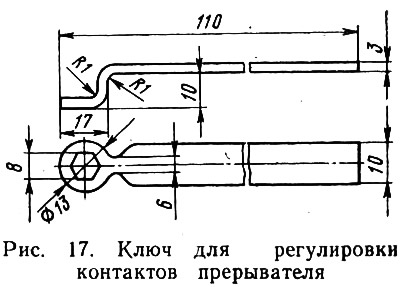
Usually adjust the gaps and check the condition of the contact surfaces. Equipment required for this: starting handle or special key, probe for ignition devices (you will find it in the small tool bag) and a simple key made by yourself (pic. 17). This wrench will be of great help when unscrewing the screws securing the contacts. In extreme cases, such a key can be replaced by a screwdriver.
With the cover of the ignition breaker-distributor removed, use the crank to turn the crankshaft until the contacts (see fig. 16) breakers open; loosen the screw 4 and move the contact post 3 with a screwdriver inserted into the groove 5 to the required gap (measure with a probe), and tighten the screw until it stops. If the contacts are adjacent to each other over the entire area, then it is enough to wipe them with a cloth soaked in gasoline. Worse, when the contacts wear out unevenly. In this case, surgical intervention is required and as an additional tool - «velvet» thin file. It should be noted that adjusting the gaps with a feeler gauge is very inaccurate, especially when it comes to such delicate operations as adjusting the gaps between the breaker contacts. The probe is not able to take into account the uneven wear of the contacts, and these «little things» are very significant. That is why at service stations this operation is performed by a device that controls the angle of the closed state of the contacts.
Similar devices have already appeared on sale. They are still expensive, however «thinking» motorists have already solved this problem. The idea of the innovator from Ivano-Frankivsk is simple: there are marks on the body of the breaker-distributor 3 (pic. 18). The division price between risks is 5°. Arrow 2 is reinforced with a screw that locks rotor 1.
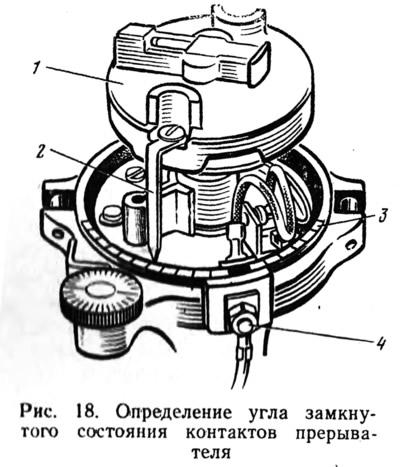
For operation, a test lamp is required, which is connected at one end to terminal 4 of the low voltage, and at the other end to «mass». By turning the crankshaft with the start handle or a special key, they notice at what angle the arrow deviates from the moment the lamp is turned on or off. For reference: when the ignition is on, the lamp flashes when the contacts open and goes out when they are closed.
It should be remembered that in cars «Zhiguli» closed angle should be 55±3°, open 35±3°. The sum of these angles is 90±1°. It remains to install the cover with high voltage wires in its place.
Please note: the slightest distortion of the cover - and rotor 1 will immediately break it.
Few people, even among experienced and diligent motorists, seriously thought about the question: what leads to excess fuel consumption and how to try to reduce it using available means. For example, studies show that if the adjustment is violated in a conventional battery ignition system, the average fuel consumption increases by 4-6%. Despite the fact that the interrupter is a simple device and its adjustments are quite simple, it requires close attention.
Of great importance is the condition of the contacts of the breaker. They oxidize and corrode. Irregularities form on their working surfaces. Repeated stripping leads to the need to replace them. Most motorists do not pay attention to contacts at all. The engine starts and it's fine. So these cars run from maintenance to maintenance, consuming significantly more fuel than expected.
At one time it was fashionable to install various imported and home-made electronic systems on their cars. Contacts became «easier», since the current passing through them decreased by 5-10 times, erosion disappeared, but new problems appeared: a small current could not overcome various kinds of film deposits. And the fashion is gone.
A truly radical solution was soon found - replacing the mechanical interrupter with a proximity sensor. For those who want to reduce the oxidation of contacts today and reduce their costs for the purchase of gasoline, we can advise you to purchase a contactless ignition kit BESZ-I, produced by the Kievpribor production association.
In addition to its main functions, BESZ-I simultaneously serves as an anti-theft device, provides a multi-spark mode when starting the engine and allows you to use various electrical appliances operating at a voltage of 127 V from the vehicle's on-board network.