




Contents: I. Initial position. The system is…↓ II. Start of braking ↓ III. Full braking ↓ IV. Disinhibition ↓
Open large image in new tab »
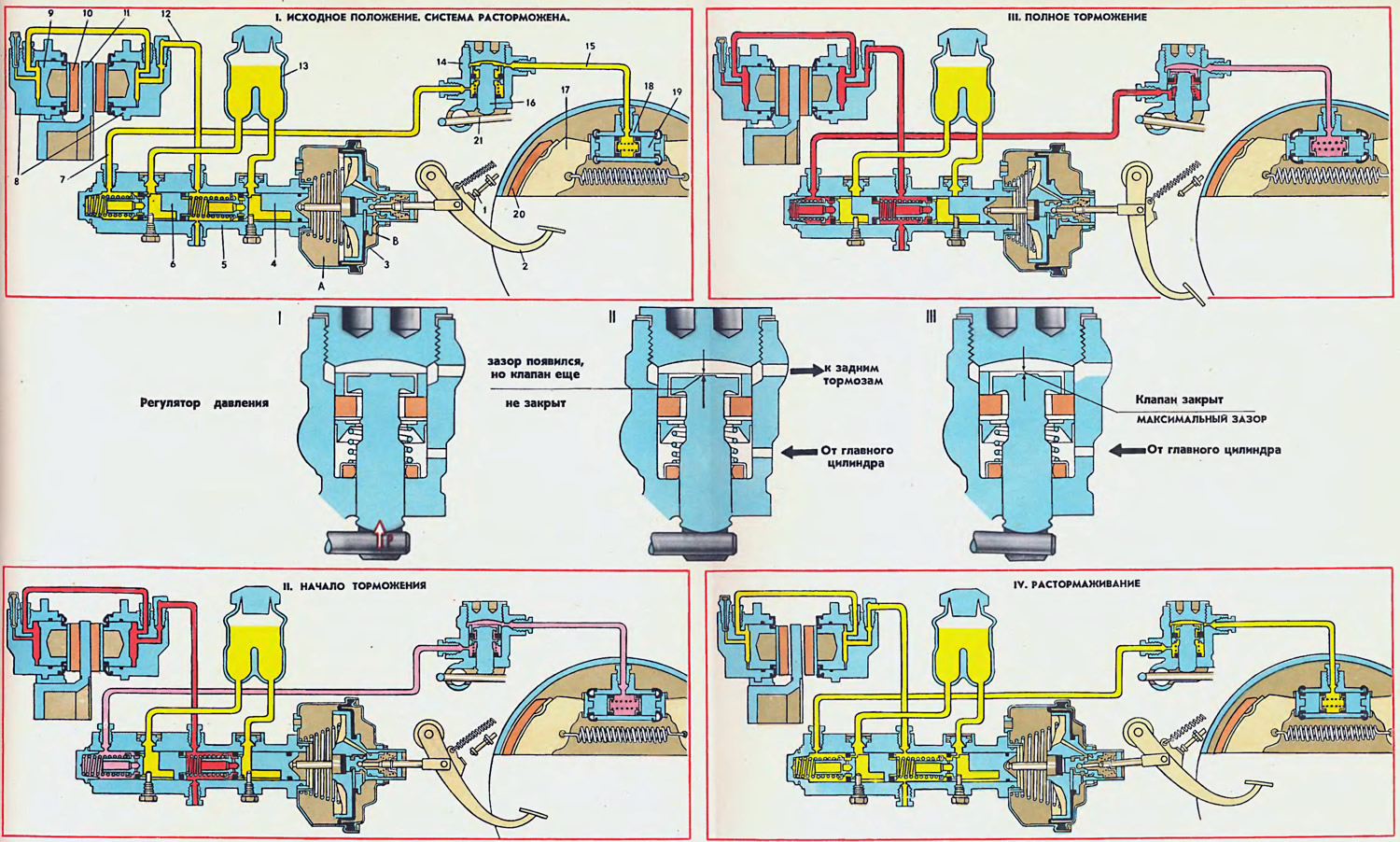
1. Brake light switch. 2. Brake pedal. 3. Vacuum booster. 4. Hydraulic front brake piston. 5. Brake master cylinder. 6. Hydraulic piston of the rear brakes. 7. Pipeline of the rear brake hydraulic drive circuit. 8. Wheel cylinders (internal and external) front brakes. 9. Front brake cylinder piston. 10. Brake pads. 11. Brake disc. 12. Front brake hydraulic circuit pipeline. 13. VAZ-2103 feed tank. 14. Pressure regulator. 15. Pipeline to the rear brake wheel cylinders. 16. Regulator piston. 17. Brake shoe. 18. Rear brake wheel cylinder. 19. Wheel cylinder pistons. 20. Brake shoe lining. 21. Short lever arm.
The diagram below shows the interaction of the units and parts of the brake system of the VAZ-2103, complicated by the introduction of a vacuum booster, in comparison with the brake system of the VAZ-2101, 2102. The operation diagram of the brakes of the VAZ-2101, 2102 is otherwise similar to the diagram of the VAZ-2103.
I. Initial position. The system is disinhibited
In the initial position, the brake pedal 2 is pulled by the spring until it stops at the brake signal switch 1. The vacuum booster pusher, and together with it the valve body with the rod, are pressed by the return spring and are in the extreme rear position.
Access of outside air to atmospheric cavity B is blocked, and vacuum cavity A freely communicates with cavity B.
When the engine is running, a vacuum is created in both cavities, since vacuum cavity A is connected to the engine intake pipe.
Pistons 4 and 6 of the main brake cylinder 5 are pressed to the extreme rear position under the action of the return springs and rest against the locking screws. The spacer rings, resting against the locking screws, press the seals to the front position, opening the passages for the brake fluid.
The cavities of the main cylinder communicate freely with the cavities of the feed tank 13 and with pipelines 7 and 12.
The pistons 9 of the wheel cylinders of the front brakes are pressed away from the brake shoes 10 by approximately 0.1 mm due to the elastic deformation of the sealing rings. The brake shoes 10, not experiencing pressure from the pistons, remain only in light contact with the friction surfaces of the brake disc.
When the vehicle is moving without braking, the piston 16 of the regulator is raised to the extreme upper position until the protrusion of the head stops in the regulator plug. Brake fluid can freely flow from the pipeline 7 into the pipeline 15 to the wheel cylinders 18 of the rear brakes. By the force of the tension spring, the brake shoes 17 rest against the adjusting eccentrics (VAZ-2101, 2102) and bushings in the axle (VAZ-2103). Pistons 19 are pushed inside the wheel cylinders, but remain pressed against the brake shoes by a spacer spring that is weaker than the tension spring. There is a gap of 0.1-0.15 mm between the brake drum and the brake shoe linings (VAZ-2101, 2102) and 0.8 mm (VAZ-2103).
II. Start of braking
When a VAZ-2103 car is moving with the engine running, a vacuum is created in cavities A and B of the vacuum booster, transmitted from the engine intake pipe.
The driver, pressing the brake pedal 2, moves the booster valve pusher. The valve flange, having reached the hole in the valve body, will close the annular gap and separate the atmospheric cavity B and the vacuum cavity A of the booster.
The piston of the booster valve moves forward, a gap appears between the piston and the flange of the valve, which connects cavity B with the atmosphere. Filling the vacuum, outside air enters through the booster filter, passes between the front end of the pusher and the flange of the valve and then through the channel enters cavity B, creating pressure on the valve body through the diaphragm dividing the booster into cavities, and thereby reducing the required force on the brake pedal.
The pressure developed on the valve body depends on the degree of vacuum in the engine intake pipe and on the force applied to the brake pedal.
The stem moves together with the valve body. Having selected the gap between the tip and piston 4, the stem moves the piston forward.
When moving away from the locking screw, the rear edge of the piston annular groove is pressed against the seal and separates the cavity of the front brake hydraulic drive from the cavity of the feed tank 13. From this moment, with further advancement of piston 4 in the cavity of the front brake hydraulic drive, the brake fluid pressure is transmitted through pipelines 12 to the inner wheel cylinders and then through connecting tubes to the outer wheel cylinders of the front brakes.
The brake fluid pressure, overcoming the elastic deformation of the sealing rings, pushes the pistons 9 out of the wheel cylinders of the front brakes until they come into contact with the brake pads. With further increase in pressure, the brake pads clamp the brake discs 11, slowing the rotation of the front wheels.
If at this point the driver stops pressing the pedal, but leaves it pressed without removing his foot, the vacuum booster valve body will move forward under atmospheric air pressure by the amount of the gap between the thrust plate and the valve piston groove. In this case, the released valve flange, having reached the piston flange, will block the air flow into cavity B, and the excess air pressure in cavity B will pass into the vacuum cavity of the booster through the newly opened annular gap, the channel in the booster body and further into the engine intake pipe. The pressure in both cavities will be balanced and the booster servo action will stop.
If you resume pressing the brake pedal, the increasing pressure of the brake fluid in the cavity of the front brake hydraulic drive will begin to move piston 6 of the rear brake hydraulic drive. With the beginning of the movement of piston 6, the same sequence of interaction of the parts associated with this piston will be repeated.
The increasing pressure of the brake fluid in the cavity of the rear brake hydraulic drive will be transmitted via pipeline 7, through regulator 14 and pipelines 15 to wheel cylinders 18 of the rear brakes. Moving under the pressure of the brake fluid, pistons 19 move apart and press brake shoes 17 to the friction surface of the brake drum.
From the beginning of braking, the mass of the car tends to move forward, the load on the front suspension increases, and on the rear decreases. Due to this, the rear of the body will begin to rise, the short arm 21 of the regulator drive lever goes down, since the other (long) arm of the lever, connected to the rear axle beam, copies the movement of the suspension. Piston 16 under the pressure of the brake fluid, overcoming the resistance of the spring, begins to go down.
III. Full braking
At the moment of full braking of a moving vehicle, the maximum load transfer from the rear suspension to the front and the greatest lift of the rear of the body occur. The grip of the rear wheels with the road decreases. The piston 16 of the regulator, moving lower, touches the seal with its head and closes the supply of fluid to the wheel cylinders of the rear brakes. Further braking of the rear wheels stops, possible slippage of the wheels relative to the road and skidding of the car are prevented.
Until the rear of the body drops and short arm 21 lifts piston 16, it will remain pressed against the seal by the difference in forces applied to the head from both sides: from above, the pressure of the brake fluid in the wheel cylinders, multiplied by the area of the head; from below, the brake fluid pressure from the master brake cylinder, multiplied by the area of the lower head flange, as well as the compression force of the piston spring and the twisting force of the drive lever.
If the rear brake hydraulic drive circuit fails, the brake fluid pressure developed when piston 4 moves will move piston 6 until it stops in the plug. In this case, the openings connecting the cavity of the rear brake hydraulic drive with the feed tank and with the pipe drive 7 will be blocked, there will be no leakage of brake fluid, and the front brake hydraulic drive circuit will retain full functionality.
In this case, only the free travel of the brake pedal and the braking distance will increase.
If the front brake hydraulic circuit fails, piston 4 will move forward until it stops against piston 6, block the compensation hole connecting the cavity with the feed tank, and when the brake pedal is pressed further, it will activate the rear brake hydraulic circuit. The free pedal travel and braking distance will also increase.
IV. Disinhibition
If you release the pedal, it will return to its original position by the force of the return spring until it stops (VAZ-2101, VAZ-2102) in switch 1 of the brake light. Return of the brake pedal to the initial position in the VAZ-2103 occurs somewhat differently, since the pedal is connected to the piston of the booster valve by means of a pusher. The released pedal pulls the pusher of the booster valve and the piston. The piston, having touched the flange of the booster valve, closes the access of outside air to cavity B. The flange moves away from the edges of the hole for the piston and opens an annular gap, which communicates the atmospheric cavity B with the vacuum A through the channels. The servo action of the booster stops, and the brake pedal, body, valves together with the rod return to the initial position.
Without experiencing pressure from the rod (at VAZ-2103), and on the VAZ-2101 and VAZ-2102, on the pusher side, pistons 4 and 6, under the action of return springs, move back to their original position until they stop against the locking screws. When returning, the spacer rings, resting against the locking screws, move the seals to the front wall of the piston ring groove and connect the cavities of the master cylinder with the feed tank.
The pistons 9 of the rear brake are retracted to the non-working position by contraction of the sealing rings, elastically deformed by the pistons exiting the cylinders at the beginning of braking, and the pistons 19 of the rear brake are retracted by contraction of the tension spring. Excess brake fluid flows through compensation holes into the feed tank 13.