




Disassembly and inspection
Before checking the connecting rod and piston group, remove the rings from the piston and clean it from carbon deposits, remove deposits from the lubrication channels of the piston and connecting rod. Then check for damage to the parts. Cracks of any kind on the piston, piston rings, pin, connecting rod and its cover are unacceptable. In this case, replacement of parts is required.
To replace the piston, piston pin or connecting rod, they are disassembled, for which the pin is pressed out under a press (with a force of at least 800 kgf) using the A.60308 mandrel, centered in the piston pin hole, and a support with a cylindrical recess into which the piston is placed. The A.60308 mandrel is a stepped rod with a diameter and length of the working part of 21 and 80 mm, respectively. The diameter of the centering shank is (14.9±0.05) mm. The use of a hammer for pressing out and pressing in is unacceptable, since it can damage the piston.
Before assembly, check the mating gaps, which must correspond to the data table 2.
The fit of the piston pin in the piston is checked by inserting a selected piston pin, previously lubricated with engine oil, into the hole of the piston boss. The fit is considered normal if the piston pin enters the hole from a simple press of the thumb and does not fall out of the boss if the piston with the piston pin is held in a vertical position. If the pin falls out of the boss, then it is replaced with a pin of the next category. If the piston had a pin of the 3rd category, then in this case the piston with the pin is replaced.
The height gaps between the rings and grooves are checked using a set of feeler gauges, installing the ring in the corresponding groove.
The gap in the ring lock is checked by inserting them into a gauge with a bore diameter equal to the nominal ring diameter with a tolerance of ±0.003 mm. Gauge A.96137 can be used for this purpose (for engines 2101) or 67.8125.9501 (for engines 21011)1.
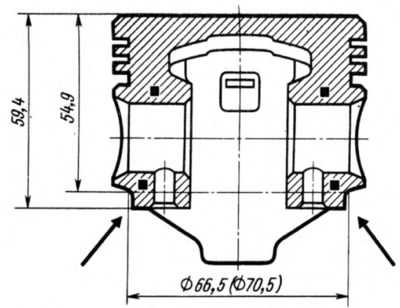
When replacing pistons, it is necessary to select them by weight, since pistons of one engine should not differ by more than 2.5 g. In the event that there is no set of pistons of the same group by weight, it can be adjusted by removing metal with a file or cutter evenly from both sides on the lower outer side of the piston pin bosses (Fig. 6). The metal removal, however, should not exceed 4.5 mm in height relative to the nominal piston height (59.4 mm), and in width it is limited to a diameter of 66.5 mm (70.5 mm for engine model 21011).
(The text is copied from the online portal: VAZbook)
Assembly
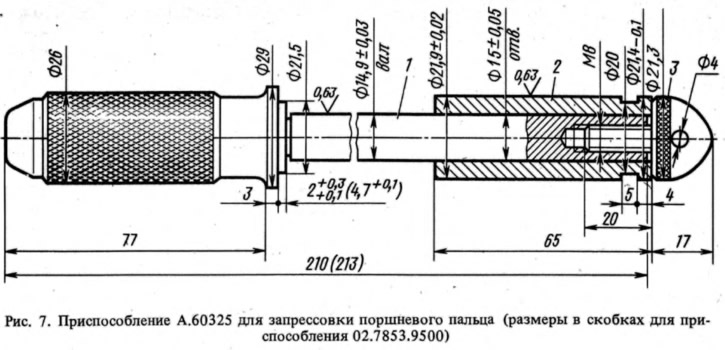
The pin is pressed into the upper head of the connecting rod with interference, therefore, to facilitate this operation, the connecting rod is heated by keeping it in an oven at 240°C for at least 15 minutes. The pin should be pressed in as quickly as possible, since the connecting rod cools quickly, and the position of the pin cannot be changed in a cooled connecting rod. The latter must be prepared for assembly in advance by placing it on shaft 1 (Fig. 7) of device A.60325 and installing guide 2 on the end of this shaft, secured with screw 3. The screw is tightened loosely to avoid jamming when the pin expands from contact with the heated connecting rod. When pressing piston pins into pistons of 21011 engines, it is necessary to use device 02.7853.9500 instead of A.60325.
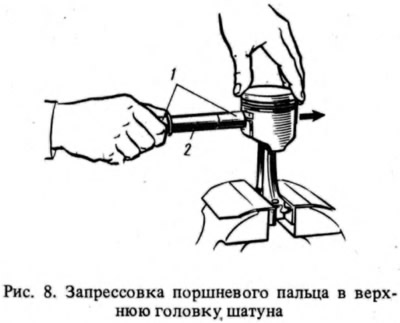
The connecting rod removed from the furnace is quickly clamped in a vise and the piston is placed on the connecting rod so that the "P" mark on the piston is located on the side of the oil outlet on the lower connecting rod head. Push the piston pin 2 fixed on the device 1 into the piston hole and the upper connecting rod head (Fig. 8) until the end of the handle of the device stops in the piston. During this operation, the piston must be pressed against the upper connecting rod head in the direction of pressing the pin, as shown by the arrow. This way, the finger will take the correct position. After cooling the connecting rod, lubricate the finger with engine oil through the holes in the piston bosses.
After assembling the piston with the connecting rod, check the strength of the pin pressing using the device A.95615 (Fig. 9). To do this, clamp the base 4 of the device in a vice, lower the bracket 8 of the indicator and install the piston with the connecting rod on the device. Insert the threaded rod 3 into the hole of the pin and advance it until the head 2 of the rod stops against the end of the pin. Screw the nut 5 onto the end of the rod and tighten it so that, when it comes into contact with the support, it takes up any possible gaps. Raise the bracket 8 to a horizontal position, secure it with the handle 7 and install the pin 1 of the indicator 9 on the head 2 of the rod inserted into the pin. Set the indicator arrow to zero and insert the stop 6 into the groove of the threaded rod so that the rod does not turn. Using a torque wrench, tighten nut 5 to a torque of 1.3 kgf·m, corresponding to an axial load of 400 kgf.
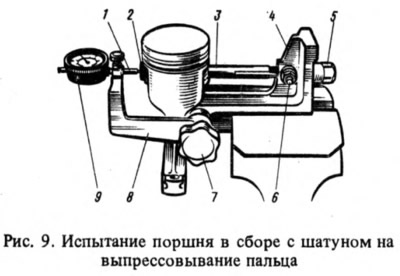
The pin is seated correctly in the connecting rod if, after the torque wrench is released and the nut is returned to its original position, the indicator arrow returns to zero. If the pin slips in the upper head of the connecting rod, the connecting rod must be replaced with a new one.
After checking the pin press-fit, lubricate the piston grooves and piston rings with engine oil. Install the rings on the piston, orienting them so that the lock of the upper compression ring is located at an angle of approximately 45° to the axis of the piston pin, the lock of the lower compression ring is at an angle of approximately 180° to the axis of the lock of the upper compression ring, and the lock of the oil scraper ring is at an angle of approximately 90° to the axis of the lock of the upper compression ring.
The lower compression ring is installed downwards with the groove that is on its outer surface. If the ring has the mark "Top" or "TOP", then the ring is installed with the mark facing upwards. The chamfers on the outer surface of oil scraper rings manufactured before 1987 were asymmetrical. Therefore, these rings must be installed on the piston with the chamfers facing upwards. Before installing oil scraper rings, check that the joint of the spring expander is located on the side opposite the ring lock.
Notes
1. Caliber A.96137 is a 26 mm thick ring with an outer diameter of 122 mm and an inner diameter of (76±0.003) mm. Caliber 67.8125.9501 differs from A.96137 only in its inner diameter.