




Piston
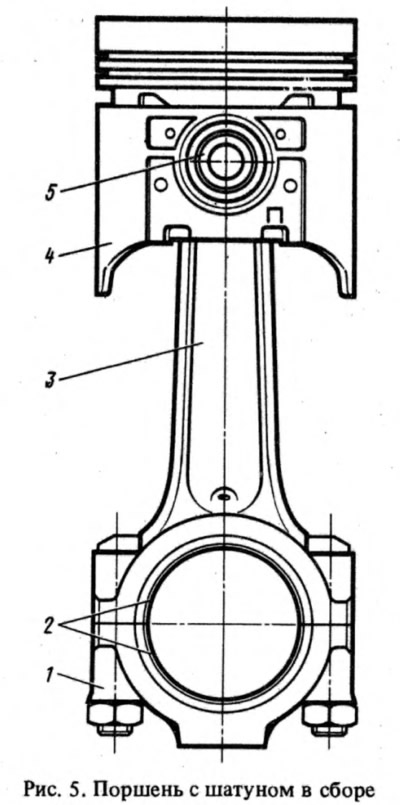
Cast from aluminum alloy. To improve the running-in ability, the outer surface of the piston (Fig. 5) is coated with a layer of tin. To compensate for uneven thermal expansion, the piston skirt has a complex shape. The piston has a conical shape: the upper part has a smaller diameter than the lower part. Therefore, the piston diameter must be measured only in a plane perpendicular to the piston pin and at a distance of 52.4 mm from the piston bottom.
The piston pin hole is offset from the axis of symmetry by 2 mm to the right side of the engine. Therefore, for correct installation of the piston in the cylinder, there is a mark "P" shown in the figure near the piston pin hole, which should be facing the front of the engine.
According to the outer diameter, pistons are divided into five classes with 0.01 mm intervals, and according to the diameter of the hole under the piston pin - into three categories with 0.004 mm intervals. The piston class (letter) and the category of the hole under the piston pin (number) are indicated on the piston bottom.
Spare parts are supplied with pistons of classes A, C, E. These classes are sufficient to select a piston for any cylinder, since pistons and cylinders are divided into classes with some overlapping sizes. For example, a piston of class C can fit cylinders of classes B and D. In addition, when repairing engines, pistons are usually replaced in worn cylinders, so a piston of class C can fit a slightly worn cylinder of class B. The main thing when selecting a piston is to ensure the necessary installation clearance between the piston and the cylinder.
Since 1986, pistons of repair sizes for all engine models have been manufactured with an outer diameter increased by 0.4 and 0.8 mm. Before 1986, pistons of the following repair sizes were produced: for 2101 engines - with an increase of 0.2; 0.4 and 0.6 mm; for 21011 - with an increase of 0.4 and 0.7 mm.
The original can be viewed on the portal [www.vazbook.ru]
The pistons of the 2101 and 21011 engines are easy to distinguish from each other by their appearance. In addition to the fact that they have different diameters, the 2101 pistons have a smooth bottom, while the 21011 pistons have a cylindrical recess on the bottom with a diameter of 55 mm and a depth of 1.9 mm.
Piston rings
The piston has two compression rings and one oil scraper ring. All of them are made of cast iron.
The outer surface of the upper compression ring is chrome plated and has a barrel shape. The lower compression ring is of the scraper type (has a recess on the outer surface), phosphated.
Piston pin
The 2101 and 21011 engines are equipped with identical steel tubular piston pins 5. They are pressed into the upper head of the connecting rod 3 and rotate freely in the piston bosses.
According to the outer diameter, the pins are divided into three categories, each 0.004 mm. The pin category is marked on its end with the corresponding color: 1st - blue, 2nd - green, and 3rd - red.
Connecting rod
The lower head of the steel forged connecting rod 3 is split, connecting rod liners 2 are installed in it. The connecting rod is machined together with the cover 1, so it is not interchangeable with the covers of other connecting rods. In order not to mix up the connecting rod covers during assembly, the connecting rod and its cover (on the side) have a stamp of the cylinder number in which they are installed. During assembly, the numbers on the connecting rod and cover must be on the same side.