




Voltage regulator test circuit on the bench
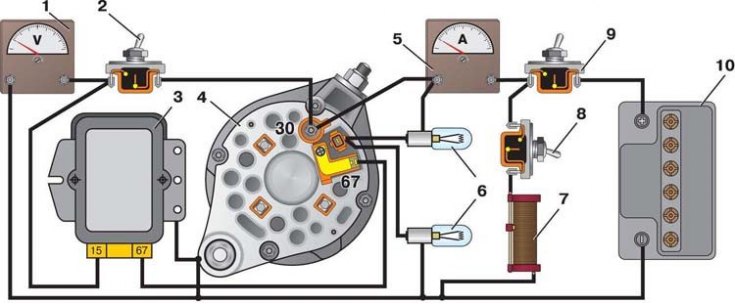
1 – voltmeter with a scale of 15 V, accuracy class not lower than 0.5; 2 – main switch; 3 – voltage regulator; 4 – generator; 5 – ammeter with a scale up to 50 A; 6 – control lamps 3 W, 12 V; 7 – rheostat 5–30 A, 15 W; 8 – rheostat switch; 9 – Battery switch; 10 – battery
Data for verification and adjustment
| Adjustable voltage at regulator and ambient temperature (50±3)°C, V: | |
| - at the second stage | 14,2 ±0,3 |
| - at the first stage lower than at the second, no more | 0,7 |
| Resistance between plug "15" and ground, Ohm | 17,7 ±2 |
| Resistance between plug "15" and plug "67" with open contacts, Ohm | 5,65 ±0,3 |
| Air gap between anchor and core, mm | 1,4 ±0,07 |
| Distance between contacts of the second stage, mm | 0,45 ±0,1 |
The regulator is tested and adjusted on a stand that has a generator, a battery, a thermostat and an electric motor with adjustable rotation speed in a wide range. The regulator with the lid closed is installed on the stand with the plugs facing down.
The electrical connection diagram of the stand is shown in Fig. Voltage regulator test diagram on the stand.
Pay special attention to the reliability and minimum resistance of the wire connections, so that the wires from switch 2 are connected directly to the generator clamp "30" and the regulator plug "15", and the regulator body is connected directly to the generator body. All wires should be as short as possible.
When performing control checks on the stand, do not allow the regulator to operate with the battery disconnected, as this may damage the regulator contacts. Bulbs 6 control the generator operation and, if it is in good condition, should have the same glow.
1. Before testing, warm up the regulator in a thermostat for 15–18 minutes at (50±3)°C, supplying the regulator winding with current at a voltage of 12–13 V. The voltage is set by rheostat 7 with switches 2, 8, 9 on and the generator not running.
2. Immediately after warming up, they begin checking and adjusting the 2nd, and then the 1st stage, and make sure that the adjusted voltage is stable, i.e. does not fluctuate sharply.
2nd stage control
3. Set the generator rotor speed to 5000 min⁻¹.
4. Using rheostat 7, set the generator load current to 2–12 A.
5. Check the generator voltage, which should be (14.2±0.3) V.
6. If it is different, stop the generator, disconnect the battery, remove the cover from the regulator and, bending the spring bracket 10 (see Fig. Voltage regulator PP-380), loosen up (if the voltage is high), or increase (if the voltage is low) its tension.
The information is published on the website: vazbook
7. Then replace the regulator cover and check the 2nd stage voltage again.
8. After completing the check and adjustment of the 2nd stage, immediately check the 1st stage of regulation.
1st stage control
9. At a rotor speed of 5000 min⁻¹ rheostat 7 (see fig. Voltage regulator test diagram on the bench) set the load current to 25–35 A. The voltage should be no more than 0.7 V lower than the value obtained when adjusting the 2nd stage.
10. If the voltage does not fall within these limits, then stop the generator, disconnect the battery, remove the regulator cover, loosen nut 4 (see Fig. Voltage regulator PP-380) and move rack 6 by 0.1–0.2 mm.
11. When the voltage is high, the post is moved down, and when it is low, it is moved up. At the same time, post 5 is moved to maintain a gap of (0.45±0.1) mm between the contacts of the 2nd stage. During this operation, ensure that the axes of the contacts of the 1st and 2nd stages coincide. The anchor contact should not go beyond the contacts on the posts.
12. Tighten nut 4, replace the cover, check the regulator again (both 1st and 2nd stage) and, if necessary, repeat the operations until a precise adjustment is achieved.
13. After completing adjustments, thoroughly clean the regulator cover and install it on the hot regulator to minimize moisture absorption.