




Open large image in new tab »
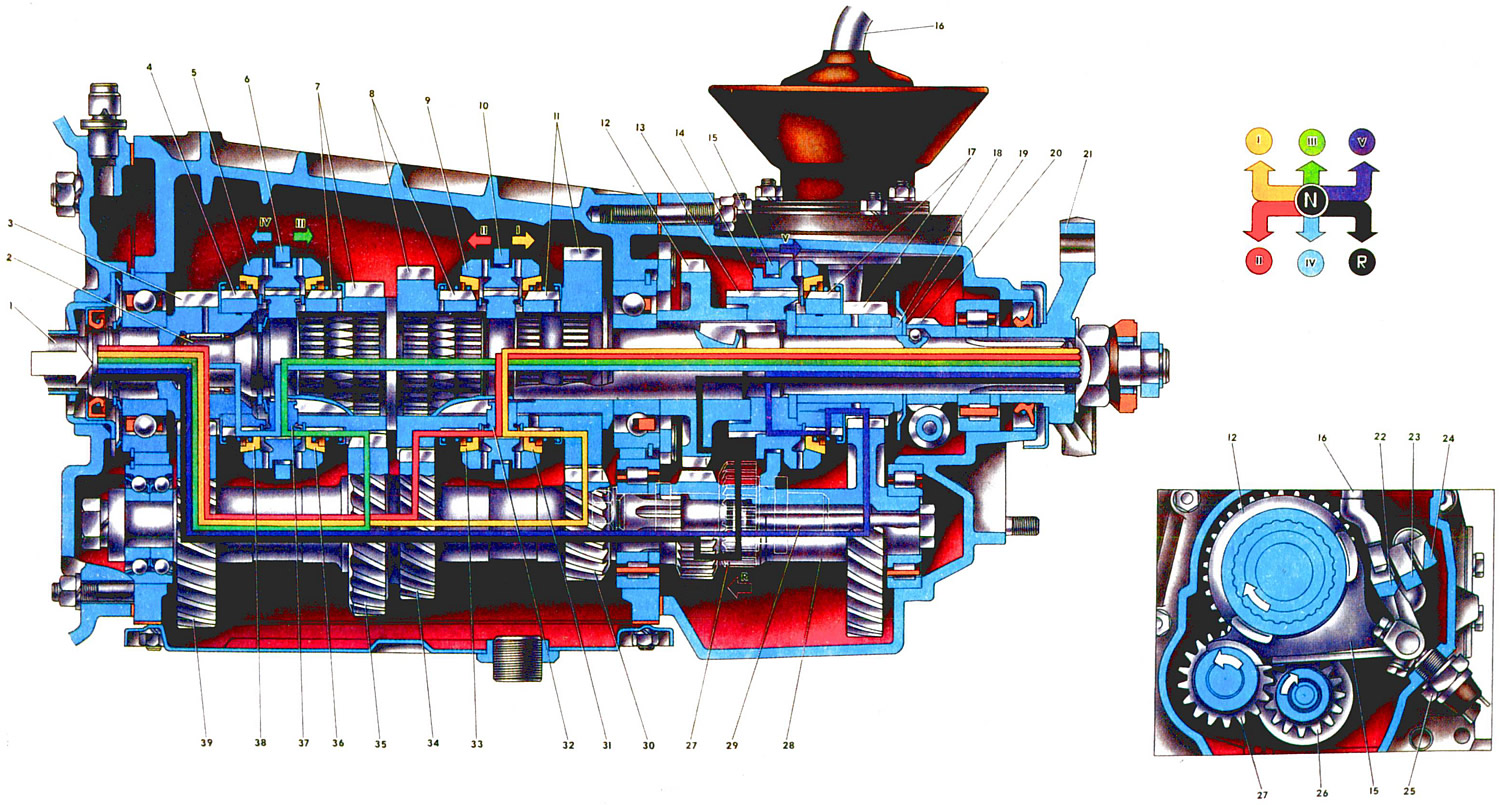
Fig. 19. Gearbox operation diagram: 1. Leading (primary) shaft; 2. Driven (secondary) shaft; 3. Primary shaft constant mesh gear; 4. Synchronizer ring gear of the 4th gear; 5. Sliding clutch of synchronizer III and IV gears; 6. Fork for engaging III and IV gears; 7. Gear and ring gear of the synchronizer of the third gear; 8. Gear and ring gear of the 2nd gear synchronizer; 9. Sliding clutch of synchronizer of 1st and 2nd gears; 10. Fork for engaging I and I gears; 11. Gear and ring gear of the 1st gear synchronizer; 12. Reverse gear; 13. Hub of the 5th gear synchronizer clutch; 14. Sliding clutch of the 5th gear synchronizer; 15. Fork for engaging 5th gear and reverse gear; 16. Gear shift lever; 17. Gear and ring gear of the 5th gear synchronizer; 18. Sleeve of the 5th gear; 19. Oil deflector washer; 20. Speedometer drive gear; 21. Flexible coupling flange; 22. Fork rod for engaging 5th gear and reverse gear; 23. Fork rod for engaging III and IV gears; 24. Fork rod for engaging 1st and 2nd gears; 25. Reverse light switch; 26. Reverse gear of the gear block; 27. Reverse intermediate gear; 28. Block of gears of 5th gear and reverse gear; 29. Reverse intermediate gear shaft; 30. Gear of the 1st gear of the intermediate shaft; 31. 1st gear synchronizer locking ring; 32. Hub of the synchronizer clutch of the 1st and 2nd gears; 33. Locking ring of the 2nd gear synchronizer; 34. Gear of the 2nd gear of the intermediate shaft; 35. Gear of the third gear of the intermediate shaft; 36. Locking ring of synchronizer of the 3rd gear; 37. Hub of synchronizer clutch of III and IV gears; 38. Synchronizer locking ring of IV gear; 39. Constant mesh gear of the intermediate shaft.
The five-speed gearbox is based on the four-speed gearbox, so the torque transmission patterns from the primary shaft to the secondary shaft in all gears, except for fifth gear and reverse, are similar to those of the four-speed gearbox. That is, the torque from the engine crankshaft is transmitted through the clutch to the primary shaft 1 and through gears 3 and 39 of constant engagement to the intermediate shaft. The block of gears of the intermediate shaft have constant engagement with gears 7, 8, 11 of the third, second and first gears of the secondary shaft. Therefore, they rotate from the intermediate shaft both with the gear engaged and disengaged. In addition, the block of 28 gears rotates together with the intermediate shaft, from the large crown of which the rotation is transmitted to gear 17 of the fifth gear. Since gears 7, 8, 11, 17 are loosely mounted on secondary shaft 2, when the gear shift lever is in neutral position, none of these gears transmit torque to the secondary shaft.
When starting the car from a standstill and overcoming difficult sections of the road, 1st gear is engaged (see gear shift lever movement diagram). In this case, the sliding clutch 9, engaging with the toothed ring of the synchronizer of gear I of the first gear, connects the hub 32 with gear II. The torque from gear II through the clutch 9 and the hub 32 is transmitted to the secondary shaft 2. The transmitted torque increases in accordance with the gear ratio by 3.67 times.
With further acceleration of the car, they switch from first to second gear. In this case, clutch 9 connects hub 32 to the toothed ring of gear 8 of the second gear and the torque from gear 8 through clutch 9 and hub 32 is transmitted to the secondary shaft. The magnitude of the torque decreases slightly and, compared to direct transmission, will be increased by 2.10 times; the speed of the car increases.
When shifting to third gear, sliding clutch 5 of another synchronizer connects hub 37 with the ring gear 7. Torque is transmitted from gear 7 through clutch 5 and hub 37 to secondary shaft 2. The magnitude of torque decreases slightly, and the speed increases.
When the fourth gear is engaged, clutch 5 engages with gear ring 4 of the primary shaft, i.e. it directly connects the primary and secondary shafts of the gearbox. In this case, the rotation speed of the primary and secondary shafts will be the same and the torque value will not change and will practically correspond to the torque on the engine crankshaft. This transmission is called direct.
When the fifth gear is engaged, the sliding clutch 14 connects the hub 13 with the toothed ring of the pinion 17. The torque will be transmitted from the primary shaft 1 through the constant mesh gears 3 and 39 to the intermediate shaft. From it to the block of 28 gears and from the large ring of the block to the driven gear 17 of the fifth gear, then through the clutch 14 and the hub 13 to the secondary shaft 2. In this case, the torque value will be minimal and the speed will be maximal.
Reverse gear is engaged by moving the gearshift lever to the right, then pressing it down and moving it backwards in the direction of the vehicle's movement. In this case, the intermediate gear 27 of the reverse gear engages with the small ring 26 of the gear block and with the ring of the gear 12 of the reverse gear. When moving the intermediate gear 27, the head of the rod presses on the ball of the switch rod 25 and sinks it. The circuit of the reverse light lamp closes, and the lamp signals in white that the reverse gear is engaged.
The gearbox parts are lubricated with transmission oil, which is poured in an amount of 1.55 liters under the edge of the filler hole. When the shafts and gears rotate, an oil mist is formed. Oil through radial holes in driven gears 7, 8, 11 and 17 goes to the landing belts of the secondary shaft, on which these gears are located. Due to the grooves on these belts, an oil film is formed, preventing direct contact of the metal surfaces of the gears and the shaft.
The tightness of the gearbox housing is ensured by the primary and secondary shaft seals and sealing gaskets, which are installed between the housing and the lower and rear covers. To reduce the oil pressure on the driven shaft seal, an oil deflector washer 19 is installed on the shaft.
The axial forces that arise when transmitting torque through helical gears are absorbed by the ball bearings of the shafts, which are fixed in their seats by mounting rings (intermediate bearing of the driven shaft with a locking plate), and on the shafts with spring washers and retaining rings.
The simple design of the gearbox, helical gears of constant engagement and synchronizers ensure long-lasting and silent operation of the gearbox. Its maintenance is reduced to a minimum: checking the level and changing the oil (see fig. 14).
[View the original on the internet resource: VazBook.ru]
To check the oil level, unscrew plug 54 (see fig. 18), the oil level should be at the lower edge of the hole. Drain the used oil through the hole in the lower cover of the gearbox. It is closed with a plug with a magnet.
When the parts of the locking devices, locking rings and synchronizer clutches wear out, the gears may not engage clearly and may even disengage spontaneously. The wear of these and other parts occurs during prolonged use of the gearbox or when changing gears, when the clutch is not fully disengaged. In this case, partial transmission of torque from the gear continues and when they engage, the gear teeth experience impact loads. Particularly intensive wear of the parts occurs when the oil level decreases or there are oil leaks. This malfunction is possible when the primary and secondary shaft seals are worn out or the lower or rear covers of the gearbox are loosened.
When parts are worn to the limit, noises appear in the gearbox. With such a malfunction, further operation of the car is not allowed, since the gearbox parts may break.
To prevent premature failure of the gearbox, you should regularly check and, if necessary, top up the oil every 10,000 km, and also visually check for oil leaks.
During operation of the gearbox, the oil "ages" due to the effects of temperature, transmission loads, oxidation and contamination with wear products, so it should be replaced every 60,000 km.