




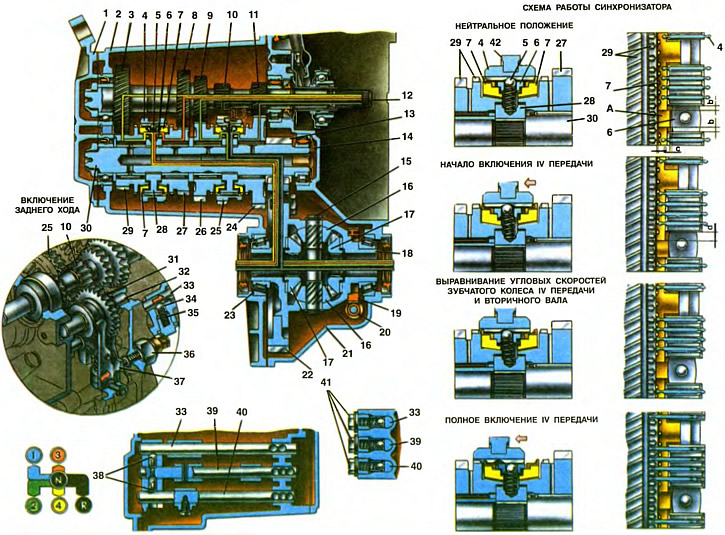
1. Rear cover. 2. Gearbox housing. 3. 4th gear pinion. 4. Sliding sleeve of synchronizer of 3rd and 4th gears. 5. Retainer ball. 8. Retainer cracker. 7. Locking ring of synchronizer of 2nd and 4th gears. 8. 3rd gear pinion. 9. 2nd gear pinion. 10. Reverse gear pinion. 11. 1st gear pinion. 12. Gearbox input shaft. 13. Final drive pinion. 14. Oil sump. 15. Satellite axle. 18. Satellite. 17. Half-shaft pinion. 18. Differential case. 19. Speedometer drive pinion. 20. Speedometer drive driven gear. 21. Clutch housing. 22. Main gear gear. 23. Adjusting ring. 24. 1st gear gear. 25. Sliding clutch for engaging 1st, 2nd and reverse gear. 26. 2nd gear gear. 27. 3rd gear gear. 28. Third and fourth gear synchronizer clutch hub. 29. 4th gear gear. 30. Gearbox secondary shaft. 31. Reverse intermediate gear. 32. Reverse intermediate gear shaft. 33. Reverse gear engagement fork rod. 34. Rod retainer ball. 35. Retainer spring. 36. Reverse light switch. 37. Reverse gear engagement fork. 38. Locking device crackers. 39. Rod of the fork for engaging III and IV gears. 40. Rod of the fork for engaging I and II gears. 41. Lock plugs. 42. Fork of the synchronizer clutch of III and IV gears.
A — projection of the blocking ring a, b, c, d — gaps
The principle of operation of a mechanical gearbox is based on changing the magnitude of the transmitted torque by replacing pairs of gears involved in transmitting torque from the primary to the secondary shaft of the gearbox. A different combination of the number of teeth of the leading and driven gear wheels of each gear ensures a change in the magnitude of the transmitted force (torque), and when the reverse gear is engaged, the direction of force transmission.
The vehicle's performance, including its dynamics and speed, fuel consumption and cross-country ability, depend on the selection of the number of gears and gear ratios.
The forward gears of the gearbox are synchronized. This ensures a smooth gear shifting process and increases the durability of the gearbox. Smooth gear shifting creates comfort when driving a car, reduces driver fatigue and has a beneficial effect on traffic safety.
The operating principle of the synchronizer is based on the alignment of the rotation frequencies of the secondary shaft of the gearbox and the freely rotating constant-mesh gear wheel of the required gear.
The diagram of the synchronizer operation shows the sequence of its actions when engaging the fourth gear.
When the sliding clutch 4 is in the neutral position, the crackers 6 are in the center of the grooves of the hub 28 and do not act on the locking ring 7. Between the projections A of the locking ring and the grooves of the hub there is a uniform lateral clearance b, and between the projections A and the crackers 6 there is a clearance c (see "Synchronizer operation diagram", diagram 1).
The beginning of the engagement of the IV gear is characterized by the fact that the sliding clutch, moving towards the gear 29, drags along the crackers 6, which rest against the projections A of the blocking ring, i.e. the gap c is selected. With further movement of the clutch, the crackers press the blocking ring against the conical surface of the synchronizer ring of the gear wheel 29. Under the action of the frictional forces between the conical surfaces of the blocking ring and the synchronizer ring and the inertia of the synchronized masses, the blocking ring rotates relative to the hub until the ring projections rest against the side walls of the hub grooves, i.e. on the one hand the gap b is selected, and on the other it increases twofold and will amount to a gap d. Due to the circumferential displacement of the blocking ring by 1/4 of the step, the lateral bevels of the sliding clutch 4 rest against the lateral bevels of the blocking ring 7, and further axial movement of the sliding clutch stops. At the next moment, the alignment of the angular velocities of the gear wheel 29 of the IV gear and the secondary shaft 30 is completed. At this moment, the friction of the friction cones of the blocking ring and the wheel 29 ceases, as a result of which the force pressing the beveled surfaces of the clutch teeth and the ring disappears. This creates conditions for the complete engagement of the IV gear, when the released clutch easily connects to the ring of the blocking ring, and then to the ring of the synchronizer, connecting it to the hub. When the gear is fully engaged, the gaps between the crackers 6 and the projections A of the blocking ring 7 and the grooves of the hub are restored.
The gearbox operation diagram shows the directions of torque transmission when each gear is engaged using colored lines.
With the gearshift lever in neutral, the engine running and the clutch engaged, the torque from the engine is transmitted through the clutch to the primary shaft 12 of the gearbox. From the leading gear wheels of the primary shaft, the torque is transmitted to the same gear wheels of the secondary shaft, which, not having a direct connection with shaft 30, will rotate freely on it. The torque is not transmitted to the main gear and differential.
When the first gear is engaged, the lever is moved from the neutral position to the left until resistance appears and forward. The sliding clutch 25 of the synchronizer, moving towards the toothed wheel 24, connects the synchronizer ring of the toothed wheel 24 with the synchronizer hub, rigidly connected to the secondary shaft. The torque from the toothed wheel 24 is transmitted through the clutch to the synchronizer hub and from it to the secondary shaft. Through the toothed wheels 13 and 22 of the main gear, the torque is transmitted to the differential. The differential box 18, rotating together with the axis 15 of the satellites, distributes the torque to the front wheel drives through the teeth of the satellites 16 and the toothed wheels 17 of the semi-axles.
To engage the second gear, the lever is moved from the neutral position to the left and back. In this case, the sliding clutch 25 connects the toothed wheel 26 of the second gear with the synchronizer hub, and the torque from the wheel 26 is transmitted through the sliding clutch 25 to the synchronizer hub and to the secondary shaft.
The third and fourth gears are engaged by another synchronizer, moving the lever forward or backward from the neutral position. When the third gear is engaged, clutch 4 connects wheel 27 to the synchronizer hub, and when the fourth gear is engaged, it connects wheel 29 to the hub of the same synchronizer. Torque is transmitted to the secondary shaft through the connected wheel and hub.
Reverse gear is engaged when the vehicle is completely stopped. When reverse gear is selected, the gearshift lever moves from the neutral position to the right until it stops with increased resistance and back. In this case, the intermediate gear wheel 31 of reverse gear connects the driving gear wheel 10 of reverse gear of the primary shaft with the toothed rim of the sliding clutch 25 of the synchronizer of the 1st and 2nd gears. Due to the intermediate gear wheel, the torque transmitted to the secondary shaft changes its direction. Simultaneously with the engagement of reverse gear, the reversing light is turned on, since the fork 37 presses the rod of the switch 36 of the reversing light and the pump circuit is connected to the current source.
[The original source is located on the website vazbook.ru]
A clear separation of the III-IV gear lines and reverse gear is achieved by a spring lock 15 (see chapter 20), which provides a sharp increase in the force of selecting the reverse gear at the beginning and its decrease at the end of the selection stroke
Lubrication of the gearbox parts occurs by splashing oil from the toothed rims of the gear wheels. Oil is supplied to the needle bearings of the secondary shaft gear wheels from the oil chamber behind the front bearing of the secondary shaft through the oil collector 14. The oil level is measured with a ruler and should reach the upper mark.
To catch particles from the oil, there is a magnet installed in the lower part of the gearbox. Oil is drained from the crankcase through an opening closed by plug 4 (see chapter 19).