




Contents: Disassembly ↓ Assembly ↓
Disassembly
If only one part needs to be replaced, then you don't have to disassemble the cylinder head completely and remove only what is needed for replacement. The cylinder head is disassembled completely in the following sequence.
Removing the cover 5 (figure 38) with gasket 7, install cylinder head 1 on the stand, unscrew the nuts and remove the carburetor with the spacer, the carburetor heat-insulating screen, and then the intake and exhaust pipes (the warm air intake is removed at the same time).
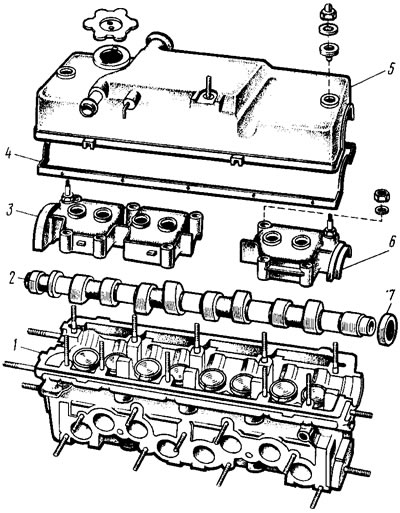
Figure 38. Cylinder head parts and assemblies
Remove the outlet pipe of the engine cooling jacket. Unscrew the coolant temperature gauge sensor, oil pressure indicator sensor and spark plugs. Unscrew the nuts and remove the fuel pump with gaskets, spacer and pusher. Disconnect the auxiliary unit housing from the cylinder head.
Remove the bearing housings 3 and 6 of the camshaft. Remove the camshaft 2 from the bearing beds of the cylinder head and remove the seal 7 from it.
Remove the tappets 11 from the cylinder head holes (figure 39) valves with adjusting washers 10. Release the valves from crackers 9, compressing the valve springs with device 67.7823.9505 (figure 40). Remove the springs with plates. Turn the cylinder head and take out the valves from the bottom. Remove the oil-deflecting caps from the guide bushings and the spring support washers.
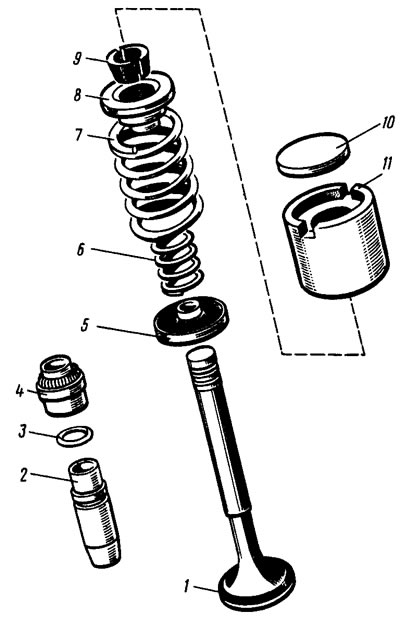
Figure 39. Valve mechanism parts: 1 - valve; 2 - guide bushing; 3 - retaining ring; 4 - oil deflector cap; 5 - spring support washer; 6 - internal spring; 7 - outer spring; 8 - spring plate; 9 - crackers; 10 - adjusting washer; 11 - pusher |
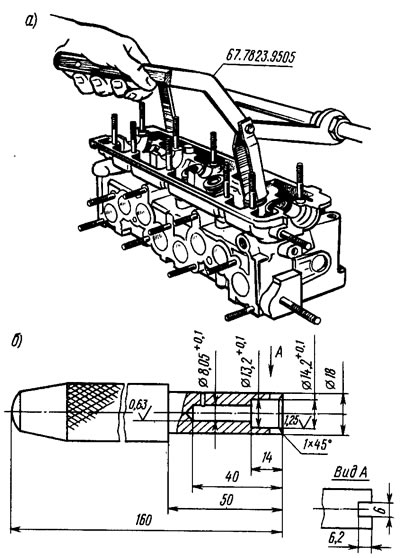
Figure 40. Valve mechanism assembly tooling: a - device 67.7823.9505 for compressing springs; b - mandrel 41.7853.4016 for installing oil-deflecting caps |
Assembly
Lubricate the valves and new valve stem seals with engine oil (old ones are not allowed to be used). Having installed the spring support washers, press the caps onto the valve guide bushings using mandrel 41.7853.4016. Insert the valves into the guide bushings, install the springs and valve plates. Compress the springs using device 67.7823.9505 (see figure 40), install the valve crackers. Insert the valve tappets with adjusting washers into the cylinder head holes.
Check whether the camshaft bearing housing mounting bushings are in place (put on the pins in figure 38). Clean the mating surfaces of the cylinder head and bearing housings from the remains of the old gasket, dirt and oil. Lubricate the bearing journals and camshaft cams with engine oil and place it in the cylinder head supports in such a position that the cams of the 1st cylinder are directed upwards.
On the cylinder head surfaces mating with the bearing housings, in the area of the extreme camshaft supports, apply SUPER THREE BOND No.50 sealant or a similar domestically produced sealant KLT-75T. It should be borne in mind that the engine may not be started earlier than 1 hour after applying the sealant.
Install the bearing housings and tighten the nuts of their fastening in two steps (see above "Removal and installation the camshaft"). Using mandrel 67.7853.9580, press in a new camshaft oil seal, after lubricating it with engine oil.
Install the cooling jacket outlet pipe with the gasket and the auxiliary unit housing with the sealing ring. In accordance with the instructions in Section. "Removal and installation the fuel pump" install a heat-insulating spacer with gaskets, a pusher and a fuel pump.
Place the gaskets on the cylinder head studs and install the exhaust manifold, secure it with the central nut, and then install the intake manifold. Secure them together with the intake 4 (see figure 35) warm air. Install the carburetor heat-insulating screen, spacer and carburetor. Secure it with nuts and close the carburetor with a technological plug.
The spark plugs and sensors for the coolant temperature indicator and oil pressure warning light are screwed into the cylinder head.