
English Русский
Български
Беларускі
Український
Српски
Hrvatski
Română
Polski
Slovenský
Magyar
| Articles | Contacts | Sitemap |   
Repair and maintenance Lada Repair and maintenance Mazda Repair and maintenance Mitsubishi Repair and maintenance Toyota Repair and maintenance Land Rover Repair and maintenance Hyundai Repair and maintenance Nissan
VAZbook.ru


Main     1111   2101   2105   2106   2107   2109   2110   2115   2121  
VAZ-2121 (1977-1994) VAZ-21213 (1994-2006) VAZ-21214 (1994-2006)
  • Main
  • «Niva»
  • VAZ-21213
  • Electrical equipment
  • Engine electrics
  • Checking the starter on the stand

Checking the starter on the stand (VAZ-21213)

            0

Contents: Checking functionality ↓ Full braking test ↓ Idle speed test ↓ Checking the traction relay ↓ Starter relay ↓
If there are any doubts about the efficiency of the starter, it is necessary to check it on the stand.

The electrical circuit diagram for testing the starter on the stand is shown in Fig. 7-15. The connecting wires to the current source, ammeter and contact bolt of the starter traction relay must have a cross-section of at least 16 mm².
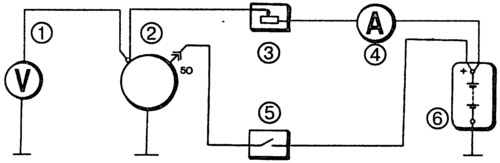
Fig. 7-15. Connection diagram for testing the starter on the stand:

Fig. 7-15. Connection diagram for testing the starter on the stand:
1 - voltmeter with a scale limit of at least 15 V; 2 - starter; 3 - rheostat 800 A; 4 - ammeter with 1000 A shunt; 5 - switch; 6 - battery/


The starter temperature during testing should be (25±5)°C, and the brushes should be well ground to the commutator.

Checking functionality


By closing switch 5 (Fig. 7-15), with a current source voltage of 12 V, turn on the starter three times with different braking conditions. For example, with braking torques of 2; 6 and 10 Nm (0.2; 0.6 and 1 kgf·m). The duration of each starter activation should be no more than 5 s, and the intervals between activations should be no less than 5 s.


If the starter does not rotate the stand's ring gear or its operation is accompanied by abnormal noise, then disassemble the starter and check its parts.

Full braking test


Brake the stand's toothed ring gear, turn on the starter and measure the current, voltage and braking torque, which should be no more than 550 A, no more than 7.5 V and no less than 13.7 N·m (1.4 kgf·m), respectively. The starter engagement time should be no more than 5 s.

If the braking torque is lower and the current is higher than the specified values, then the reason for this may be an interturn short circuit in the stator and armature winding or a short circuit of the windings to ground.

If the braking torque and current consumption are lower than the values specified above, the cause may be oxidation and contamination of the commutator, severe wear of the brushes or a decrease in the elasticity of their springs, brushes hanging in the brush holders, loosening of the stator winding terminals, oxidation or burning of the contact bolts of the traction relay.

When fully braking, the starter anchor should not turn; if this happens, the freewheel clutch is faulty.

To troubleshoot, disassemble the starter and replace or repair damaged parts.

(The text is on the website: «VAZbook»)

Idle speed test


Disengage the stand's toothed ring gear from the starter pinion. Turn on the starter and measure its consumed current and the starter anchor rotation speed, which should be no more than 60 A and (5000±1000) min⁻¹, respectively, at a voltage of 11.5-12 V at the starter terminals.


If the current strength and the rotation speed of the armature shaft differ from the specified values, then the reasons may be the same as in the previous test.

Checking the traction relay


Install between the limiting ring 21 (fig. 7-13) and a 12.8 mm thick gasket with a gear and turn on the relay. The relay turn-on voltage when the gear rests on the gasket should not exceed 9 V at an ambient temperature of (20±5)°C. If the voltage is higher, this indicates a faulty relay or drive.

Starter relay


The relay turn-on voltage should be no more than 8 V at a temperature of (23±5)°C. If the voltage is higher, this indicates a relay or drive malfunction.


This article is available at russian, bulgarian, belarusian, ukrainian, serbian, croatian, romanian, polish, slovak, hungarian
The text was reviewed by the specialist: Grigory Vologodtsev

Share with friends:

Previous articles
VAZ-21213: Engine electrics
Next articles

Possible starter malfunctions, their causes and methods of elimination
Features of the starter device
Replacing additional generator diodes
Replacing generator rotor bearings
Replacing the generator brush holder
Disassembling the starter
Checking the technical condition of starter parts
Assembling the starter
Features of the ignition system
Possible malfunctions of the ignition system, their causes and methods of elimination

More articles from other manuals on VAZ cars:
➠ Checking the starter on the stand VAZ-1111 (1988-1996)
➠ Checking the starter on the stand VAZ-2101 (1970-1983)
➠ Checking the starter on the stand VAZ-2105 (1979-2010)
➠ Checking the starter on the stand VAZ-2108 (1984-2003)
➠ Starter — checking and adjustment VAZ-2106 (1976-2006)
Link in different formats to this page


Visitor comments

No comments yet


How much will 25 + 33 ?


VAZ-2121 (1977-1994) 
  • General information
  • Vehicle device
  • Car VAZ-21219
  • Power unit
  • Engine repair
  • Cooling system
  • Lubrication system
  • Supply system
  • Transmission
  • Clutch
  • Car gearbox
  • Transfer case
  • Cardan gear
  • Rear axle and gearbox
  • Front axle
  • Chassis
  • Front suspension
  • Rear suspension
  • Steering
  • Brake system
  • Body
  • Exterior
  • Interior
  • Doors and windows
  • Electrical equipment
  • Equipment and devices
  • Headlights and lighting
  • Engine electrics


VAZ-21213 (1994-2006) 
  • General information
  • Vehicle device
  • User manual
  • Power unit
  • Engine repair
  • Cooling and lubrication system
  • Supply system
  • Transmission
  • Clutch
  • Car gearbox
  • Transfer case
  • Cardan gear
  • Rear axle and shafts
  • Front axle and wheel drive
  • Chassis
  • Wheel suspension
  • Steering
  • Brake system
  • Body
  • Exterior
  • Interior
  • Electrical equipment
  • Engine electrics
  • Equipment and devices


VAZ-21214 (1994-2006) 
  • General information
  • Vehicle information
  • Troubleshooting
  • Power unit
  • Engine repair
  • Cooling system
  • Fuel system (carburetor)
  • Fuel system (injector)
  • Ignition system
  • Control system
  • Exhaust system
  • Transmission
  • Clutch
  • Car gearbox
  • Transfer case
  • Cardan gear
  • Front axle
  • Rear axle
  • Chassis
  • Front suspension
  • Rear suspension
  • Steering
  • Brake system
  • Body
  • Exterior
  • Interior
  • Doors, covers and windows
  • Ventilation and heating
  • Electrical equipment
  • Equipment and devices
  • Headlights and lighting
  • Engine electrics
  • Electrical circuits


VAZbook.ru © 2017 · Mobile version · Contact with administration · Sitemap: EN BG BY UA RS HR RO PL SK HU · Site search · News and articles VAZ-1111 · VAZ-11113 · VAZ-2101 · VAZ-21011 · VAZ-2104 · VAZ-2105 · VAZ-21051 · VAZ-2106 · VAZ-21061 · VAZ-2107 · VAZ-21099 · VAZ-2109 · VAZ-2108 · VAZ-2110 · VAZ-2112 · VAZ-2114 · VAZ-2115 · VAZ-2121 · VAZ-21213 · VAZ-21214 ·
The site stores technical data using cookies to improve the service.