




Open large image in new tab »
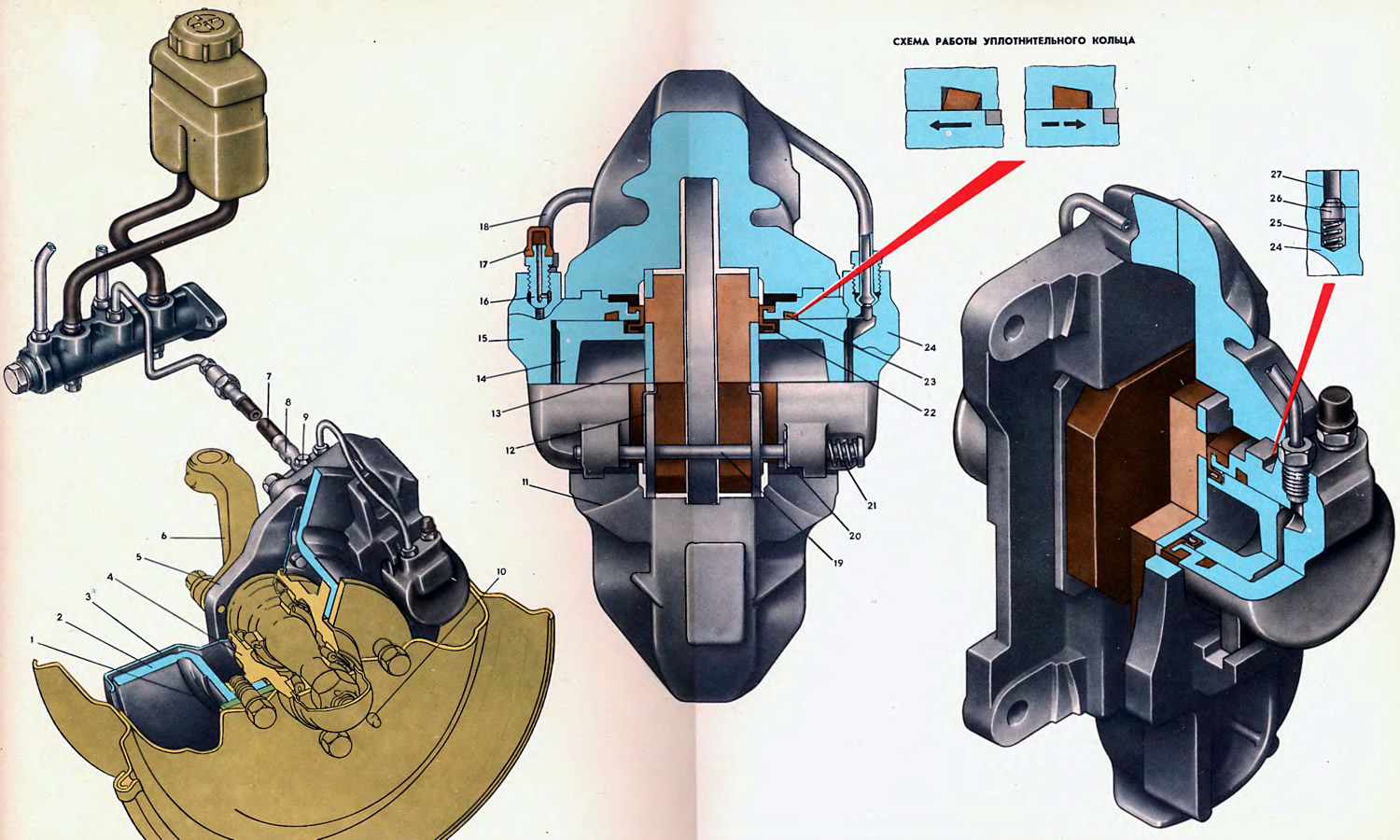
1. Disc pressure ring. 2. Brake disc. 3. Brake protective cover. 4. Wheel hub. 5. Caliper bracket. 6. Steering knuckle. 7. Flexible hose. 8. Guide bracket. 9. Flexible hose tip fastening nipple. 10. Guide pin. 11. Front brake caliper. 12. Brake shoe spring. 13. Brake shoe and lining assembly. 14. Piston. 15. Outer brake cylinder. 16. Brake bleed hose nipple. 17. Nipple protective cap. 18. Connecting tube. 19. Brake shoe pin. 20. Pin cotter pin. 21. Expansion spring. 22. Protective cuff. 23. Sealing ring. 24. Inner brake cylinder. 25. Lock spring. 26. Cylinder lock. 27. Caliper groove for lock.
The front brake mechanism is mounted on bracket 5 secured to steering knuckle 6 with four bolts, the 1 lugs of which are locked in pairs against self-unscrewing with lock washers. Simultaneously with the bracket, stamped steel protective casing 3 of the brake and the steering lever are secured to the steering knuckle with the same bolts. The tightening torque of the fastening nuts is 6 kgf·m. Caliper 11 of the front brake is secured to the ears of bracket 5 from its inner side with two hexagon-head screws. After tightening with a torque of 3.5 kgf·m, the screw heads are locked with lock washers, the petals of which are bent at the edge of the caliper and the screw head.
The support is a basic part for installing brake hydraulic cylinders and brake shoes and is a complex casting made of high-strength cast iron. A radius groove is made in the center of the support to cover the brake disk 2. On the side walls of the radius groove there are two transverse grooves for installing brake shoes 13, and in the lugs of the support walls there are two windows with guide grooves for brake cylinders 15. To increase resistance to corrosion, the outer surface of the support, as well as bracket 5, is cadmium-plated.
When installed in the caliper windows, the brake cylinders are locked by clamps 26, which are loosely seated in the cylinder sockets and in the working position rest against the walls of the groove 27, specially made in the caliper lug, using a spring 25. The clamps are intended only for the precise determination of the position of the cylinders relative to the calipers and for simplifying the installation and removal of these cylinders. The reactions of the supports, arising from the braking forces, act on the guide projections of the cylinders and are completely perceived by the guide grooves of the caliper windows.
Brake cylinders 15 and 24 are made of aluminum alloy. To increase corrosion resistance, the cylinder surface is subjected to chromium passivation.
The cylinder mirror is machined with high precision, necessary for reliable operation of the cylinder-piston pair. The cylinder mirror has an annular groove with a conical bottom and a beveled front wall for the rubber sealing ring 23. These design features of the groove are necessary for the operation of the ring 23, which seals the piston 14.
Inside the cylinders are placed steel pistons 14, the friction surfaces of which on the cylinder mirror are chromed and processed with high precision to increase wear resistance. The exit of the pistons from the cylinders is protected by rubber cuffs 22, the outer edges of which are thrown over the flanges of the cylinders, and the inner working edges embrace the landing flange of the pistons.
The central hole of the cylinder for piston 14 is made blind with a rear wall, in the lug of which two threaded holes are made:
- the inner cylinder has one hole for connecting flexible pipe 7, which supplies brake fluid from the main brake cylinder, the other is for tube 18, which connects the inner cylinder to the outer one;
- the outer cylinder has one hole for the fitting 16 of the brake bleeding hose, the other for the tube 18 connecting the outer cylinder to the inner one. Both holes have outlets into the cylinder cavity through inclined drillings in the rear wall.
Brake shoes 13 are inserted into the transverse grooves of the side walls of the caliper. They are a 5 mm thick steel plate with a friction lining glued to it. To increase the strength of the grip, four holes are made in the plate for the corresponding projections of the lining.
Two oval holes on the shoe eye are intended for fastening pins 19. Each pin 19 is installed in the holes of the lugs of the inner and outer brake cylinders and limits the radial movements of the brake shoes.
To eliminate vibrations during the movement of the car, spacer springs 21 are inserted under the heads of the pins, and shaped springs 12 are thrown over the ears of the brake shoes, pressing the brake shoes to the pins. In addition, springs 12 fix the position of the brake shoes in the non-working position and thereby eliminate unnecessary friction against the brake disc. The fastening pins are locked in the cylinder lugs with cotter pins 20.
Brake fluid is supplied to the inner brake cylinder via flexible hose 7. The end of hose 7 is installed in a certain position, most favorable for bending hose 7 during suspension vibrations, thanks to guide bracket 8, which simultaneously prevents self-unscrewing of nipple 9.
Brake fluid is supplied to the outer brake cylinder 15 through a steel connecting tube 18 from the inner brake cylinder.
A nipple 16 is screwed into the threaded hole of the outer brake cylinder boss, onto which a hose is put when bleeding the brakes. In the non-working position, nipple 16 is closed with a rubber cap 17.
The caliper 11, assembled and secured to the bracket 5, covers the brake disc 2, mounted on the wheel hub 4 and secured to it together with the pressure ring 1 by two guide pins 10.
When subsequently installing the wheel on the hub, the brake disc (together with wheels) additionally secured with four screws.
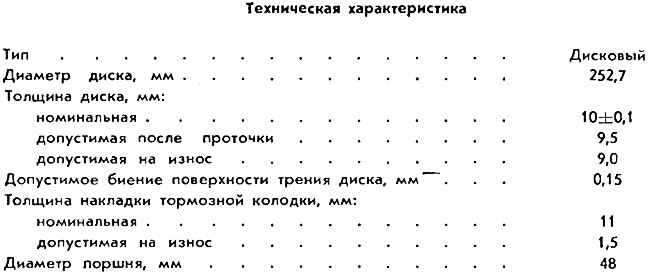
The brake disc is made of grey cast iron. The friction surfaces of the disc on the brake pads are processed with great precision, the permissible non-flatness and non-parallelism is 0.02 mm. Dents and porosity are not allowed on the friction surfaces of the disc, since surface defects will contribute to rapid wear of the brake shoe pads.
The material is posted on the website www.VAZbook.ru