




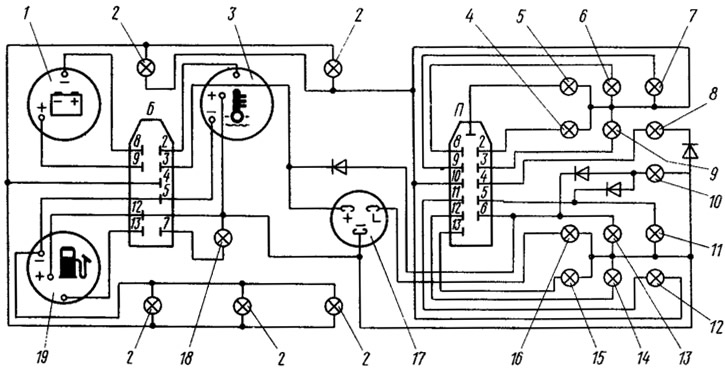
Figure 132. Instrument cluster wiring diagram (rear view):
1 - voltmeter; 2 - instrument lighting lamps; 3 - coolant temperature indicator; 4 - Rear window heating indicator lamp; 5 - high beam indicator lamp; 6 - Rear fog light indicator lamp; 7 - side light indicator lamp; 8 - direction indicator lamp; 9 - backup indicator lamp; 10 - "STOP" control lamp; 11 - Oil pressure indicator lamp; 12 - Hazard warning light; 13 - brake fluid level indicator lamp; 14 - carburetor air damper control lamp; 15 - Low battery indicator lamp; 16 - Parking brake system indicator lamp; 17 - socket for the relay-interrupter of the control lamp of the parking brake system; 18 - Fuel reserve indicator lamp; 19 - fuel level indicator.
In the connection blocks, the numbers indicate the conventional numbers of the plugs.
Instrument clusters can be of domestic production or manufactured in Hungary. They differ slightly in design, but have the same arrangement of instruments and the same connection dimensions.
The instrument cluster includes a speedometer, fuel gauge, coolant temperature gauge, voltmeter, economy meter and 12 indicator lights.
Speedometer
The speedometer consists of a pointer indicator of the vehicle's speed and two counters: a totalizer and a daily distance traveled counter. The latter counter can be reset using a handle located on the instrument panel or directly on the instrument cluster. The counter can only be reset when the vehicle is stationary. The speedometer's drive shaft is driven by a flexible shaft from a drive installed on the clutch housing. The speedometer operates by induction. A permanent magnet is installed on the speedometer's drive shaft, which, when rotating, induces eddy currents in a metal disk located on the same axis as the pointer. These currents create their own magnetic field, which interacts with the magnetic field of the permanent magnet. As a result, a moment is created that rotates the disk and the pointer by a certain angle, depending on the rotation frequency of the drive shaft.
The counters are driven by the drive shaft through three worm gears, giving a 1:1000 slowdown. The summing counter has six counting drums, and the daily counter has four. The drums have internal gear transmissions with intermediate wheels. The number of teeth is selected so that the gear ratio between adjacent drums is 1:10.
Fuel level indicator
The fuel gauge is a magnetoelectric type. It has a permanent magnet attached to the same axis as the pointer, which interacts with the magnetic field created by two coils located mutually perpendicularly. The electric circuit of the coils includes a sensor that changes its electrical resistance depending on the fuel level. As a result, the current strength in the windings of the coils of the gauge and the direction of the magnetic flux created by them change. Under the action of this magnetic flux, the permanent magnet connected to the pointer rotates and moves the pointer of the gauge.
(The text is on the website vazbook)
The indicator sensor is installed in the fuel tank. It has a wire resistor along which a contact controlled by a float slides. Depending on the fuel level, the float rises or falls and moves the movable contact of the resistor, changing the resistance of the sensor. The sensor also has contacts for switching on the fuel reserve control lamp installed in the indicator. These contacts close when 4...6.5 liters of fuel remain in the tank.
Coolant temperature gauge
The coolant temperature gauge is designed and operates in the same way as the fuel gauge, but has different coil winding data. It works in conjunction with a sensor mounted on the engine cylinder head. The sensor contains a thermistor that changes its electrical resistance depending on the temperature.
Voltmeter
The voltmeter is also of the magnetoelectric type and its operating principle is similar to the principle of the devices described above. When the ignition is on and the engine is not running, the voltmeter shows the voltage at the battery terminals, and when the engine is running, it shows the voltage generated by the generator. If, when the engine is running, the arrow is in the red zone at the beginning of the scale (8...10 V), this indicates a discharge of the battery due to weak tension of the generator drive belt or the generator itself. The red zone at the end of the scale corresponds to 15...16 V. If the arrow is in this zone, the generator voltage regulator is faulty. Intermediate position of the arrow (between the red zones) indicates that the generator is operating normally.
Econometer
An economizer is a vacuum gauge that measures the vacuum in the engine intake manifold. The vacuum value has a direct and inverse relationship with fuel consumption. The less the throttle valve is opened in the carburetor, the greater the vacuum in the intake manifold, and the lower the fuel consumption. At high engine loads, the throttle valves open more strongly, the vacuum drops (the economizer needle is in the yellow zone), and fuel consumption increases. Thus, the economizer helps the driver to maintain the most economical driving mode by selecting the gear in the gearbox and the crankshaft speed.
An econometer is a mechanical device. It has a thin sealed tube. Under the action of vacuum, it deforms and turns the arrow through a lever mechanism.