




- 1.3 l (vAZ-2108 and 2109 cars) — 2108-1107010;
- 1.1 l (vAZ-21081 car) — 21081-1107010;
- 1.5 l (vAZ-21083,21093 cars) — 21083-1107010.
All these carburetors differ from each other only in individual parameters of calibration data (see table 2).
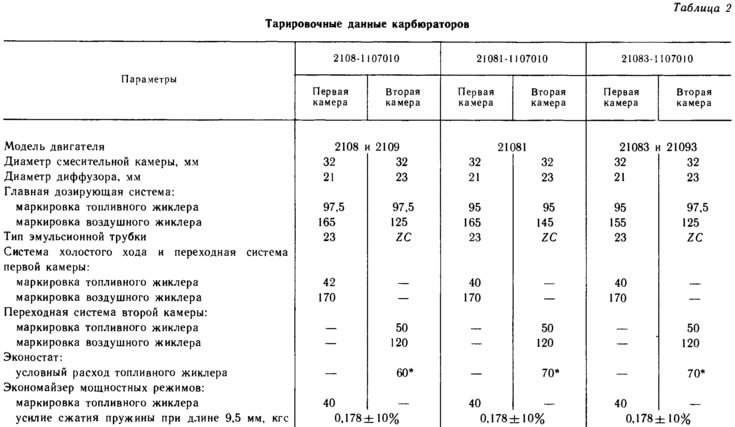
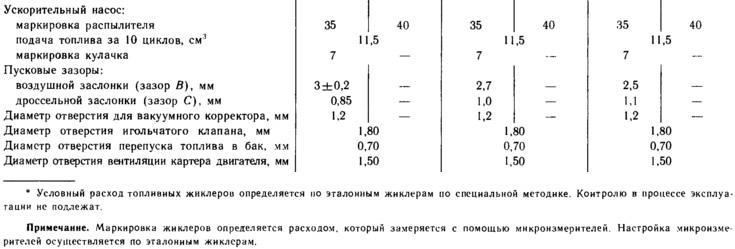
Carburetor (figure 45) — emulsion type, with a falling flow, two-chamber with sequential opening of the throttle valves. The carburetor has a balanced float chamber, heating of the throttle valve zone of the first chamber at the outlet of the emulsion from the idle system, blocking of the second chamber when the air valve is not fully open.
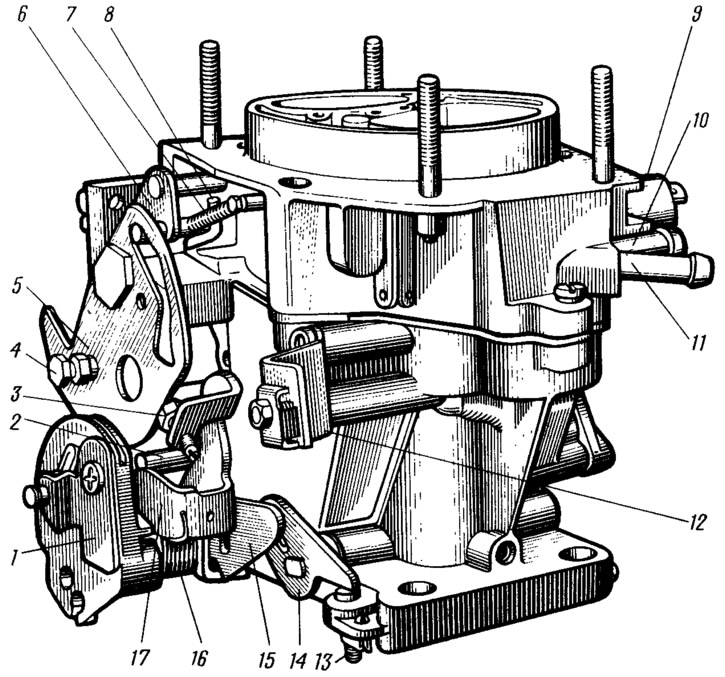
Figure 45. Carburetor 2108-1107010:
1 - throttle control sector with bracket; 2 - pin of the second chamber locking lever; 3 - adjusting screw for opening the throttle valve of the first chamber; 4 - air damper drive rod mounting screw; 5 - air damper control lever; 6 - air damper lever; 7 - air damper return spring; 8 - diaphragm rod of the starting device; 9 - electromagnetic shut-off valve; 10 - fuel supply pipe; 11 - branch pipe for draining part of the fuel into the fuel tank; 12 - bracket for fastening the air damper drive rod casing; 13 - adjusting screw of the second chamber; 14 - second chamber throttle lever; 15 - second chamber throttle actuator lever; 16 - return spring of the first chamber throttle valve; 17 - throttle control lever.
The carburetor has two main metering systems, a transition system and an idle system with an electromagnetic shut-off valve of the first chamber, a transition system of the second chamber, an economizer, a power mode economizer, a diaphragm accelerator pump, a diaphragm starting device. In addition, the electromagnetic shut-off valve and the limit switch of the idle mixture quantity adjusting screw, complete with an electronic control unit and the electrical wires connecting them, make up the forced idle economizer.
The carburetor is installed on the intake manifold with four studs and secured with nuts. A heat-insulating spacer and a heat shield are placed under the carburetor.
The float chamber is balanced using two 4 mm diameter holes connecting the float chamber to the air filter.
The carburetor is connected to a crankcase gas suction system, for which a branch pipe and a calibrated hole are provided, which goes into the throttle space of the first chamber. The hole with a diameter of 1.5 mm does not have a noticeable effect on the depletion of the combustible mixture with closed throttle valves in idle mode.
To heat the throttle valve area of the first chamber, a heating unit is attached to the carburetor body with a screw, through which the cooling system fluid passes. The heating unit, due to surface contact with the carburetor body, prevents icing of the emulsion outlet area and the throttle valve. In cases of icing, the car may jerk at low accelerations or the engine may stop when switching to idle.
The second chamber lock prevents the second chamber throttle valve from opening in any engine operating mode unless the air damper is fully open. This eliminates the second mixing chamber from operating when the engine is not warmed up. Lock lever with pin 2 (see figure 45) is mounted pivotally on the throttle control lever 17 (the locking lever is not visible in the picture). When the air damper is not completely closed, the air damper control lever 5 acts with its outer edge on the pin 2 and disengages the locking lever from engagement with the lever 15 of the second chamber throttle actuator. In this position, when the first chamber throttle valve is opened, the lever 15 will not turn and act on the lever 14 of the second chamber throttle valve, rigidly mounted on the valve axis.
When the air damper is fully open, lever 5 releases pin 2 and the locking lever will be pressed against lever 15 by the spring. In this case, the locking lever will be able to turn lever 15 by the protrusion when the throttle valve of the first chamber is opened by more than 2/3 of the value, and therefore, lever 14 and the throttle valve of the second chamber (sequential throttle opening). Full opening of the throttle valves will occur simultaneously.
The carburetor consists of two body parts: the body and the cover. The cover contains the inlet necks of the first and second chambers, wells for the passage of air to the main air jets and two channels for balancing the float chamber, connecting it with the cavity behind the filter element of the air filter. An air damper is installed in the neck of the first chamber. Lever 6 (see figure 45) the damper has two pins, one of which is connected to the spring that closes the damper. The second pin enters the groove of the lever 5 of the air damper control. The groove has a certain profile. The lever 5 is mounted hingedly on the carburetor cover and is connected by a rod to the handle in the car interior.
The diaphragm starter housing with an adjusting screw, diaphragm and rod 8 is attached to the carburetor cover. An electromagnetic shut-off valve 9 is installed on the carburetor cover. The cover contains channels and jets for idle running, transition systems and an economizer.
The cover contains a fuel supply needle valve, a float, a fuel filter, a fuel supply pipe 10 and a fuel drain pipe 11 into the tank. Pipe 11 has a calibrated hole with a diameter of 0.70 mm. The float chamber with a constant level covers the mixing chambers on both sides, due to which the carburetor can withstand significant tilts without ceasing normal operation. The fuel level fluctuates around a fixed point, in the area of which the emulsion wells of the main metering systems are located. Fuel is taken from the float chamber below this point. In connection with this shape of the chamber and the need to withstand significant tilts of the carburetor, the float is made double with one bracket having a tongue that ensures contact with the ball of the needle valve damper.
A sealing gasket is installed between the cover and the carburetor body.
Large diffusers are cast together with the carburetor body, and small diffusers are inserted into it, cast together with the sprayers of the main metering systems. The body contains channels for these systems, the idle system, transition systems, the power mode economizer and the accelerating pump. The accelerating pump sprayers with a ball valve for fuel supply, the main fuel jets and the main air jets with emulsion tubes are installed in the body.
The cover with the drive lever and the working diaphragm of the accelerator pump are attached to the lug of the carburetor body, which forms the working cavity of the accelerator pump, with four screws. The pump is driven by a cam on the axis of the throttle valve of the first chamber. The cover of the power mode economizer with a diaphragm and a ball valve is also attached to the body.
The throttle valves of the first and second mixing chambers of the carburetor are installed in the housing. The valves are fastened with screws on the axles; the screws are ribbed to prevent them from loosening. Levers 17 and 15 for controlling the throttle valves with the Y control sector are installed on the axle of the throttle valve of the first chamber. Lever 14 is installed on the axle of the throttle valve of the second chamber; it is driven by lever 15 of the drive.
The throttle control lever 17 has an adjusting screw 3 for opening the throttle valve of the first chamber. When the lever 5 is turned, the air damper is closed, while the adjusting screw 3 opens the throttle valve of the first chamber. The carburetor body also has adjusting screws for the quantity and quality of the idle mixture. The holes in the adjusting screw for the quality of the mixture are closed with a plastic plug.