




Place the car on a lift or inspection pit and disconnect the wire from the negative terminal of the battery. Raise the car, remove the engine splash guard and drain the coolant from the radiator and cylinder block by opening the heater valve and unscrewing the drain plugs on the radiator and cylinder block (just two plugs).
Disconnect the exhaust pipe 3 (see figure 20) from the exhaust manifold, unscrewing the nuts that secure it and the bolts that secure bracket 1 to the cylinder block. Remove bracket 2 (see figure 35) the coolant pump supply pipe by unscrewing the nuts securing it to the pipe and the flange of the exhaust manifold.
Lower the car, remove the air filter, disconnect the crankcase ventilation system hoses from the cylinder head cover and from the carburetor and disconnect the warm air supply hose from the warm air intake. Close the carburetor with a technological plug.
Disconnect the wires from the spark plugs and the ignition distributor, from the oil pressure warning lamp and coolant temperature gauge sensors, from the limit switch and the carburetor electromagnetic valve. Remove the ignition distributor with the high-voltage wire mounting bracket, disconnecting the vacuum hose from the carburetor and the distributor.
Disconnect the fuel supply hose from the fuel pump and the fuel drain hose from the carburetor. Disconnect the vacuum take-off hoses to the economizer and brake booster from the intake manifold. Disconnect the outlet pipe 3 (see figure 33) the engine cooling jacket disconnects the hoses leading to the radiator, thermostat and heater.
Disconnect the throttle and air valve drive cables from the engine. Remove the front toothed belt cover and the cylinder head cover.
Set the gearshift lever to neutral and turn the crankshaft clockwise to a position where the mark on the flywheel (see figure 52), visible in the clutch housing hatch, was opposite the middle division of the scale. At the same time, the mark on the camshaft pulley (see figure 6) must be located opposite the installation mark on the rear cover of the timing belt.
Loosen the axle mounting nut 7 (see figure 25) tension roller 6 and remove the axle together with the roller and spacer ring 5. Then remove the belt from the camshaft pulley.
Holding the camshaft pulley from turning with device 67.7811.9509 or some lever with grips on the pulley holes, unscrew the mounting bolt and remove pulley 4 with the key.
Loosen the nut that secures the rear timing belt cover to the cylinder head. Loosen the mounting bolts and remove the cylinder head with the gasket.
Install the cylinder head in the reverse order, following the recommendations set out in section. "Engine assembly". The gasket between the head and the cylinder block cannot be reused, so it is replaced with a new one.
If the cylinder head mounting bolts have stretched out (length exceeds 135.5 mm), then I replace them! with new ones. The bolts are tightened in a certain sequence (figure 18, a). To ensure a reliable seal and to avoid tightening the bolts during vehicle maintenance, the cylinder head mounting bolts are tightened in four stages:
- 1st technique - with a torque of 2 kgf·m;
- 2nd technique - with a torque of 7.1-8.7 kgf·m;
- step 3: Tighten the bolts by 90°;
- step 4: Turn all the bolts 90° again.
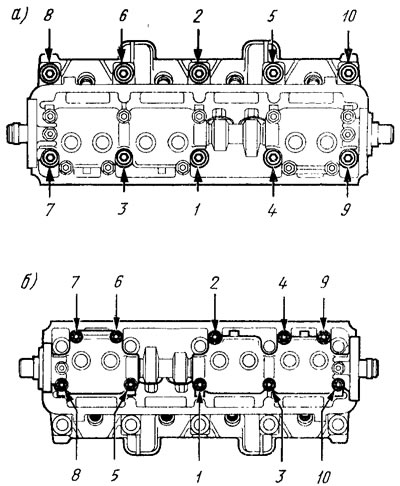
Figure 18. Tightening order of cylinder head mounting bolts (a) and camshaft bearing housing mounting nuts (b)
Install new nuts for fastening the exhaust pipe. Old nuts are not allowed to be used.
After installing the cylinder head, check and adjust the valve clearance, camshaft drive belt tension, carburetor drive and ignition timing.