




The car body (Fig. 52) is closed and load-bearing. The body is made of all-metal and is the main load-bearing element of the car. The engine, transmission and suspension elements are attached to the base of the body. The body does not have a rigid spatial frame. In order for the body to have a certain rigidity, its individual parts are made of the appropriate shape and cross-section. The car body has three doors: two front and one rear.
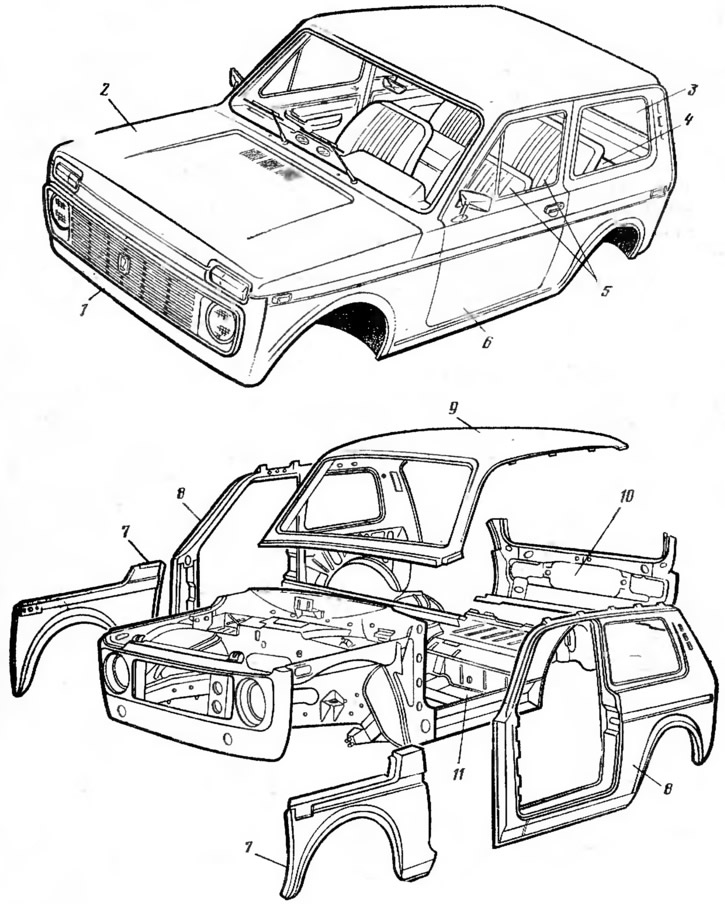
Fig. 52. Car body:
1 - body; 2 - engine hood; 3 - back door; 4 - luggage compartment; 5 - seats; 6 - front door; 7 - front wing; 8 - sidewall; 9 - roof; 10 - the hall is part of the building; 11 - base.
The body has a one-piece steel frame 1, to which the engine hood 2, front 6 and rear 3 doors and decorative trim parts are attached (radiator grille, front and rear bumpers, decorative trims, etc.) Inside the body there are 5 seats for passengers and the driver and there is a luggage compartment 4.
Body shell is a rigid welded structure; consisting of separate pre-assembled units: base 11 (floor) with the front part of the body, left and right sidewalls 8 with rear wings, roof 9, rear part of the body 10 and front of the wings 7.
The base 11 of the body consists of the front and rear panels. It is reinforced with side members and cross members. The front and rear parts of the body are connected to the base. The front part includes the front shield, panels, mudguards, the rear part - panels and mudguards. The sides 8 of the body are one-piece stamped. They have openings for doors and windows. The roof 9 of the body is also one-piece stamped. It is made together with the opening for the windshield. Soundproofing of the body is provided by applying anti-noise mastic and bitumen sheet gaskets with high noise-absorbing properties to the surface of the base. The entire front part of the passenger compartment and the floor of the body is covered with textile-bitumen gaskets with high sound-absorbing properties. For thermal and noise insulation of the roof, its inner surface is covered with gaskets made of super-thin fiberglass reinforced with resins.
Body door (front, back) consists of external and internal stamped panels connected to each other.
The front door is suspended in the body opening on hinges. In the closed position, it is held by a special lock, which prevents the door from opening arbitrarily while driving. The door has a limiter, which limits the opening angle of the door and ensures its fixation in the open position. The front door window consists of two parts made of safe tempered glass, which breaks into small pieces when broken. The larger part of the window is a sliding glass, and the smaller part is a pivot glass. The sliding glass moves in special guides with the help of a window lifter, which is installed inside the door. The window lifter is a gear mechanism with a cable drive, providing for raising, lowering and fixing the glass in any position. The front door has an external handle that does not protrude from the outer door panel, which reduces the likelihood of pedestrian injuries in road accidents.
The rear door opens upward and is held open by special gas-filled stops. The door has a window consisting of one fixed safety glass. The door is equipped with a lock that holds it closed.
Windshield and side windows are installed in the body openings together with rubber seals and special decorative edging.
The windshield is curved, panoramic, triplex type, consists of two thin polished glasses glued together with a transparent elastic film between them. Such glass does not lose transparency, does not break into small fragments upon impact and is safer than tempered glass.
The side windows are flat and made of safety tempered glass.
Hood closes the engine compartment located at the front of the car body from above. The hood consists of an outer panel and internal reinforcements connected to each other. It is attached to the body with two hinges. The hood opens forward and is fixed in the open position by a special limiter. The hood is equipped with a lock that holds it in the closed position. The lock is unlocked from inside the body with a special handle installed under the instrument panel and connected to the lock by a cable drive.
Seats (Fig. 53) are installed in two rows in the car body.
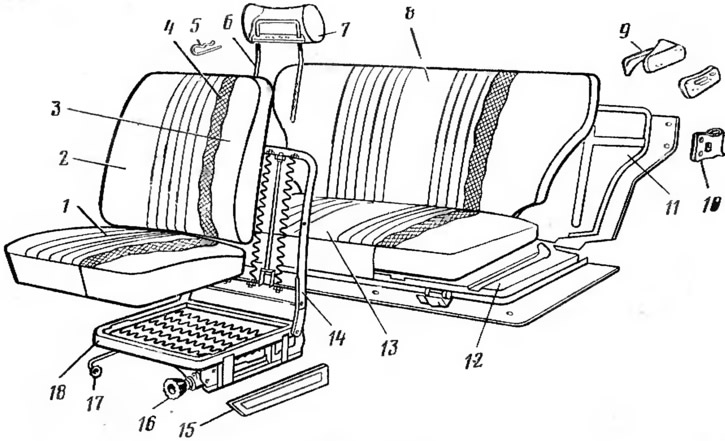
Fig. 53. Seats:
1 - cushion, front seat; 2 - back of the front seat; 3 - stuffing; 4 - upholstery lining; 5 - headrest lock; 6 - headrest frame; 7 - headrest; 8 - back of the rear seat; 9 - rear seat backrest lock; 10 - rear seat back bracket; 11 - base of the rear seat back; 12 - rear seat cushion base; 13 - rear seat cushion; 14 - front seat back frame; 15 - Front seat trim; 16 - backrest tilt mechanism handle; 17 - seat movement mechanism handle; 18 - front seat cushion frame.
The front seat is separate and consists of two separate chair-type seats with headrests. For the convenience of the driver and passenger, each seat is adjustable in the longitudinal direction and by the angle of the backrest. Moreover, each seat is adjusted independently of each other.
The seat is mounted on special skids, along which it can move to the desired position by turning the handle 17 of the movement mechanism. The spring metal frames 14 of the backrest and 18 of the seat cushion have a hinged connection, which allows changing the tilt of the backrest up to a horizontal position. Changing the tilt of the seat back is carried out by turning the handle 16 of the tilt mechanism. The position of the headrest 7 of the seat is also adjustable, but only in height.
The seat cushion 1 and backrest 2 have padding 3, upholstery lining 4 and special decorative upholstery. The front seat can be folded forward to provide free passage to the rear seat.
The rear seat is a three-seater, sofa-type seat. It is made of solid material. The seat has metal bases 11 of the backrest and 12 of the cushion. The design of the cushion 13 and the backrest 8 of the rear seat is the same as that of the front seat. To increase the area of the luggage compartment, the rear seat can be folded if necessary.
Seat belts are used in a car to protect the driver and passengers from serious injuries and death when the car hits fixed obstacles and when it collides with other cars and vehicles. The belts are attached inside the car body.
The front passenger and driver's seat belts are of the diagonal-lap type. They consist of two belts: a diagonal belt that goes around the person's chest, and a lap belt. Each belt consists of a strap, a belt length adjuster, and a tongue that is inserted into the buckle. The belts are adjusted in length depending on the build of the passengers and the driver.
Seat belts can be installed in the car for rear passengers as well. Moreover, only a lap belt is installed for the middle passenger. The rear seat belts have the same design as the front belts. They can also be adjusted in length depending on the build of the passengers.
Ventilation and heating. The body ventilation and heating system is designed to regulate air exchange and air temperature in the car body. It also protects the body windshield from fogging and freezing.
The ventilation and heating system includes a liquid-type heater with additional devices (Fig. 54), which is located in the front part of the car's interior under the instrument panel.
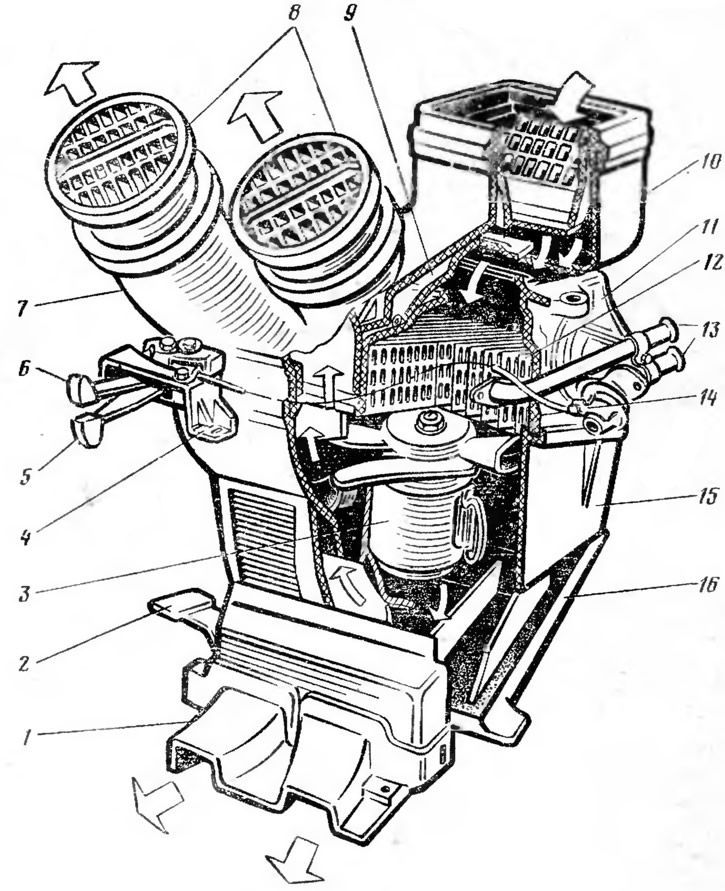
Fig. 54. Interior heater:
1 - internal ventilation air duct; 2 - air distribution cover lever; 3 - electric fan; 4 - bracket; 5 - air intake cover control lever; 6 - heater valve control lever; 7 - air duct for deflectors; 8 - deflectors; 9 - air intake cover; 10 - air intake box; 11 - radiator casing; 12 - radiator; 13 - pipelines; 14 - crane; 15 - fan casing; 16 - air distribution cover.
The heater consists of a radiator 12, to which coolant is supplied from the engine cooling system. Air enters the radiator through the air intake box 10, into which it enters from the outside through longitudinal openings located in the rear part of the engine hood. The air intake cover 9 allows you to regulate the amount of air entering the passenger compartment through the heater. At low vehicle speeds and when parked, when the air velocity pressure is insufficient or absent, fresh air is forced in by the electric fan 3.
The temperature of the air entering the passenger compartment is regulated by the amount of liquid supplied to the heater radiator, which is connected in parallel to the engine cooling system. Such a connection of the radiator to the cooling system allows the heater to be used regardless of the engine's thermal state. The amount of liquid supplied to the heater radiator is regulated by the opening value of valve 14.
The air entering the passenger compartment through the heater is directed to the deflectors 8 and to the air duct 1. The air distribution cover 16 allows you to regulate the amount of air directed to the deflectors and the air duct. When the cover is closed, all the air enters the passenger compartment through the deflectors 5, and when the cover is open, most of it is directed through the air duct 1 to the lower front part of the passenger compartment to the feet of the driver and front passenger and from there to the foot area of the rear passengers.
The deflectors have rotating covers with guide grilles, which allows you to adjust the direction of the outgoing air flow. When the cover 16 is closed, intensive blowing of the inner surface of the body windshield is achieved, protecting the glass from fogging and freezing.