




The steering wheel in the car is located on the left in the direction of travel, which provides better visibility when passing oncoming traffic. Injury safety is ensured by the design of the intermediate steering shaft and a special fastening of the steering shaft to the car body.
The steering system (Fig. 42) consists of a steering mechanism and a steering drive.
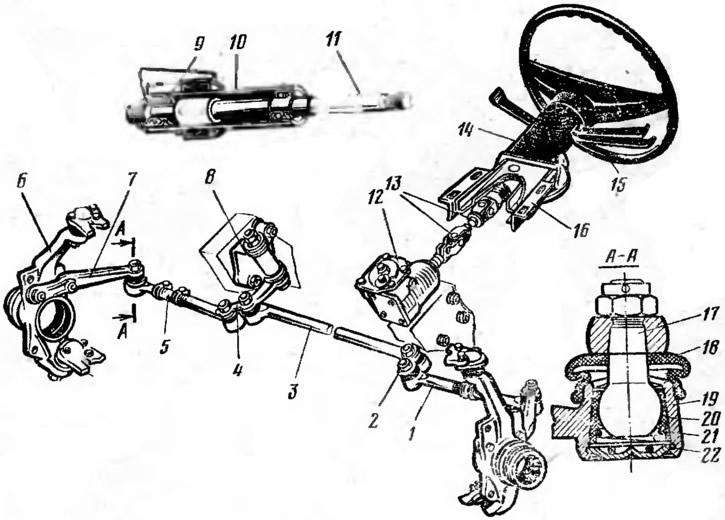
Fig. 42. Steering:
1 - side pull; 2 - steering knuckle; 3 - medium thrust; 4 - pendulum lever; 5 - adjusting coupling; 6 - steering knuckle; 7 - turnbuckle lever; 8 - pendulum arm bracket; 9 - bearing; 10 - steering shaft bracket pipe; 11 - steering rod; 12 - steering gear housing; 13 - intermediate steering shaft; 14 - steering column; 15 - steering wheel; 16 - bracket; 17 - ball pin; 18 - rubber cover; 19 - traction rod end; 20 - insert; 21 - spring; 22 - plug.
Steering gear increases the driver's effort and transmits it to the steering gear.
The car uses a worm gear steering mechanism.
The steering mechanism includes: steering wheel 15, steering shaft 11, intermediate shaft 13 and steering pair (worm and roller).
Steering wheel two-spoke, plastic, with a steel frame. It is fixed on the splines of the upper end of the steering shaft 11, which is installed in the pipe 10 of the bracket 16 in two ball bearings 9. The steering shaft with the steering column 14 is attached to the car body using the bracket 16.
The bracket is fastened to the body so that in case of accidents the steering shaft 11 with the steering wheel moves slightly towards the driver, which ensures his safety. The lower end of the steering shaft is connected via splines to the intermediate shaft 13, which is a cardan shaft with two hinges. The intermediate shaft is also connected via splines to shaft 12 (Fig. 43) of worm 11. The worm is installed in housing 4 in two ball bearings 14, the tightening of which is adjusted using gaskets 15 installed under cover 16. The worm is in engagement with roller 6, which is installed in a groove in the head of shaft 5 of the steering knuckle on axis 17 on needle bearings 18. The shaft of the steering knuckle is installed in housing 4 in bronze bushings 3. The engagement of the worm and roller is adjusted using adjusting screw 7, the head of which enters the groove in shaft 5 of the steering knuckle. The adjusting screw is screwed into cover 10 and locked with nut 8. Steering knuckle 1 is installed on the splined end of shaft 5.
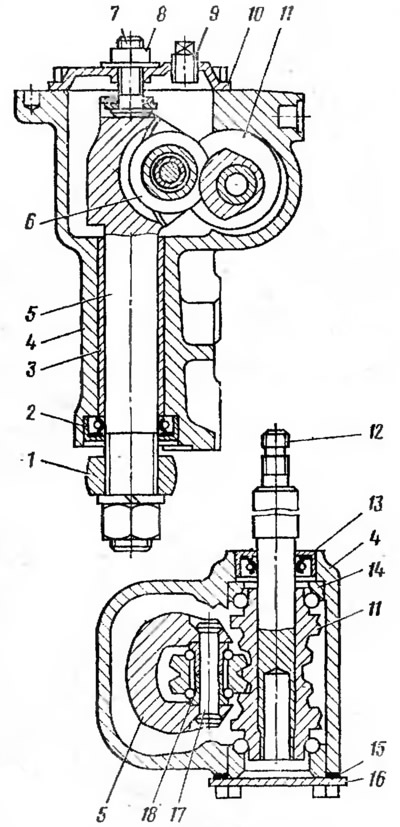
Fig. 43. Steering mechanism:
1 - steering knuckle; 2, 13 - oil seals; 3 - bushing; 4 - crankcase; 5 - steering knuckle shaft; 6 - roller; 7 - adjusting screw; 8 - nut; 9 - filler plug; 10 - lid; 11 - worm; 12 - worm shaft; 14 - bearing; 15 - adjusting shims; 16 - bottom cover; 17 - roller axis; 18 - needle bearing.
Steering drive transmits force from the steering mechanism to the steered wheels. The steering gear ensures the correct turn of the vehicle's steered wheels.
Steering drive (see fig. 42) includes: steering knuckle 2, pendulum arm 4, lateral 1 and middle 3 rods with hinges and levers 7 of steering knuckles. The car uses a steering drive with a split steering trapezoid. The steering trapezoid ensures the rotation of the steered wheels of the car at different angles (the inner wheel is at a greater angle than the outer one). It is located behind the front wheel axle. The steering trapezoid consists of three transverse rods and levers 7, pivotally connected to each other. The middle rod 3 of the steering trapezoid is made solid. One end of it is connected to the steering knuckle 2, and the other to the pendulum lever 4, which is fixedly secured to the axle installed in two plastic bushings in the bracket 10, fixed to the car body. The side rod 1 consists of two tips connected to each other by an adjusting coupling 5, fixed to the tips with clamps. This allows changing the length of the side rods of the steering trapezoid when adjusting the toe-in of the front steered wheels of the car. The connection of the middle rod and the side rods of the steering trapezoid with the pitman arm and the pendulum lever, as well as the side rods with the levers 7 of the steering knuckles, is made using ball joints, which provide the possibility of relative movement of the steering gear parts in the horizontal and vertical planes with simultaneous reliable transmission of forces between them. The ball joints are located in the tips 19 of the steering rods. The pin 17 rests with its spherical head on a conical plastic insert 20, which is pressed by a spring 21, eliminating the gap in the joint when worn. The ball joint is closed at one end with a plug, and protected at the other by a rubber cover. The pin of the joint with its conical part is rigidly attached to the part of the steering gear to which the steering rod is attached.
Stabilization of steering wheels. The forces acting on the vehicle tend to deflect the steered wheels from the position corresponding to straight-line movement. In order to prevent the wheels from turning under the action of disturbing forces (shocks from hitting uneven road surfaces, gusts of wind, etc.), the steered wheels must have adequate stabilization. The better it is, the better the control of the car, the higher the traffic safety, less wear on the tires and steering.
On a car, stabilization of the steered wheels is ensured by the inclination of their axis of rotation in the transverse and longitudinal planes and the elastic properties of the pneumatic tire.
Transverse tilt of the pivot axis (fig. 44, a), characterized by an angle β, when the wheel turns it causes the front of the car to rise to a certain height h. In this case, the mass of the front of the car tends to return the wheel to a position corresponding to rectilinear motion.
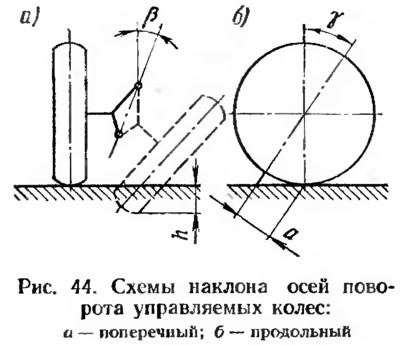
Longitudinal tilt of the pivot axis (fig. 44, b), defined by the angle γ, creates a shoulder a, on which the reactions that occur when the wheel turns between the tire and the road at their points of contact act. These reactions help return the wheel to the neutral position.
For the Niva VAZ-2121 car, the tilt of the steering axis of the steering wheels is: transverse β = 3°30'±30', longitudinal γ = 6°10'±30'. The transverse tilt of the steering axis on the car is adjusted using adjusting washers 39 (see fig. 37), installed between the axle 38 of the upper arms and the bracket 2 of the front suspension crossmember. The longitudinal tilt of the pivot axis is adjusted by washers 44 (see fig. 37), which are installed on the axis 46 of the lower arm 1 of the front suspension.