




The vehicle suspension (Fig. 36) consists of three devices: guide 1, elastic 2 and damping 3.
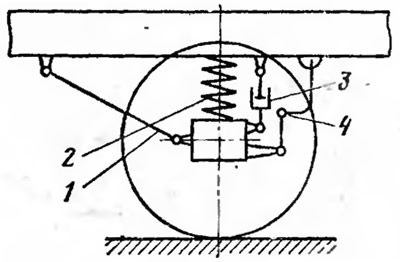
Fig. 36. Schematic diagram of the vehicle suspension:
1, 2, 3 - guide, elastic and damping devices; 4 - anti-roll bar.
Guiding device the suspension determines the nature of the wheel's movement relative to the car body and the road. The guide device transmits longitudinal and transverse forces and their moments between the wheel and the car body.
Elastic device the suspension softens the shocks and impacts transmitted from the wheel to the car body when driving over uneven road surfaces. The elastic device improves the smoothness of the car's ride, i.e. it creates the possibility of movement without unpleasant sensations and rapid fatigue of people and damage to the transported goods.
[The original source is located on the website vazbook.ru]
Extinguishing device suspension reduces vibrations of the car body and wheels that occur when driving on uneven roads. The damping device converts mechanical vibration energy into thermal energy with its subsequent dissipation into the environment.
In the front suspension of the car, in addition to the elastic, guiding and damping device, there is also an additional device - a stabilizer of transverse stability. The stabilizer reduces lateral roll and transverse angular vibrations of the car body.
Front suspension
The front suspension of the car is independent, lever-spring, with hydraulic shock absorbers and anti-roll bar.
The front wheels of the car are suspended independently of each other, have no direct connection with each other, move in a transverse plane, and the movement of one wheel does not cause the movement of the other wheel.
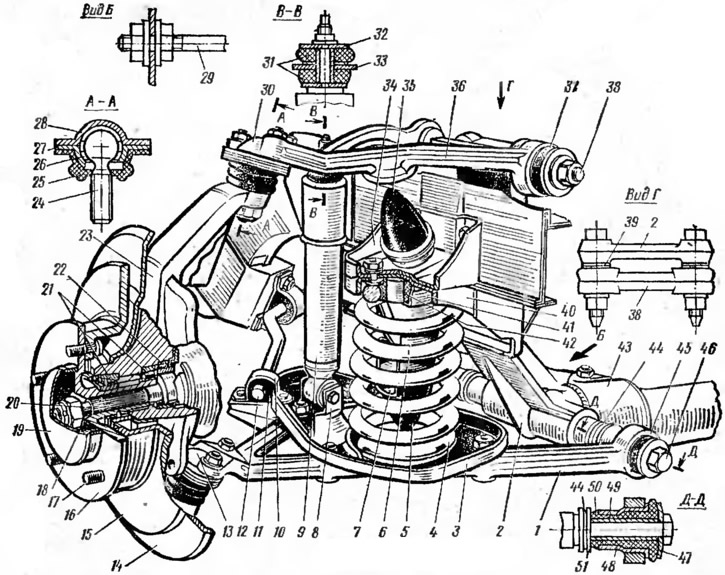
Fig. 37. Front suspension:
1 - lower arm; 2 - crossbar bracket; 3 - lower spring support cup; 4 - spring; 5 - compression buffer; 6 - compression buffer support; 7 - emphasis; 8 - lower shock absorber bracket; 9 - shock absorber 10 - stabilizer support clip; 11 - rubber stabilizer support; 12 - rod stabilizer to jam; 13 - lower ball joint; 14 - brake shield; 15 - brake disc; 16 - wheel hub; 17 - wheel and brake disc mounting stud; 18 - conical bushing; 19 - decorative cap; 20 - outer joint shank of the wheel drive; 21 - wheel hub bearings; 22 - oil seal; 23 - steering knuckle; 24 - ball joint pin; 25 - protective cover; 26 - bearing; 27 - clip; 28 - case; 29 - stretching; 30 - upper ball joint; 31 - shock absorber rubber cushion; 32 - pillow cup; 33 - Upper shock absorber bracket; 34 - recoil buffer bracket; 35 - recoil buffer; 36 - upper arm; 37 - rubber-metal hinge of the upper arm; 38 - Upper arm axle: 39, 44 - Adjusting washers: 40 - Upper spring support; 41 - upper spring support cup; 42 - spring gasket; 43 - Front suspension crossmember; 45 - rubber-metal hinge of the lower arm; 46 - lower arm axle; 47, 51 - thrust washers; 48 - outer sleeve; 49 - inner bushing: 50 - rubber bushing.
The guide device of the front suspension (Fig. 37) are levers 1 and 36, the elastic device is coiled cylindrical springs 4, the damping device is telescopic hydraulic shock absorbers 9, and the anti-roll bar is elastic rod 12. The front suspension is mounted on crossmember 43, attached to the car body. Between the crossmember and the body, stretchers 29 are installed, which, when the car is moving, absorb longitudinal forces and their moments transmitted from the front wheels to the crossmember. The upper 36 and lower 1 suspension arms are installed transversely to the car and have longitudinal rolling axes. Axle 46 of the lower arm is attached to tubular crossmember 43, and axis 38 of the upper arm is attached to bracket 2 of the crossmember. The inner ends of the upper and lower arms are connected to the axles with rubber-metal hinges. The upper 37 and lower 45 rubber-metal hinges have the same design and differ only in their dimensions. The use of rubber-metal hinges ensures silent operation of the suspension and eliminates the need for lubrication of the hinges. The outer ends of the upper and lower suspension arms are connected to the steering knuckle 23 by ball joints 30 and 13. The ball joints are made non-separable, have the same design, are interchangeable and do not require lubrication during operation. The suspension spring 4 is installed between the lower support cup 3 attached to the lower arm and the upper support cup 41 connected to the support 40, which is connected to the suspension crossmember. Vibration and noise insulating gaskets 42 are installed between the ends of the spring and the support cups. The shock absorber 9 is attached with its lower end to the bracket 8 of the support cup 3 using a rubber-metal hinge. The upper end of the shock absorber is attached to bracket 33 through rubber cushions 31. The upward travel of the wheel is limited by a 5% compression buffer which is fixed to support 6 installed inside the suspension spring. Under static load, buffer 5 touches the lower support cup 3 of the spring, which ensures its constant operation. Stop 7 limits the compression of buffer 5. The downward travel of the wheel is limited by recoil buffer 35, which is installed in bracket 34, connected to crossbar 43 and support 40. When the wheel moves downwards, buffer 35 rests against a special support pad of upper arm 36. The anti-roll bar is an elastic torsion-type device installed transversely to the vehicle. Stabilizer rod 12 is U-shaped, circular in cross-section. It is made of spring steel. The middle part of the stabilizer rod and its ends are fastened in rubber supports 11 by collars 10 respectively to the car body and brackets of the support cups 3 of the lower suspension arms. During lateral rolls and transverse angular oscillations of the body, the ends of the stabilizer rod move in different directions: one end is lowered, and the other is raised. As a result, the middle part of the stabilizer rod is twisted, thereby reducing the roll and transverse rocking of the car body. Creating resistance to roll and transverse oscillations of the body, the stabilizer at the same time does not interfere with its vertical and longitudinal angular oscillations.
With such vibrations, the stabilizer rod rotates freely in its supports.
Rear suspension
The rear suspension is dependent, spring, with hydraulic shock absorbers. The rear wheels of the car are connected to each other by the rear axle beam, as a result of which the movement of one of the wheels in the transverse plane is transmitted to the other wheel. The guiding device of the rear suspension (Fig. 38) is the longitudinal 3, 17 and transverse 24 rods, the elastic device is the coiled cylindrical springs 9, and the damping device is the telescopic hydraulic shock absorbers 25.
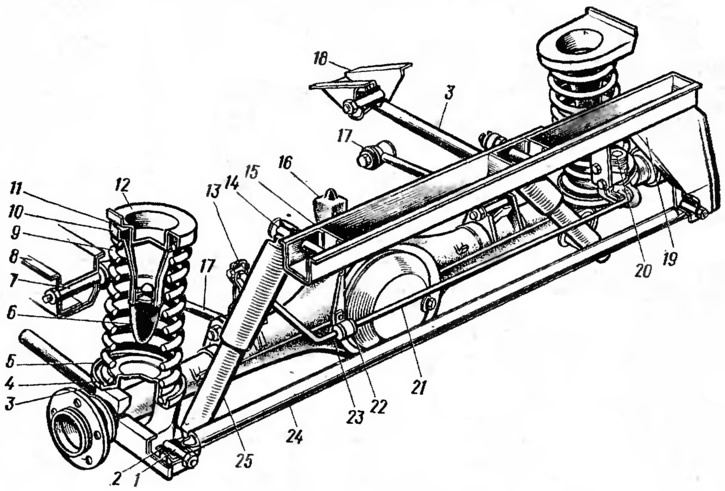
Fig. 38. Rear suspension:
1 - spacer sleeve; 2 - rubber bushing; 3, 17 - lower and upper longitudinal bars; 4, 11 - spring gaskets; 5 - lower spring support cup; 6 - compression buffer; 7 - finger of the upper longitudinal bar; 8 - Upper longitudinal rod bracket; 9 - spring; 10 - spring cup; 12 - upper spring support cup; 13 - brake pressure regulator lever rod; 14 - shock absorber finger; 15 - body cross member; 16 - additional buffer; 18 - lower longitudinal rod bracket; 19 - crossbar bracket; 20 - brake pressure regulator; 20 - regulator lever; 22 - clip; 23 - bushing; 24 - crossbar; 25 - shock absorber.
The rear axle is connected to the car body by means of four longitudinal 3 and 17 and one transverse 24 rods. Rods 3 and 24 are steel, tubular, and rods 17 are solid. The ends of all the rods, except for the front ends of the upper longitudinal rods 17, are secured in brackets on the car body and the rear axle beam. The front ends of the rods 17 are cantilevered on the pins 7. Rubber-metal hinges are used to secure all the rods. The rubber-metal hinges ensure silent operation of the rear suspension and do not require lubrication. The suspension springs 9 are installed between the lower support cups 5 welded to the rear axle beam and the upper support cups 12 connected to the car body. Between the ends of the springs and the support cups, vibration- and noise-insulating pads 4 and 11 are installed. The upper ends of the shock absorbers 25 are cantilevered on pins 14 to the car body, and the lower ends are attached to the rear axle beam. Rubber-metal hinges are used to attach the shock absorbers.
The upward travel of the wheels is limited by compression buffers 6, which are fixed on supports installed inside the suspension springs. Additional buffer 16 limits the travel of the front part of the rear axle housing during the upward travel of the wheels. The downward travel of the wheels is limited by shock absorbers, which reduce the movement of the rear axle during its downward movement.
Shock absorbers
Shock absorbers are designed to dampen vibrations of the car body and wheels. Hydraulic shock absorbers, as a result of the resistance they create, (fluid friction) convert the mechanical energy of the body and wheel vibrations into thermal energy, which is dissipated into the environment. The front and rear suspensions of the car are equipped with double-acting telescopic hydraulic shock absorbers, which dampen the vibrations of the car body and wheels during both compression and recoil strokes.
The front and rear shock absorbers have the same design and differ only in length and mounting method.
The shock absorber (Fig. 39) consists of three main units: cylinder 12 with bottom 2, piston 10 with rod 13 and guide bushing 21 with seals. In the shock absorber piston there are two rows of through holes located along the circumference. The holes of the outer row are closed from above by a bypass valve 24, which is under the influence of a weak plate spring 23, and the holes of the inner row are closed from below by a return valve 29 with a strong spring 9. In the bottom of the shock absorber cylinder there is a compression valve, the collar 6 and plate 7 of which have a row of through holes. Cylinder 12 is filled with shock absorber fluid, the leakage of which is prevented by seal 18, pressed by nut 15, which is screwed into reservoir 11. The cavity of the shock absorber, enclosed between cylinder 12 and reservoir 11, is a chamber, which serves to compensate for the change in the volume of fluid in the cylinder on both sides of the piston, arising due to the movement of rod 13.
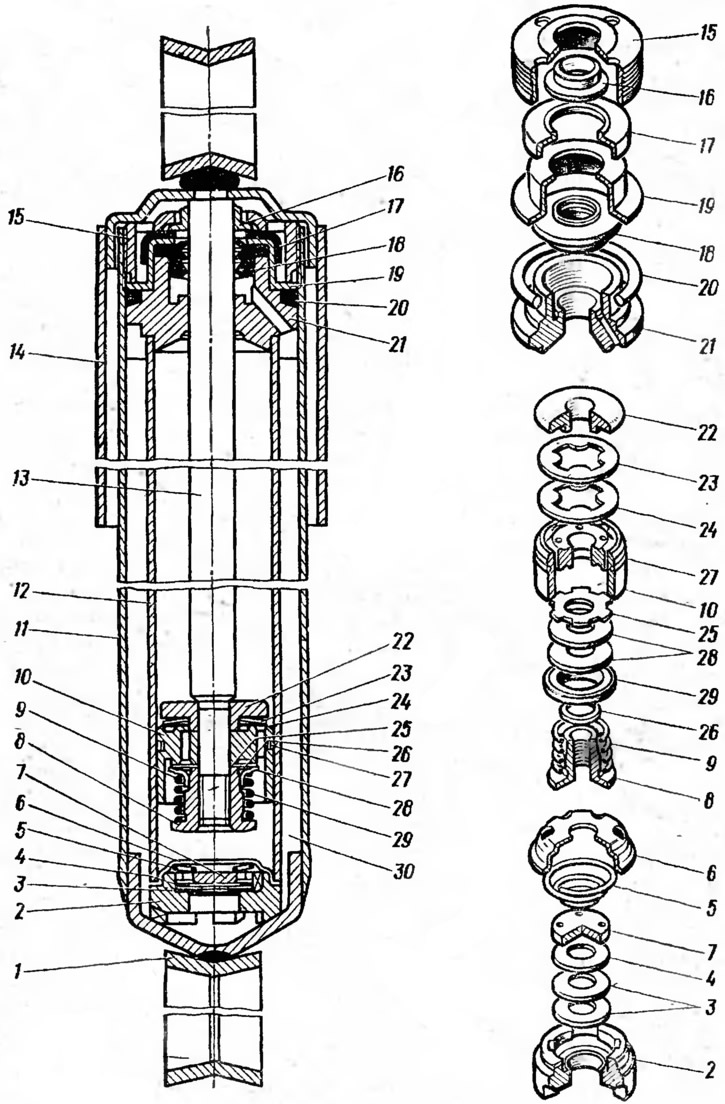
Fig. 39. Shock absorber:
1 - eye; 2 - bottom; 3 - compression valve discs; 4 - compression valve throttle disc; 5 - compression valve spring, 6 - compression valve cage; 7 - compression valve plate; 8 - recoil valve nut; 9 - recoil valve spring 10 - piston; 11 - reservoir; 12 - cylinder; 13 - rod; 14 - casing; 15 - reservoir nut; 16 - protective ring; 17 - Protective ring gasket; 18 - rod seal; 19 - oil seal cage; 20 - sealing ring; 21 - rod guide bushing; 22 - limiting plate; 23 - bypass valve spring; 24 - bypass valve plate: 25 - throttle disc of the return valve; 26 - washer; 27 - piston ring; 28 - recoil valve discs; 29 - recoil valve plate; 30 - compensation chamber.
During the compression stroke, piston 10 moves downwards and rod 13 enters cylinder 12. The pressure exerted by the piston on the liquid displaces it in two directions: into the space above the piston and into compensation chamber 30. Having passed through the outer row of holes in the piston, the liquid opens bypass valve 24 and flows from under the piston into the space above it. Part of the liquid, the volume of which is equal to the volume of the rod introduced into the cylinder, flows through the compression valve into the compensation chamber, increasing the pressure of the air located there.
During the recoil stroke, the piston moves upward and the rod comes out of the shock absorber cylinder. The bypass valve 24 closes and the fluid pressure above the piston increases. The fluid enters the space under the piston through the inner row of holes in the piston and the recoil valve 29. At the same time, under the action of air pressure, some of the fluid from the compensation chamber also enters the shock absorber cylinder.
During smooth recoil, valve 29 is closed and the liquid passes through the grooves of its throttle disk 25. During sharp recoil, the piston speed increases, and under the influence of increased pressure, recoil valve 29 opens and the liquid passes through it.
The rebound valve relieves the shock absorber and suspension from heavy loads that occur during high-speed vibrations when the car is moving on an uneven road. The valve also limits the increase in shock absorber resistance in the event of an increase in fluid viscosity at low temperatures.
The resistance created by the shock absorber during compression is several times less than during rebound: 5 times for the front shock absorber and 4 times for the rear shock absorber. This is necessary to ensure that jolts and impacts from road irregularities are transmitted to the car body to a minimum degree.