




The wheel (Fig. 40) consists of a pneumatic tire 7, rim 2, disk 3 and hub 4. The pneumatic tire smooths out road irregularities and, together with the suspension, softens and absorbs shocks and impacts from road irregularities, ensuring a smooth ride for the vehicle. The rim and disk are designed to install the pneumatic tire and connect it to the wheel hub. The hub ensures the installation of the wheel on the axle and allows the wheel to rotate.
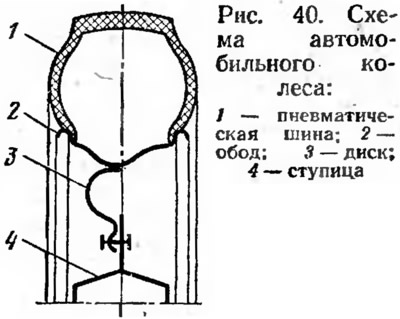
The car is equipped with disc wheels. The tires are tube-type, have a toroidal (round) profile and diagonal arrangement of cord threads. Tire designation 175-16/6.95-16. Internal air pressure in the front tires is 1.8 kgf/cm² (0.18 MPa), and in the rear tires 1.7 kgf/cm² (0.17 MPa). The rims and disks of the wheel are stamped steel. The rims have a special profile. The disks have a curved profile to increase their rigidity. They are welded to the rims of the wheels. The disks have two rows of holes located along the circumference. Some holes are used to attach the wheel to the hub, while others reduce the weight of the wheel, facilitate assembly and disassembly work and improve cooling of the brakes and tires.
The front wheel hub is flanged. It is made of alloy steel. Hub 16 (see fig. 37) is installed in the steering knuckle 23 on two tapered roller bearings 21. The outer rings of the bearings are pressed into the steering knuckle, and the inner ones are mounted on the hub tailpiece, which has internal splines and is connected to the tailpiece 20 of the outer joint housing of the front wheel drive of the vehicle. The conical bushing 18 ensures the correct installation of the tailpiece 20 relative to the wheel hub. The position of the bearings on the hub is fixed with a nut. The hub bearings are lubricated during assembly.
To protect the bearings from dust, dirt and moisture, and to retain grease in the steering knuckle, seals 22 and protective rings are installed, and on the outside - a stamped decorative cap 19. Using spherical nuts and studs 17, the wheel and disc 15 of the brake mechanism are attached to the hub. The rear wheel hub is missing. It is replaced by a flange of the half-axle 9 (see fig. 33), which is the rotating seat of the wheel. The wheel and brake drum 2 are attached to the flange of the axle shaft using spherical nuts and studs.
To create the least resistance to movement, reduce tire wear and reduce fuel consumption, the steered wheels must roll in vertical planes parallel to the longitudinal axis of the vehicle. For this purpose, the steered wheels are installed on the vehicle with camber in the vertical plane and toe-in in the horizontal plane.
Steering wheel camber angle — angle α (fig. 41, a), between the plane of the wheel and a vertical plane parallel to the longitudinal axis of the vehicle. The camber angle is necessary to ensure that the wheels are perpendicular to the road surface when the bridge parts are deformed under the weight of the front of the vehicle.
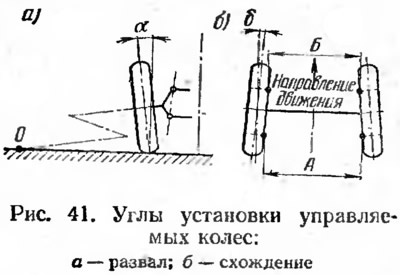
If there is camber, the wheel tends to roll away from the longitudinal axis of the car along an arc around the point O of intersection of the extension of the wheel axis with the road plane. To eliminate this phenomenon, the wheels are installed with toe-in, i.e. not parallel, but at some angle to the longitudinal axis of the car.
Toe-in angle of steering wheels — angle δ (Fig. 41.6), determined by the difference in distances A and B between the wheels, which are measured at the back and front along the edges of the rims at the height of the wheel axle.
For the VAZ-2121 Niva car, the steering wheel alignment angles are: camber α = 0°30'±20', toe-in δ = A - B - 3±1 mm.
During vehicle operation, the camber angles of the steering wheels change due to wear of the front suspension joints, front wheel hub bearings, and deformation of the front suspension crossmember. The toe-in angles of the wheels change due to wear of the steering trapezoid hinge joints and deformation of its levers.
The camber of the steering wheels on the car is adjusted using adjusting washers 39 (see fig. 37), which are installed between the axle 38 of the upper arms and the bracket 2 of the front suspension crossmember. The toe-in of the steered wheels is adjusted by changing the length of the lateral rods of the steering trapezoid using adjusting couplings.