




The flywheel surfaces mating with the crankshaft and the driven clutch disc must be free of scratches, burrs and be completely flat.
If there are scratches on the working surface 3 (Fig. 2-38) of the flywheel under the driven clutch disk, grind this surface, removing a layer of metal no more than 1 mm thick. Then grind surface 2, maintaining a size of 0.5 ±0.1 mm and ensuring parallelism of surfaces 2 and 3 relative to surface 1. The permissible non-parallelism, measured at the extreme points of surfaces 2 and 3, should not exceed 0.1 mm.
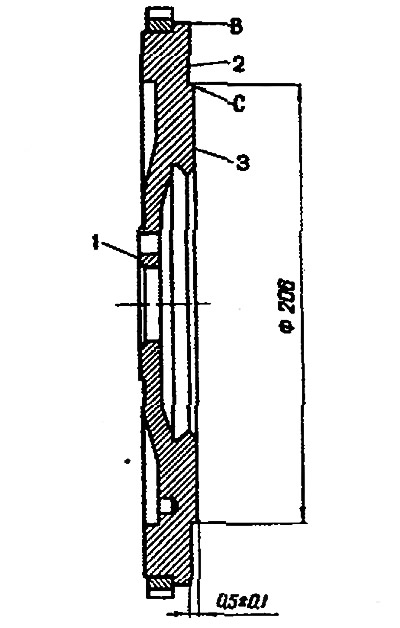
Fig. 2-38. Flywheel: 1 - mounting surface to the crankshaft flange; 2 - clutch mounting surface; 3- supporting surface of the driven clutch disc: B - place for checking the runout of surface 2; C - place of checking the runout of surface 3
Install the flywheel on the mandrel, centering it on the mounting hole with a stop on surface I (Fig. 2-38) check the runout of planes 3 and 2. At points B and C, the indicator should not show runout exceeding 0.1 mm.
Checking the axial clearance of the crankshaft
The axial movement of the crankshaft is limited by two retaining half rings installed on both sides of the rear main bearing. A steel-aluminum half ring is installed on the front side of the bearing, and a metal-ceramic half ring is installed on the rear side (yellow color). Half rings are made of normal thickness (2,310-2,360 mm) and increased (2.437-2.487 mm).
The axial clearance between the thrust half rings and the thrust surfaces of the crankshaft is checked as follows:
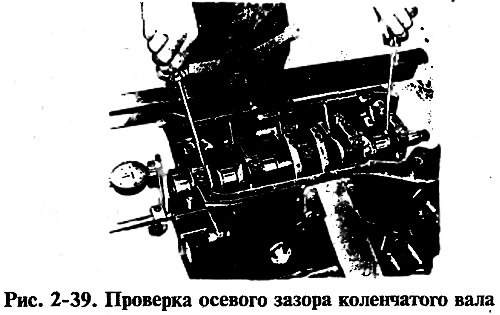
- place the indicator on the magnetic stand and insert the ends of two screwdrivers as shown in Fig. 2-39;
- move the shaft with screwdrivers and check the axial clearance using the indicator, which should be within 0.06-0.26 mm.
If the gap exceeds the maximum permissible 0.35 mm, replace the thrust half rings with others that are larger by 0.127 mm.
Note: The axial clearance of the crankshaft can also be checked on the engine installed in the vehicle. Using the device 67.8701.9510. In this case, the axial movement of the crankshaft is created by pressing and releasing the clutch pedal, and the value of the axial clearance is determined by the movement of the front end of the crankshaft.
[The material is posted on the online resource VazBook.ru]