On the working chamfers of the saddles (valve contact area) there should be no pitting, corrosion or damage. Minor damage can be eliminated by grinding the seats. In doing so, remove as little metal as possible. Grinding can be done manually or with a grinding machine.
Sand in the following order:
- install the head on the support A.60353, insert the rod A.94059 into the valve guide sleeve and clean the seat chamfers from carbon deposits using countersinks A.94031 and A.94092 for the exhaust valve seats and countersinks A 94003 and A.94001 for the intake valve seats. The countersinks are put on the spindle A.94058 and centered using the guide rod A.94059;
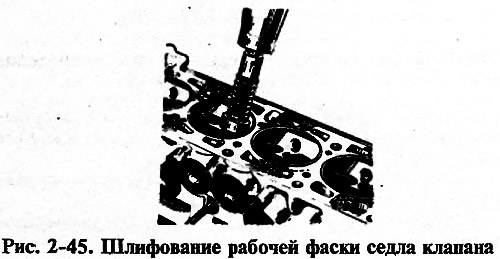
- place the spring A.94069/5 on the guide rod A.94059, install the conical circle A.94078 for the exhaust valve seats or the circle A.94100 for the intake valve seats on the spindle A.94069, secure the spindle in a grinder and grind the valve seat (Fig. 2-45).
Note: Rods A.94059 are available in two different diameters: A.94059/1 - for intake valve guides and A.94059/2 for exhaust valve guides.
At the moment of contact of the wheel with the saddle the machine should be switched off, otherwise vibration will occur and the chamfer will be incorrect. It is recommended to correct the wheel with a diamond more often.
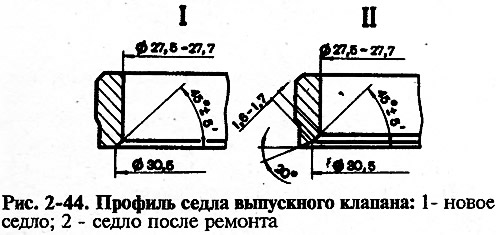
For the exhaust valve seats, bring the working chamfer width to the values shown in Fig. 2-44 using countersink A.94031 (angle 20°) and countersink A.94092, which removes work hardening on the inner diameter. Countersinks are placed on spindle A.94058 and, as with grinding, are centered using rod A.94059.
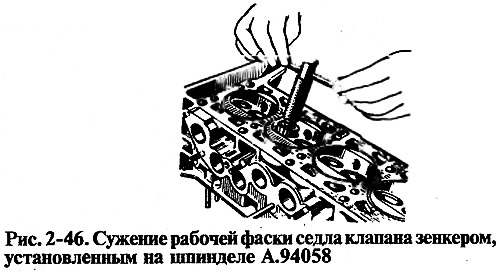
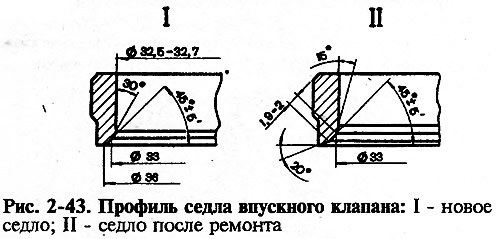
At the inlet valve seats, bring the width of the working chamfer to the values shown in Fig. 2-43, first by processing the inner chamfer with countersink A94003 (Fig. 2-46) until a diameter of 33 is obtained, and then the 20° chamfer with countersink A.94101 until the working chamfer is obtained.