




Contents: Cleaning the lubrication system…↓ Main and connecting rod journals ↓ Main bearing shells ↓
The main dimensions of the crankshaft are given in Fig. 2-35.
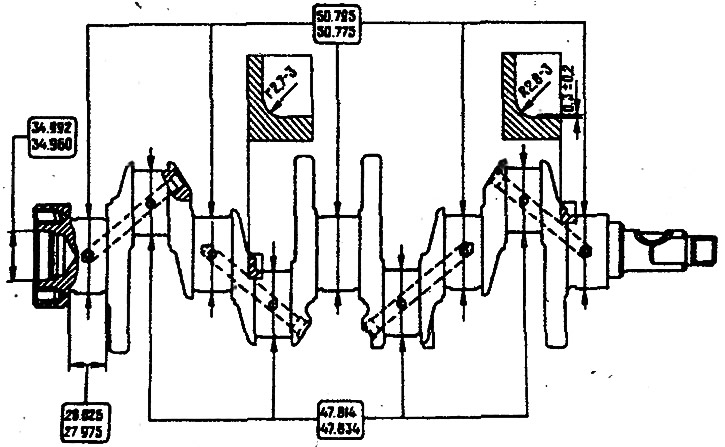
Fig. 2-35. Main dimensions of connecting rod and main journals of the crankshaft and their fillets
Cleaning the lubrication system channels
To clean, remove the channel plugs. Then run through the plug sockets with the countersink A.94016/10, put on the spindle A.94016, thoroughly wash the channels with gasoline and blow with compressed air.
Use the A.86010 mandrel to press in new plugs and, for greater reliability, punch each plug at three points with a center punch.
Main and connecting rod journals
Examination. Install the crankshaft on two prisms (Fig. 2-36) and check with an indicator:
- runout of main journals: maximum permissible 0.03 mm;
- runout of the seating surfaces under the sprocket and bearing of the primary shaft of the gearbox; maximum allowable 0.04 mm;
- displacement of the axes of the crank journals from the plane passing through the axes of the crank and main journals; maximum allowable ±0.35 mm;
- non-perpendicularity of the flange end surface to the crankshaft axis. When turning the shaft, the indicator installed on the side, at a distance of 34 mm (Fig. 2-36) from the shaft axis, should not show a runout of more than 0.025 mm.
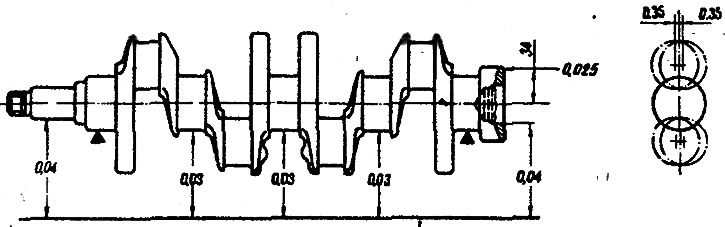
Fig. 2-36. Permissible runout of the main surfaces of the crankshaft
Cracks are not allowed on the main and connecting rod journals and on the crankshaft cheeks. If they are found, replace the shaft.
No scratches, nicks or grooves are allowed on the surfaces of the crankshaft that are mated with the working edges of the seals.
Measure the diameters of the main and connecting rod journals. The journals should be ground if their wear is more than 0.03 mm or the ovality of the journals is more than 0.003 mm, and also if there are burrs and scratches on the journals.
Grinding of necks. Grind the main and connecting rod journals, reducing by 0.25 mm, so as to obtain, depending on the degree of wear, diameters corresponding to the values given in Tables 2-2, 2-3 and the radii of the journal fillets as shown in Fig. 2-35.
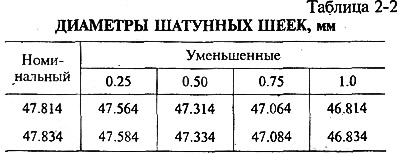
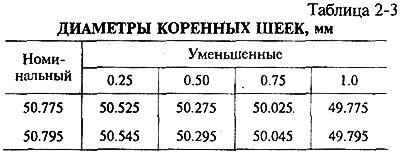
After grinding and subsequent finishing of the journals, thoroughly wash the log shaft to remove any remaining abrasive. Wash the lubrication channels with the plugs removed several times with gasoline under pressure. On the first cheek of the crankshaft, mark the amount of reduction of the main and connecting rod journals (for example, K 0.25; W 0.50). The ovality and taper of the main and connecting rod necks after grinding should not exceed 0.007 mm.
Main bearing shells
Do not perform any adjustment operations on the liners. If there are any scuffs, scratches or delamination, replace the liners.
Check the clearance between the bearing shells and the crankshaft journals:
- place a piece of calibrated plastic wire on the neck being tested;
- install the caps with the main bearings and tighten the cap mounting bolts to a torque of 80.36 N·m (8.2 kgf·m);
- remove the covers and determine the size of the gap by the amount of flattening of the wire on the packaging scale (Fig. 2-37).
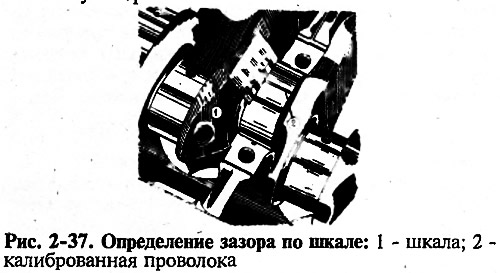
The clearance between the crankshaft journals and the liners can also be determined by calculation, by measuring the diameters of the main journals, the bearing beds and the thickness of the liners.
The nominal calculated clearance is 0.050 -0.095 mm. If it is less than the limit (0.15 mm), then you can use these liners again. If the clearance is greater than the limit, replace the liners on these journals with new ones. If the crankshaft journals are worn and ground to a repair size, then replace the liners with repair ones (increased thickness, see Table 2-4). A sign of correct assembly and mating of the journals with the liners is the free rotation of the crankshaft.
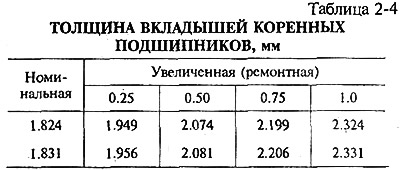
The numbers 0.25, 0.50, etc. indicate the amount of reduction in the diameter of the crankshaft journals after grinding.