Check whether the working chamfer is too worn or damaged. When grinding the working chamfer of the valve on a grinding machine, maintain a chamfer angle of 45°30' ±5' and ensure that the thickness of the cylindrical part of the valve plate after grinding is not less than 0.5 mm, and also that the layer of hard alloy fused to the chamfer of the exhaust valve is not removed.
Valve guide bushings
Check the clearance between the valve guides and the valve stem by measuring the valve stem diameter and the valve guide bore.
Mounting clearance for new bushings: 0.022-0.055 mm for intake valves and 0.029-0.062 mm for exhaust valves; maximum permissible marginal clearance (when worn out) 0.15 mm.
If the increased clearance between the guide bushing and the valve cannot be eliminated by replacing the valve, replace the valve bushings using the A.60153/R mandrel (Fig. 2-47).
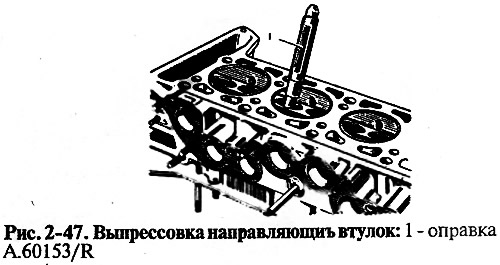
To replace the two guide bushings of the intake and exhaust valves of cylinders No.1 and No.4, unscrew the two studs securing the camshaft bearing housing, as they interfere with the installation of the mandrel.
Press in the guide bushings with the retaining ring fitted until the ring rests against the cylinder head plane.
After pressing in, ream the holes in the guide bushings using reamers A 90310/1 (for intake valve bushings) and A.90310/2 (for exhaust valve bushings). Then grind the valve seat and bring the working chamfer width to the required dimensions as indicated above.
Oil deflector caps of guide bushings
The oil deflector caps must not have any separation of the rubber from the fittings, cracks or excessive wear of the working edge.
When repairing an engine, it is recommended to always replace the oil deflector caps with new ones.
It is recommended to replace damaged valve stem seals with the cylinder head removed to avoid bending the valve stems. Use mandrel 41.7853 4016 to press on the seals.
Valve Levers
Check the condition of the lever working surfaces that mate with the valve stem, the camshaft cam and the spherical end of the adjusting screw. If these surfaces have scoring or scratches, replace the lever with a new one.
If deformation or other damage is found on the lever adjusting screw bushing or on the screw itself, replace the parts.
Springs
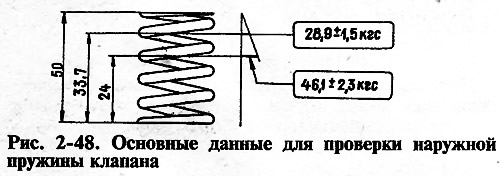
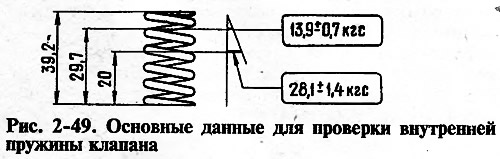
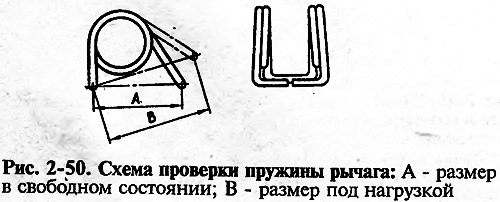
Make sure that there are no cracks on the springs and that the elasticity of the springs has not decreased by checking the deformation of the springs under load (fig. 2-48, 2-49, 2-50).
For lever springs (Fig. 2-50) size A (spring in free state) should be 35 mm, and the size B under load is 51-73.5 N (5.2-7.5 kgf) — 43 mm.