




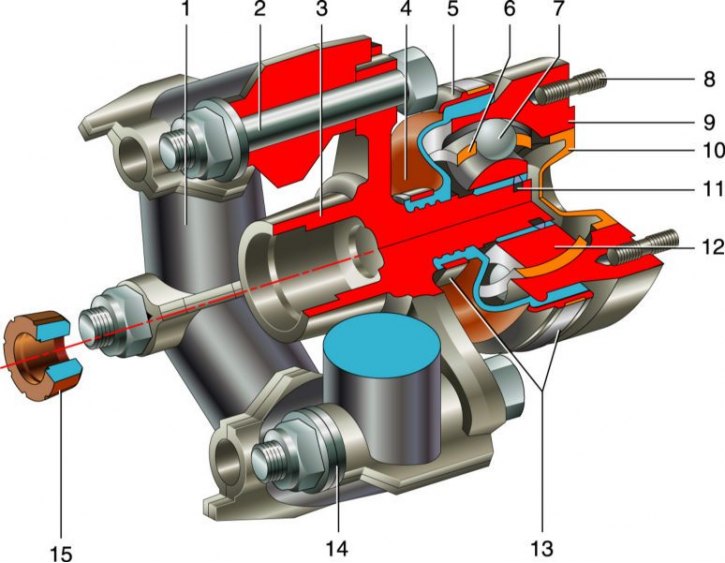
Intermediate shaft: 1 – elastic coupling; 2 – elastic coupling mounting bolt; 3 – elastic coupling flange; 4 – protective cover; 5 – casing; 6 – separator; 7 - ball; 8 – stud for fastening the hinge housing to the transfer case flange; 9 – hinge housing; 10 – plug; 11 – retaining ring; 12 – hinge sleeve; 13 – clamps; 14 – balancing washer; 15 – centering sleeve.
The intermediate shaft transmits torque from the secondary shaft of the gearbox to the main shaft of the transfer case. It consists of an elastic coupling, a flange and a constant velocity joint. The intermediate shaft is centered on the secondary shaft of the gearbox with a rubber bushing.
The elastic coupling consists of six steel inserts connected by rubber bridges. Due to its elasticity, the coupling dampens jerks in the vehicle transmission. The elastic coupling is attached to the secondary shaft flange with three bolts passed through holes in the inserts. Three other holes are used to attach the coupling to the flange on the intermediate shaft. Balancing washers are located under the nuts of the bolts. When disassembling, we mark their location so that we can later install them in their original places. In order not to disturb the balance, we mark the relative positions of other parts of the intermediate shaft.
A constant velocity joint is placed on the splined end of the elastic coupling flange. Its design is similar to the outer joint of the front wheel drive (see Front wheel drives). The hinge is secured from displacement by a locking ring located in a groove on the flange shaft. The hinge is protected from dirt by a rubber corrugated cover and a plastic plug in the rear end of the hinge housing. The cover is secured to the flange shaft and the hinge housing by special clamps with locks. Under the large clamp (on the hinge body) there is a protective plastic cover.