




The vehicle uses a cardan transmission (Fig. 29), which consists of intermediate, front, rear cardan shafts and cardan joints.
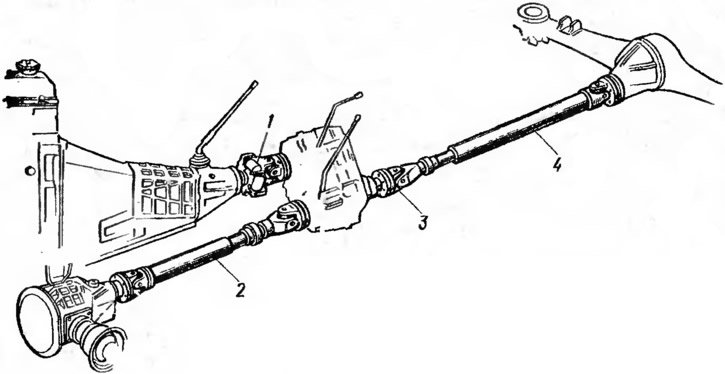
Fig. 29. Cardan transmission:
1, 2, 4 - intermediate, front, rear cardan shafts; 3 - cardan joint.
Intermediate cardan shaft (Fig. 30) connects the secondary shaft of the gearbox with the driving shaft of the transfer case. Flange 4 of the intermediate shaft is connected to the driving shaft of the transfer case via crosspiece 5 and flange-yoke 8. A rubber elastic coupling 1 is attached to flange 4 with three bolts 3, which in turn is attached with three bolts to the flange installed on the end of the secondary shaft of the gearbox. Mutual centering of flange 4 and the secondary shaft of the gearbox is ensured by sleeve 9, which includes a centering ring fixed on the secondary shaft. Elastic coupling 1 allows transmitting torque with minor changes in the angle between the shafts of the gearbox and transfer case, protects transmission parts from dynamic impacts and reduces noise and vibration of the cardan transmission during operation.
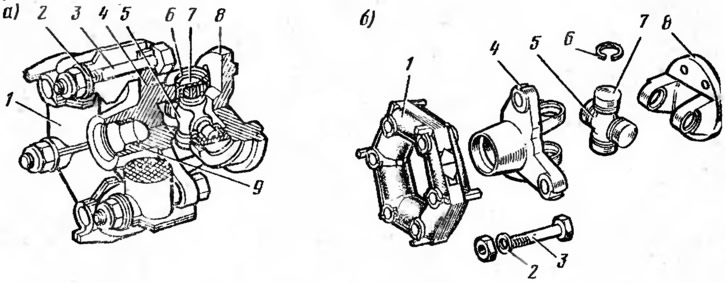
Fig. 30. Intermediate cardan shaft:
a - assembled; b - details:
1 - elastic coupling; 2 - balancing washer; 3 - bolt; 4 - flange; 5 - crosspiece; 6 - retaining ring; 7 - needle bearing; 8 - flange fork; 9 - centering sleeve.
Front and rear propeller shafts connect the drive shafts of the front and rear axles of the transfer case with the drive shafts of the main transmissions of these axles.
Each cardan shaft 7 (Fig. 31) is made of a thin-walled steel pipe, with a cardan joint fork 8 welded to one end and a splined tip 9 welded to the other end. A sliding fork 4 of the cardan joint is mounted on the tip. The splined connection of tip 9 and fork 4 allows for compensation of the change in the length of the cardan transmission when the drive axle moves while the vehicle is in motion.
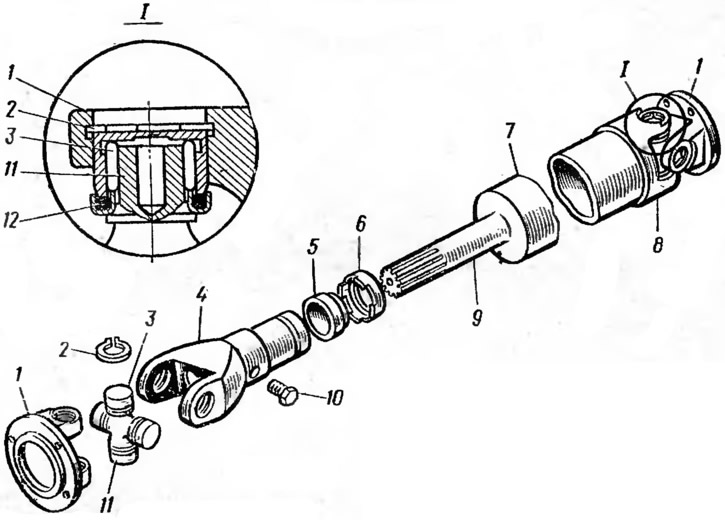
Fig. 31. Front propeller shaft:
1 - flange-fork; 2 - retaining ring; 3 - needle bearing; 4 - sliding fork; 5 - oil seal; 6 - oil seal cage; 7 - cardan shaft; 8 - fork; 9 - tip; 10 - cork; 11 - crosspiece; 12 - oil seal.
Cardan joint transmits rotation from one shaft to another with a changing angle between the shafts.
Cardan joint (see fig. 31) consists of two forks 1 and 4, connected to each other by a crosspiece 11. Needle bearings 5 are installed on the crosspiece pins, which are sealed by oil seals 12 and fixed in the holes of the forks by retaining rings 2.