




The rear axle in the VAZ-2121 car is a driving one. It (Fig. 33) is made in the form of a solid beam 7 with a developed central part of a ring shape. The bridge beam is welded from two steel stamped halves. On one side, a cover 12 is welded to the middle part of the bridge beam, and on the other side, a crankcase 16 is attached with bolts. Flanges 4 are welded to both ends of the beam. Support cups 6 of the rear suspension springs and brackets 8 and 26 for fastening suspension parts are also welded to the rear axle beam.
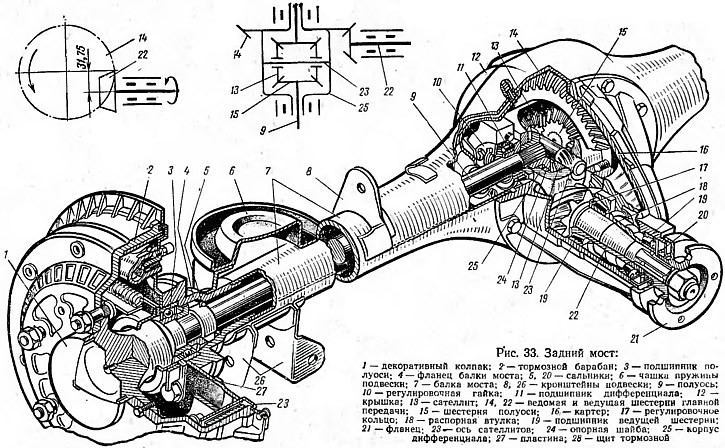
Fig. 33. Rear axle:
1 - decorative cap; 2 - brake drum: 3 - axle shaft bearing; 4 - bridge beam flange; 5, 20 - seals; 6 - suspension spring cup; 7 - bridge beam; 8, 26 - suspension brackets; 9 - half shaft; 10 - adjusting nut; 11 - differential bearing; 12 - lid; 13 - satellite; 14, 22 - driven and leading gears of the main transmission; 15 - axle gear; 16 - crankcase; 17 - adjusting ring; 18 - spacer sleeve; 19 - pinion bearing; 21 - flange; 23 - satellite axis; 24 - support washer; 25 - differential housing; 27 - plate; 28 - brake shield.
The rear axle houses the main gear, differential and axle shafts.
Main gear serves to increase the torque supplied to the vehicle's drive wheels.
The vehicle uses a single hypoid gear final drive with a gear ratio of 4.3.
The main gear has one pair of bevel gears with a spiral tooth. The axes of the gears do not intersect, but cross and lie at some distance (the axis of the driving gear is below the axis of the driven gear), i.e. have a hypoid offset. Due to the hypoid offset, the car's center of gravity is somewhat lowered and its stability is increased. In addition, the hypoid main gear has increased strength and durability, and also ensures smooth engagement of gears and quiet operation.
The axis of the driving gear 22 is shifted downwards by 31.75 mm relative to the axis of the driven gear 14. The driving gear 22, manufactured together with the shaft, is installed in the housing 16 on two tapered roller bearings 19. Between the bearings there is a spacer sleeve 18, which ensures the correct tightening of the bearings. The driven gear 14 is attached with bolts to the differential housing 25. The correct position of the driving gear relative to the driven gear is ensured by the adjusting ring 17.
[The original is available on the online resource: VAZbook.ru]
Differential is designed to distribute torque between the drive wheels of a vehicle. The differential allows the drive wheels to rotate at different speeds when the vehicle is moving on turns and uneven roads.
The car uses a conical, symmetrical interwheel differential. It distributes torque equally between the driving wheels of the car.
The differential housing 25 is installed in bearings 11. The bearing tightening and engagement of the teeth of the leading 22 and driven 14 gears of the main transmission are adjusted by adjusting nuts 10. An axis 23 with two satellites 13 is fixed inside the differential housing. The satellites are in constant engagement with the gears of the half-axles 15, which are connected to the splined ends of the half-axles 9. All differential gears are straight-toothed.
Half shafts are designed to transmit torque from the differential to the drive wheels of the vehicle.
The car uses semi-unloaded axle shafts. They transmit torque and absorb bending moments in the vertical and horizontal planes.
The axle shaft 9 is made in the form of a solid shaft. The inner end of the axle shaft has splines, and the outer end has a flange. The inner end of the axle shaft is connected to the gear 15, located in the differential housing 25. The outer end of the axle shaft is installed in the bearing 3, which is located in the flange 4 of the axle beam. The brake drum 2 and the wheel with the tire are bolted to the flange of the axle shaft. The axle shaft is kept from shifting by a special plate 27, which fixes the bearing 3, which together with the brake shield 28 is attached to the flange 4 of the axle beam.