




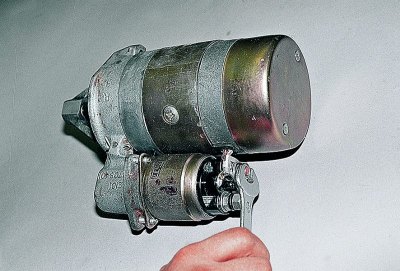
Using a 13 mm wrench, loosen the nut securing the wire to the traction relay...
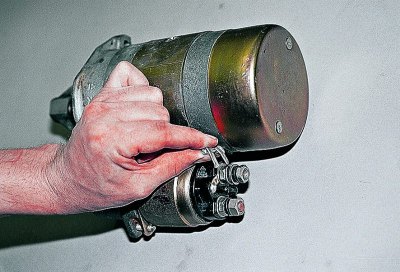
...and disconnect the wire tip.
To check the traction relay...
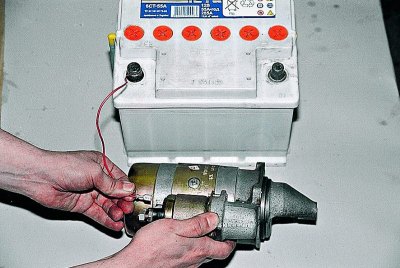
...we apply 12 V voltage to the relay output,...
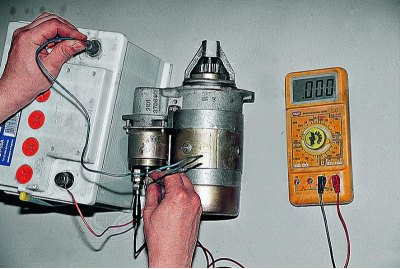
... "minus" - to the body, and we connect the ohmmeter to the contact bolts.
In this case, the anchor of a working relay should push the overrunning clutch into the front cover window, and the contact bolts should close. We replace the faulty traction relay with a new one.
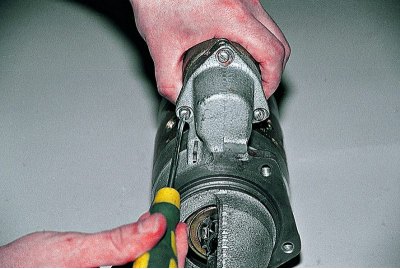
Using a slotted screwdriver, unscrew the three screws...
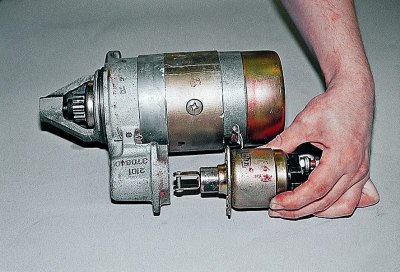
...and remove the traction relay.
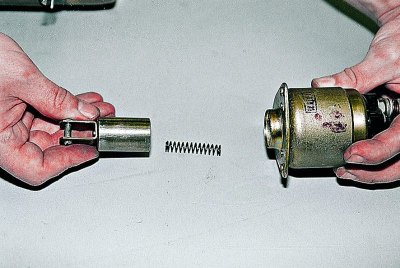
We remove the rod with the spring from the relay housing.
We install the new traction relay in the reverse order.
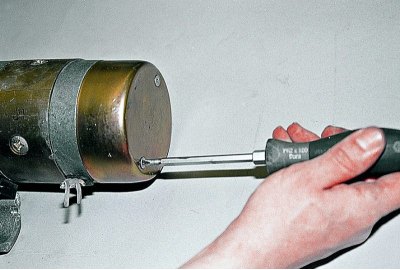
To further disassemble the starter, use a Phillips screwdriver to unscrew two screws...
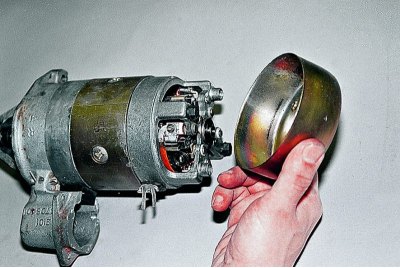
...and remove the lid.
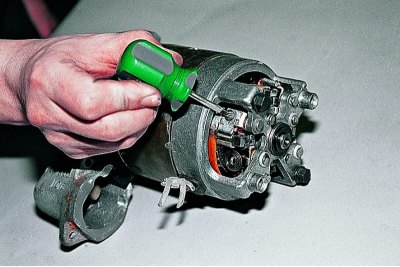
To check the condition of the brushes, use a screwdriver to unscrew the screw securing the contact wire...
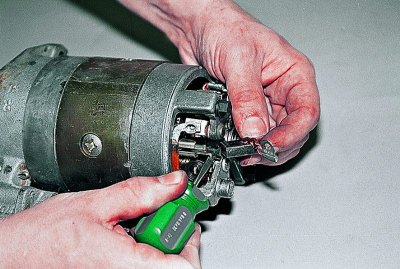
...and, pressing the spring with a screwdriver, we remove the brush.
We extract the three remaining brushes in the same way. We replace the brushes that are worn to a height of 12 mm or less.
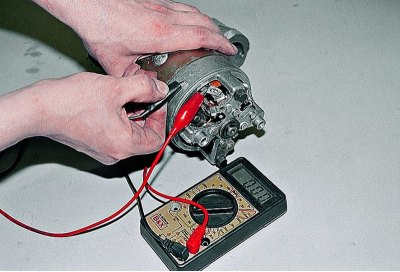
By connecting the ohmmeter one by one to the terminals of the stator windings, we check them for short circuits to the housing and for interturn short circuits.
In this case, make sure that the free terminals of the windings are insulated from the housing.
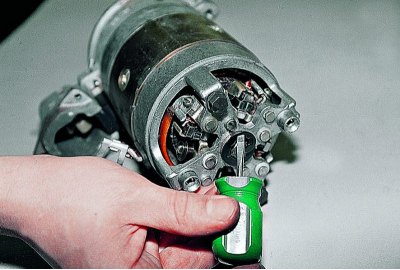
Using a screwdriver, remove the retaining ring.
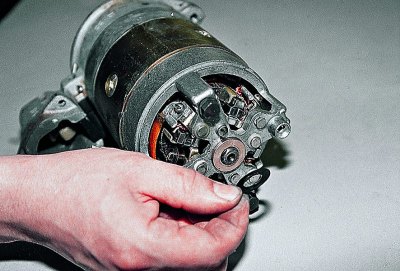
We remove the washer from the shaft.
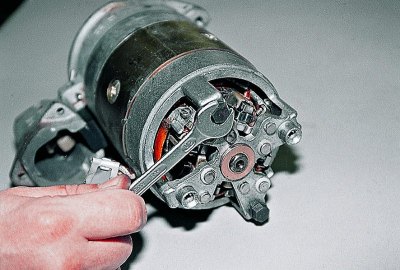
Using a 10 mm spanner, unscrew the two tie bolts...
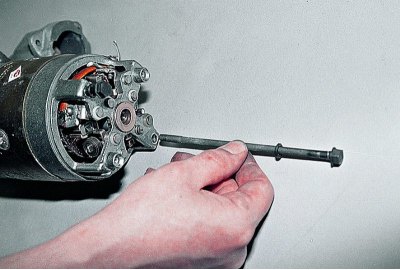
...and we take them out.
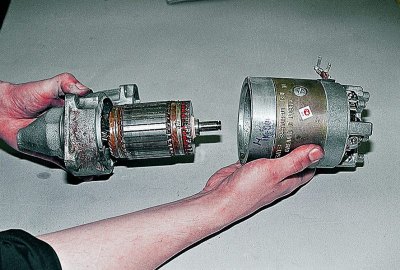
We disconnect the starter parts...
...and we take out the bolt insulating tubes.
We check the condition of the collector and windings by visual inspection. Charring of the windings is not allowed. If the collector is slightly burned, we clean its plates with fine abrasive paper. If there is severe burning and wear, it is better to replace the anchor. Scoring and metal dragging from the bearings on the anchor shaft journals are eliminated with the finest sandpaper followed by polishing.
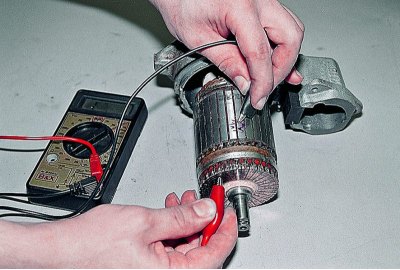
We check the anchor windings for short circuits with an ohmmeter. We replace the faulty anchor.
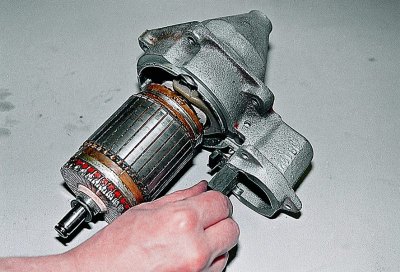
We remove the rubber seal from the drive cover.
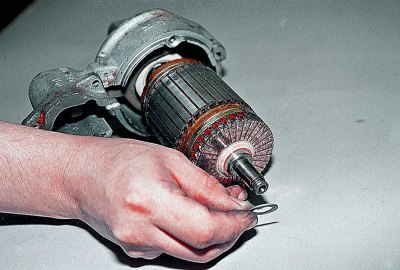
We remove the adjusting washer from the anchor axis.
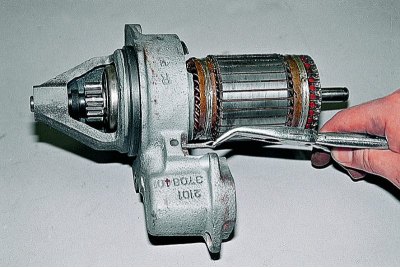
We remove the cotter pin from the lever axle.
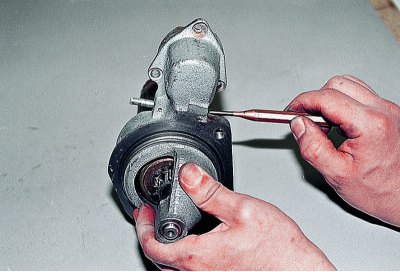
We knock out the axis with a beard...
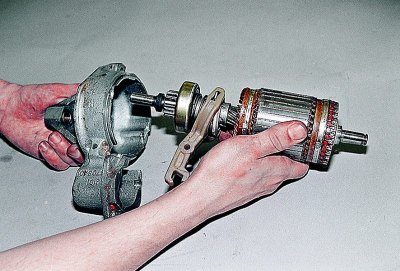
...and we take out the anchor with the drive.
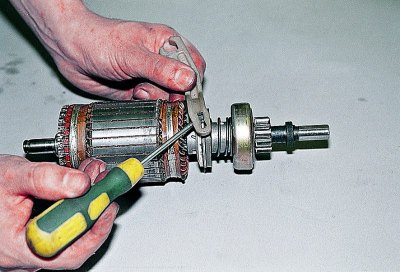
Using a screwdriver, we remove the drive lever.
The drive gear should rotate easily in one direction and not rotate in the other, and should not have chips or nicks on the leading part of the teeth. A worn gear or faulty overrunning clutch is replaced as an assembly.
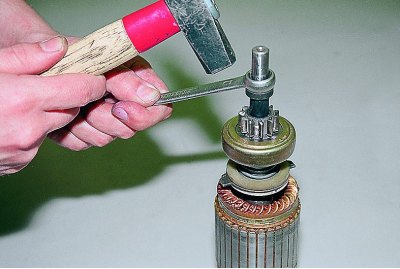
Having supported the anchor shaft on a wooden block, we use a 14 mm wrench to knock the limiting ring off the locking ring.
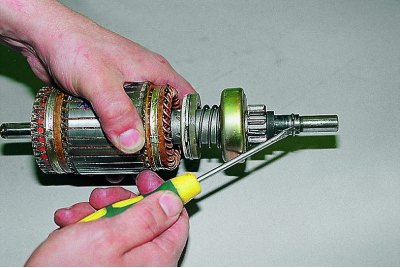
Using a screwdriver, remove the retaining ring.
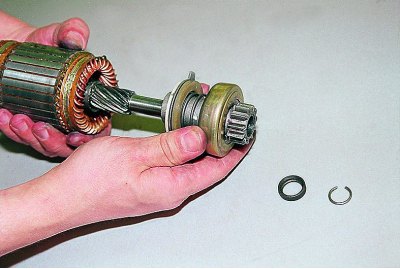
We remove the limiting ring and the overrunning clutch assembly with the drive gear from the shaft.
We assemble the starter in the reverse order.
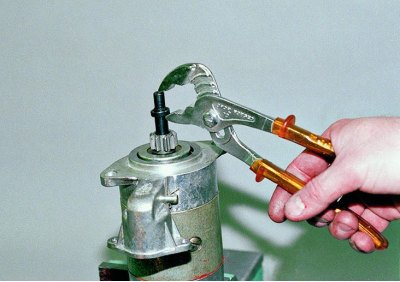
When installing the limiting ring (on the stopper) it is convenient to tighten it with sliding pliers.
Blow the housing and brush holder with compressed air. Lubricate the drive ring and the plastic surfaces in contact with it with Litol-24. Lubricate the bushings and screw splines of the anchor shaft, as well as the hub of the overrunning clutch with motor oil.
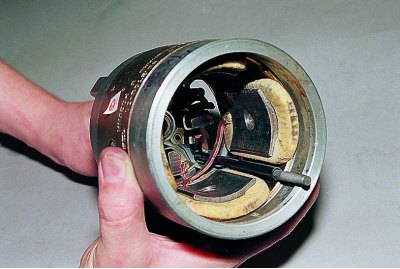
Before connecting the cover to the starter housing, insert the tie bolts into the corresponding holes.
Attention! If only one bolt was insulated, when assembling the starter, we put the insulating tube on the one that can touch the copper busbar connecting the starter stator windings.
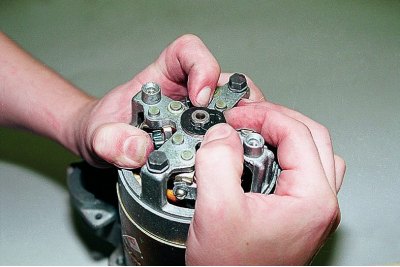
To install the retaining ring, press the starter armature up through the cover bushing on the drive side.