




Contents: Removal ↓ Installation ↓
Note: The work is shown on engine 21124. For details on how to perform the work on engine 2112, see the text.
Removal
1. Prepare the car for work (see "Preparing the car for maintenance and repair").
2. Remove the camshaft pulleys (see "Camshaft pulleys - removal and installation").
3. Remove the tension and guide rollers (see "Timing Belt - Replacement").
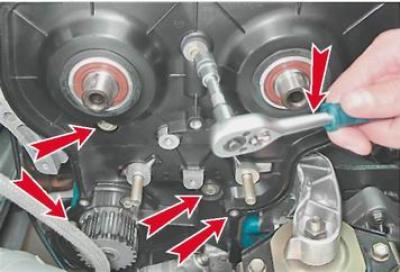
4. With a socket wrench by 10 mm we unscrew the six bolts securing the rear timing belt cover and remove it.
5. Remove the cylinder head cover (see "Cylinder head cover for engines 2112 and 21124 (16v) - removal and installation").
6. To avoid damage, remove the oil pressure sensor (see "Engine Oil Pressure Sensor - Replacement") or disconnect the wire tip from it.
7. With a socket wrench by 8 mm evenly, half a turn at a time, unscrew the 20 bolts securing the camshaft bearing housing.
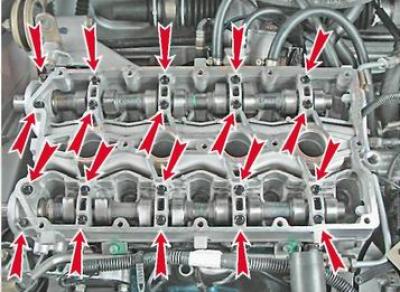
8. Remove the camshaft bearing housing.
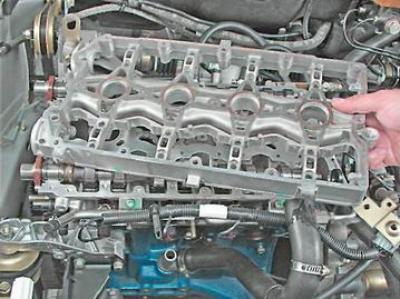
Comment.On the 2112 engine, we remove the camshaft bearing housing together with the spark plug guide tubes (candle wells). We remove the pipes from the bearing housing.
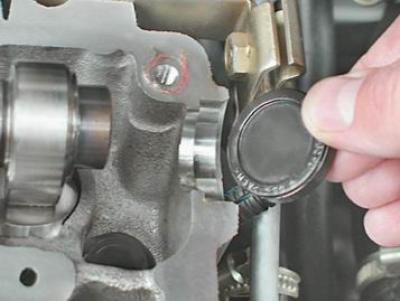
9. Remove two plugs of technological holes from their seats in the cylinder head (near the rear ends of the camshafts).
10. Remove the intake and exhaust camshafts.
11. Remove the seals from the shafts.
12. Inspect the shafts. There should be no signs of severe wear, scratches, cracks, or metal drag on the shaft journals and cams.
Installation
1. Lubricate the bearing journals and camshafts with clean engine oil.
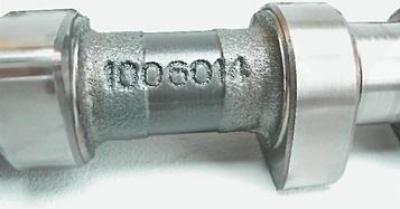
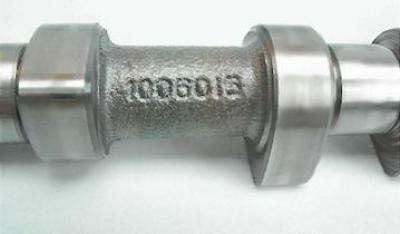
2. Place the camshafts in the cylinder head. The shafts are not interchangeable and have different markings.
The exhaust valve shaft is marked 1006014.
Intake valve shaft - marked 1006015.
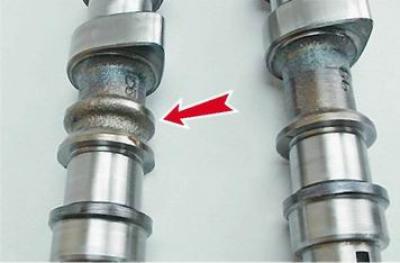
In addition, the intake valve shaft has an additional belt.
Warning! When repairing an engine, do not use sealant with a high silicone content (silicon compounds), vapors of which can enter the cylinders through the crankcase ventilation system and further into the exhaust tract. Use a sealant that is specifically labeled as safe for the oxygen sensor
Caution! Do not apply too much sealant to the mating surfaces of the bearing housing. When tightening the mounting bolts, the sealant squeezed into the internal cavities of the engine may clog the oil channels.
3. Apply a thin layer of sealant "Loctait" No.574 or similar to the cylinder head plane and to the lower surface of the bearing housing around the spark plug well holes according to the following scheme:
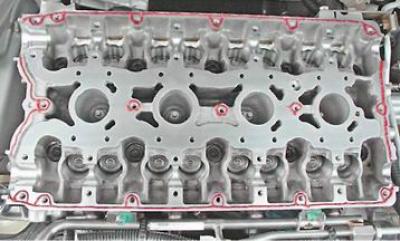
4. Install the camshafts into the cylinder head with the keyways facing up.
5. Install the bearing housing on the cylinder head and tighten the mounting bolts evenly until the bearing housing touches the cylinder head. Finally tighten the bearing housing mounting bolts in pairs, with a torque of 8.0-10.0 N·m (0.8-1.0 kgf·m) in the following sequence (see photo).
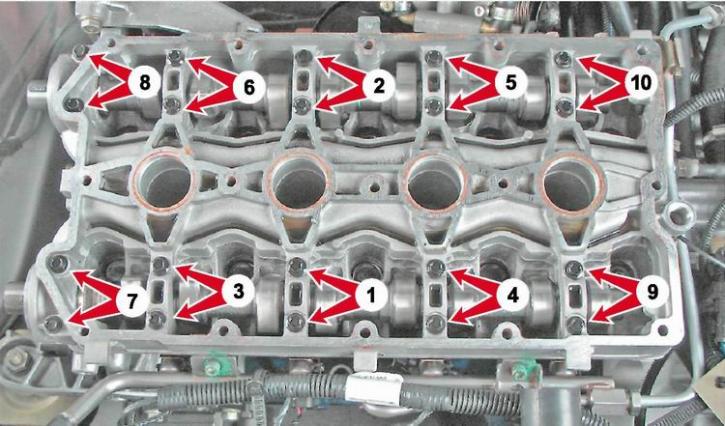
Tightening sequence of camshaft support bolts
6. Press in the camshaft seals (see "Camshaft Seals - Replacement").
7. On engine 2112 apply clean motor oil to the rubber sealing rings of the spark plug guide tubes (candle wells) and install the pipes into the head.
8. Further assembly is carried out in the reverse order of disassembly.