




Note: The operation is shown on engine 21114. Checking the fuel pressure on other engines is performed similarly.
Attention! Before performing the operation, read the safety rules for servicing and repairing the power supply system (see "Safety precautions for maintenance and repair of the power supply system").
To perform the work you will need a special pressure gauge.
Sequence of execution
1. Prepare the car for work (see "Preparing the car for maintenance and repair").
2. On engines of models 2112, 21114 and 21124 remove the decorative trim (see "Engine trim - removal and installation").
3. Unscrew the protective cap of the diagnostic connector of the fuel rail.
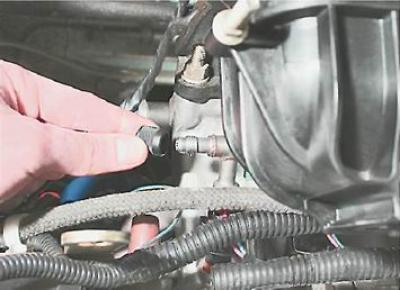
4. Connect the pressure gauge hose tip to the fuel rail fitting.
5. With an open-end wrench by 14 mm we wrap the tip of the hose.
Advice. If necessary, the pressure in the fuel rail can be measured with a homemade device made from a pressure gauge from a foot pump. Before connecting such a pressure gauge, it is necessary to release the fuel pressure (see "Fuel line - pressure relief"). After this, unscrew the valve from the fuel rail fitting. This can be done with a metal cap of the wheel valve. To connect the pressure gauge to the fuel rail fitting, use a piece of gasoline-resistant hose of a suitable diameter. The ends of the hoses must be securely fastened with clamps.
6. Turn on the ignition. The fuel pump will work for a few seconds. Wait until the pump stops working, then turn off the ignition.
7. To remove air from the pressure gauge, lower the end of the drain tube into a small container, unscrew the pressure gauge bleed nipple by 1/3-1/2 turn and release excess gasoline pressure from the fuel rail. This will remove air from the pressure gauge hose.
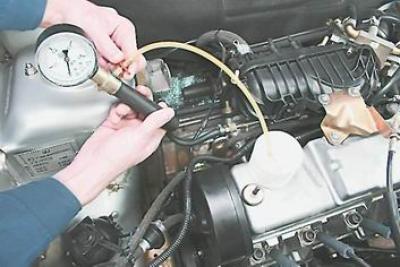
8. Tighten the bleed nipple until it stops.
We start the engine and measure the operating pressure in the fuel rail at different crankshaft speeds. In a serviceable engine, it should be within the range: for engines 2111 and 2112 - 284-325 kPa (2.8-3.2 bar); for engines 21114 and 21124 - 378-390 kPa (3.8-3.9 bar).
Note: On 16-valve engines, the operation is performed as follows:
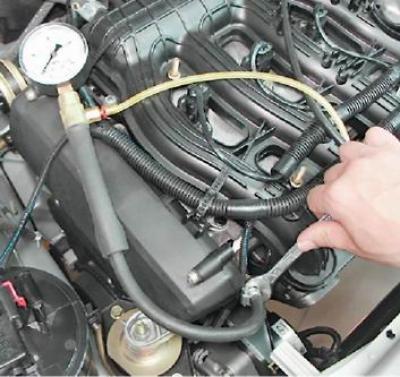
On engines 2111 and 2112 disconnect the rubber hose from the pressure regulator pipe. If after this the fuel pressure has not increased by more than 0.2 bar, then the regulator is faulty.
9. Turn off the ignition.
10. After lowering the end of the tube into the container, open the fitting and release the pressure from the fuel line.
11. Disconnect the pressure gauge from the diagnostic fitting of the fuel rail.
12. Screw the protective cap onto the fuel rail fitting.
Recommendation: If the operating pressure in the fuel rail is unstable or higher than normal, then the fuel pressure regulator is faulty (see "Fuel module of engines 21114 and 21124 (1.6i) - replacement of fuel pressure regulator", "Fuel rail engine 2111 (1.5i 8v) - replacement of fuel pressure regulator", or "Fuel rail engine 2112 (1.5i 16v) - removal, disassembly, assembly and installation"). Low pressure (below normal) can also be caused by a faulty regulator. The fuel pump mesh filter may be clogged or the fuel pump may not be producing the required pressure. To clean the mesh filter, you will need to remove the fuel module (see "Fuel module of engines 2111 and 2112 (1.5i) - removal and installation", or "Fuel module of engines 21114 and 21124 (1.6i) - removal and installation".