




The engine cooling system is liquid, closed, with forced circulation of liquid. Forced circulation of the coolant (Tosol-A) in the system is provided by a pump, and the connection of the cooling system with the atmosphere is carried out through special valves (at a certain pressure and vacuum), located in the radiator and expansion tank plugs.
The engine cooling system includes a cooling jacket for the cylinder head and block, a radiator, a pump, a thermostat, a fan, an expansion tank, connecting pipes and drain cocks. In addition, the cooling system includes a car body heater and a heater for the intake manifold and the carburetor throttle body.
The basic diagram of the engine cooling system of the Niva VAZ-2121 car is shown in Fig. 9.
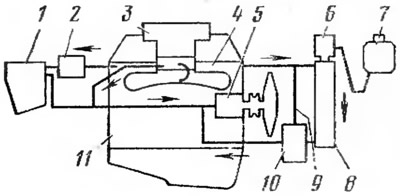
Fig. 9. Schematic diagram of the engine cooling system:
1 - heater; 2 - heater edge; 3 - Carburetor; 4 - cylinder head; 5 - pump; 6 - radiator cap; 7 - expansion tank; 8 - radiator; 9 - bypass pipeline: 10 - thermostat; 11 - cylinder block.
(The text is on the website vazbook.ru)
When the engine is not warmed up, the main thermostat valve 10 is closed, and the coolant does not pass through the radiator 8. In this case, the liquid is pumped by the pump 5 into the cooling jacket of the block 11 and the head 4 of the cylinders. From the cylinder head, the liquid flows through the bypass pipe 9 to the additional thermostat valve and gets back into the pump. Due to the circulation of this part of the liquid, the engine quickly warms up. At the same time, a smaller part of the liquid comes from the cylinder head to the heater (jacket) of the intake pipe and the throttle body of the carburetor 3, and with the valve 2 open, to the heater 1 of the car body.
When the engine is warm, the additional thermostat valve is closed, and the main valve is open. In this case, most of the liquid from the cylinder head enters the radiator, cools down in it and through the open main thermostat valve enters the pump. A smaller part of the liquid, as with an unheated engine, circulates through the carburetor heater and the car body heater.
In a certain temperature range, the main and additional thermostat valves are open simultaneously, and the coolant circulates in this case in two circles. The amount of circulating liquid in each circle depends on the degree of opening of the thermostat valves, which ensures automatic maintenance of the optimal engine temperature.
The expansion tank 7, filled with coolant, communicates with the atmosphere through a rubber valve installed in the tank cap. The tank is connected by a hose to the radiator filler neck, which has a cap with valves. The tank compensates for changes in the volume of coolant, and a constant volume of circulating liquid is maintained in the system.
Coolant pump (Fig. 10) centrifugal type, provides forced circulation of liquid in the engine cooling system. Pump shaft 5 is installed in cover 6 in double-row non-separable bearing 4. Impeller 8 and fan hub 3 are pressed onto the pump shaft. When the pump shaft rotates, coolant flows to the center of the impeller, is captured by its blades, thrown to the pump body under the action of centrifugal force and directed to the cooling jacket of the engine cylinder block. Sealing device 7, installed on the pump shaft, prevents liquid from entering the shaft bearing. The pump and fan are driven by a V-belt from a pulley, which is installed on the front end of the crankshaft. This belt also rotates the generator pulley.
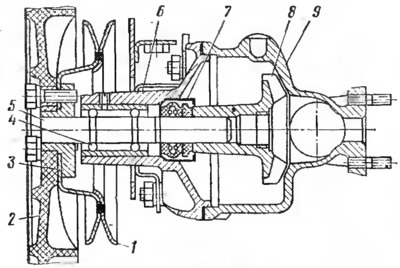
Fig. 10. Coolant pump:
1 - pump pulley; 2 - fan; 3 - hub; 4 - bearing; 5 - shaft; 6 - lid; 7 - seal; 8 - impeller; 9 - body.
Thermostat (Fig. 11) helps to speed up the engine warming up and regulates within certain limits the amount of coolant passing through the radiator. The thermostat is an automatic valve. It has a solid filler, is non-separable, has two inlet pipes 1 and 13, outlet pipe 6, two valves (main 9, additional 2) and a sensitive element. The thermostat is installed before the coolant pump inlet and is connected to it through pipe 6. Through pipe 1, the thermostat is connected to the engine cylinder head, and through pipe 13 - to the lower radiator tank. The sensitive element of the thermostat includes a cylinder 4, a rubber diaphragm 5 and a rod 12. Inside the cylinder, between its walls and the rubber diaphragm, there is a solid filler (fine crystalline wax), with a high coefficient of volumetric expansion. The main valve 9 of the thermostat begins to open at a coolant temperature of more than 80°C. At a temperature below 80°C, the main valve closes the outlet of the liquid from the radiator and it enters the pump from the engine, passing through the open additional valve 2 of the thermostat. When the coolant temperature increases above 80°C, the solid filler melts in the sensitive element and its volume increases. As a result, the rod leaves the cylinder, and the cylinder moves upward. The additional valve begins to close and at a temperature of more than 94°C blocks the passage of the coolant from the engine to the pump. In this case, the main valve opens completely, and the coolant circulates through the radiator.
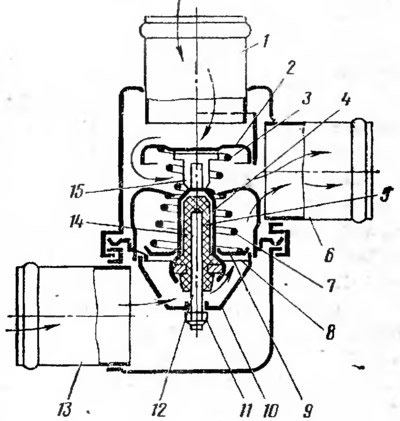
Fig. 11. Thermostat:
1 - inlet pipe from the engine; 2 - additional valve; 3 - additional valve spring; 4 - cylinder; 5 - rubber diaphragm; 6 - outlet pipe; 7 - main valve spring; 8 - main valve seat; 9 - main valve; 10 - holder; 11 - adjusting nut; 12 - rod; 13 - radiator inlet pipe 14 - filler; 15 - clip.
Radiator (Fig. 12) ensures the removal of heat from the cooling liquid into the atmosphere. It is tubular and plate-shaped, has vertically arranged tubes and horizontally arranged cooling plates. The radiator tanks and tubes are brass, and the cooling plates are tinned steel. In the upper tank 3 of the radiator there is a neck 4 through which the cooling system is filled with liquid. The neck is hermetically sealed with a plug 5, which has two valves (inlet 7 and outlet 8). The outlet valve opens at an excess pressure in the system of 0.5 kgf/cm² (0.05 MPa), and the boiled coolant is discharged into the expansion tank through the branch pipe 6 and the connecting hose. The inlet valve does not have a spring and provides a connection between the cooling system and the atmosphere through the expansion tank and the rubber valve in its plug, which is triggered at a pressure close to atmospheric. The inlet valve releases liquid from the expansion tank when its volume in the system decreases (when cooling) and passes into the expansion tank when the volume increases (when heating liquid).
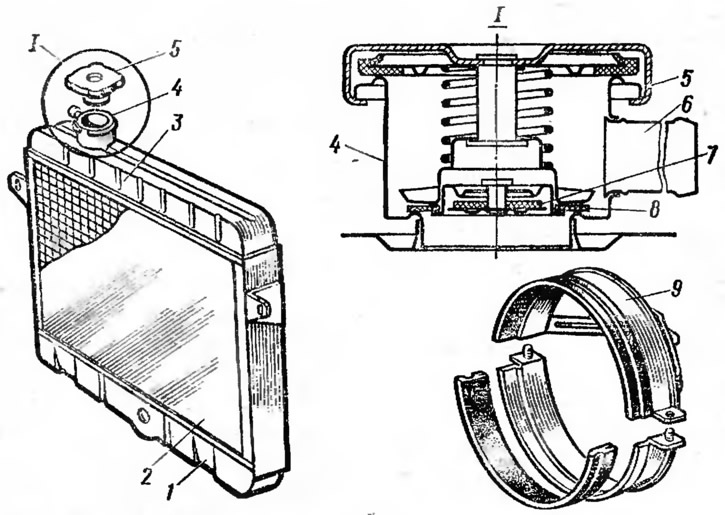
Fig. 12. Radiator:
1 - lower tank; 2 - core; 3 - upper tank; 4 - filler neck; 5 - radiator cap; 6 - vapor discharge pipe; 7 - inlet valve; 8 - exhaust valve; 9 - fan casing.
To direct the air flow through the radiator and for more efficient operation of the fan, a fan casing 9 consisting of two halves is installed behind the radiator.
Fan (see fig. 10) increases the speed and amount of air passing through the radiator. The fan has six blades and is made of plastic. The blades have rounded ends and are positioned at an angle to the plane of rotation of the fan. The fan is attached to the hub 4 on the coolant pump shaft. A pulley 1 of the coolant pump drive is installed between the fan and the hub.