




Contents: Possible malfunctions of the…↓ Ignition distributor sensor ↓ Switch ↓ Ignition coil ↓ Spark plugs ↓ High voltage wires ↓
The electrical equipment of the VAZ-21219 differs from the VAZ-2121 by the introduction of a contactless ignition system and a carburetor electromagnetic valve control system.
The diagram of the contactless ignition system is shown in Fig. 9-17. In this system, the power supply circuit of the primary winding of the ignition coil is interrupted by a powerful transistor in the electronic switch 5. Control pulses are supplied to the switch from a contactless sensor located in the ignition distributor sensor 6.
The initial ignition timing setting angle for adjusting the ignition timing is 1° ±1°.
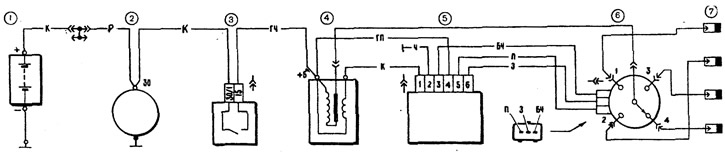
Fig. 9-17. Contactless ignition system diagram: 1 - battery; 2 - generator; 3 - ignition switch; 4 - ignition coil; 5 - switch; 6 - ignition distributor sensor; 7 - spark plugs
Warnings:
- The vehicle uses a high-energy ignition system with extensive use of electronics. Therefore, in order to avoid injury and damage to electronic components, it is necessary to follow the following rules.
- When the engine is running, do not touch any elements of the ignition system (switch, ignition coil and high-voltage wires), and even more so, disconnect high-voltage wires.
- Do not start the engine using a spark gap and do not check the functionality of the ignition system "for a spark" between the tips of the spark plug wires and the ground. All this can lead to burnout of high-voltage components and failure of the ignition system.
- Do not run low voltage ignition system wires in the same harness with high voltage wires.
- Ensure that the connection to the switch ground via the mounting screws is secure. This affects its smooth operation.
- When the ignition is on, do not disconnect the wires from the battery terminals or disconnect the plug from the switch, as this may cause increased voltage on individual elements of its circuit and damage it.
- After servicing or repairing the vehicle, before starting the engine, make sure that the high-voltage wires are securely connected to the ignition coil and spark plugs.
Below are the faults related to the original components of the contactless ignition system. For other faults, see the chapter "Ignition system".
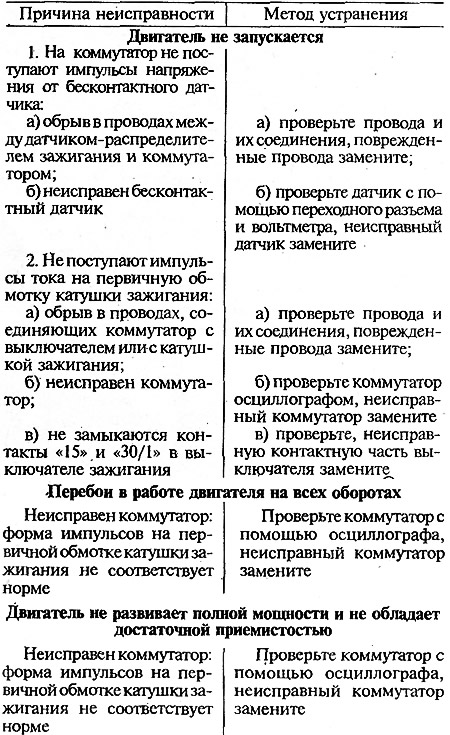
Possible malfunctions of the contactless ignition system, their causes and methods of elimination
Ignition distributor sensor
The contactless ignition system of the 21213 engine uses a type 3810.3706 ignition distributor sensor. It differs from the 30.3706-02 ignition distributor in that instead of a cam on the shaft there is a steel screen 18 (Fig. 9-18) with four slots, and instead of the breaker contacts a microelectronic contactless sensor 20 is installed, operating on the basis of the Hall effect.
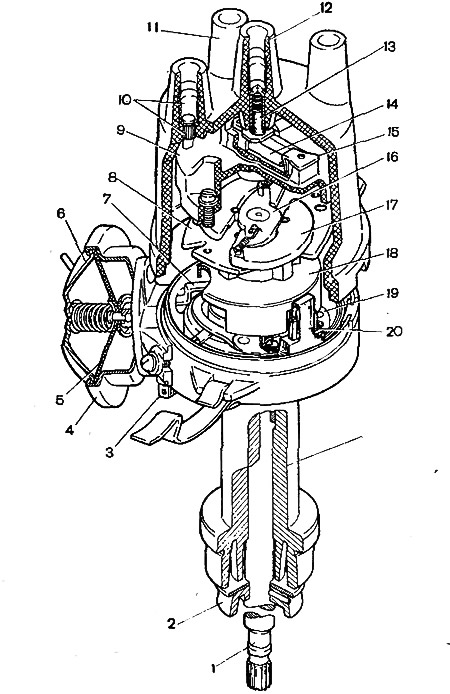
Fig. 9-18. Ignition distributor sensor 3810.3706: 1 - roller; 2 - oil-deflecting clutch; 3 - plug connector; 4 - vacuum regulator housing; 5 - diaphragm, 6 - vacuum regulator cover; 7 - vacuum regulator rod; 8 - centrifugal regulator support plate; 9 - ignition distributor rotor; 10 - side electrode with terminal; 11 - lid; 12 - central electrode with terminal; 13 - central electrode carbon; 14 - resistor; 15 - outer rotor contact, 16 - centrifugal regulator plate; 17 - weight; 18 - screen; 19 - contactless sensor support plate; 20 - contactless sensor; 21 - ignition distributor sensor housing.
Voltage is removed from the contactless sensor output if there is a screen in its gap. If there is no screen in the gap, then the voltage at the sensor output is close to zero.
Checking the ignition distributor sensor on the stand
The ignition distributor sensor 3810.3706 is checked using the same method as the ignition distributor 30.3706-02. To check, make connections to the ignition coil, battery and switch similar to the car ignition system diagram (see fig. 9-17).
To read the characteristics of the centrifugal and vacuum ignition advance regulators, make connections with the switch on the stand according to Fig. 9-19. Connect terminal "4" of switch 1 to the "+" terminal of the stand, terminal "1" to the "breaker" terminal of the stand, and terminals "3", "5" and "6" to the ignition distributor sensor.
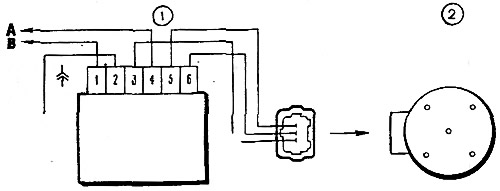
Fig. 9-19. Scheme for taking characteristics of the ignition distributor sensor on the stand: 1 - switch; 2 - ignition distributor sensor; A - to the "+" terminal of the stand; B - to the "breaker" terminal of the stand
The method for taking the characteristics is the same as for the 30.3706-02 ignition distributor. The characteristics of the centrifugal and vacuum ignition advance regulators for the 3810.3706 ignition distributor sensor are shown in Fig. 9-20 and 9-21.
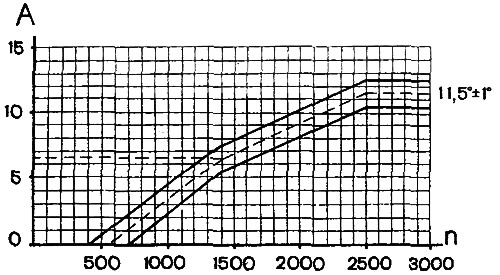
Fig. 9-20. Characteristics of the centrifugal regulator of the ignition distributor sensor: A - ignition timing angle, degrees; n - rotation speed of the ignition distributor shaft, min⁻¹
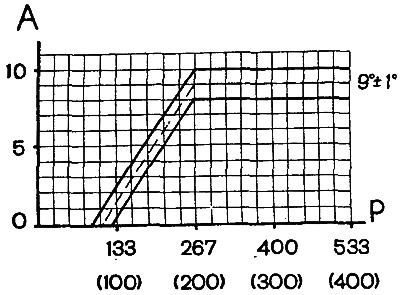
Fig. 9-21. Characteristics of the vacuum regulator of the ignition distributor sensor: A - ignition timing angle, degrees; P - vacuum hPa (mm Hg.)
Checking the contactless sensor
On the ignition distributor sensor removed from the engine, the sensor can be checked according to the diagram shown in Fig. 9-22, with a supply voltage of 8-14 V.
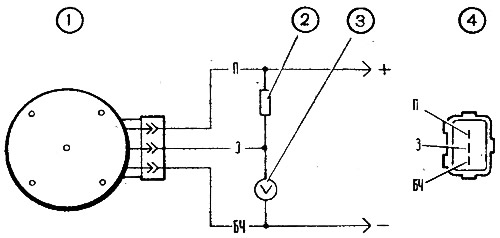
Fig. 9-22. Diagram for checking the contactless sensor on the removed ignition distributor sensor: 1 - ignition distributor sensor; 2 - 2 kOhm resistor; 3 - a voltmeter with a scale limit of at least 15 V and an internal resistance of at least 100 kOhm; 4 - view of the plug connector of the ignition distributor sensor
Slowly rotating the ignition distributor sensor shaft, measure the voltage at the sensor output with a voltmeter. It should change sharply from the minimum - no more than 0.4 V, to the maximum - no more than 3 V less than the supply voltage.
The sensor can be checked on the vehicle using the diagram shown in Fig. 9-23. An adapter connector 2 with a voltmeter is connected between the plug connector of the ignition distributor sensor and the connector of the wire bundle. Turn on the ignition and, slowly turning the crankshaft with the key, check the voltage at the sensor output with a voltmeter. It should be within the limits specified above.
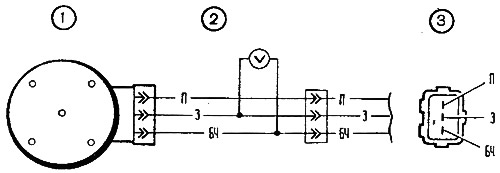
Fig. 9-23. Circuit diagram for testing a contactless sensor on a vehicle: 1 - ignition distributor sensor; 2 - adapter connector with a voltmeter having a scale limit of at least 15 V and an internal resistance of at least 100 kOhm; 3 - view of the plug connector of the ignition distributor sensor
Switch
The contactless ignition system can be equipped with switches of the 3620.3734, HIM-52 or BAT10.2 type (the last two are of Hungarian manufacture).
The switch is checked using an oscilloscope and a rectangular pulse generator according to the diagram shown in Fig. 9-24. The generator output resistance should be 100-500 Ohm. It is advisable to use a two-channel oscilloscope. Channel 1 is for generator pulses, and channel 2 is for switch pulses.
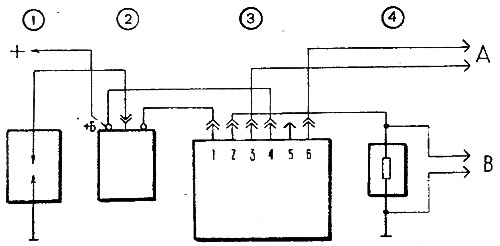
Fig. 9-24. Circuit diagram for testing the switch: 1 - spark gap; 2 - ignition coil, 3 - switch; 4 - resistor 0.01 Ohm ±1%, not less than 20 W; A - to the rectangular pulse generator; B - to the oscilloscope
Rectangular pulses simulating sensor pulses are fed to terminals "3" and "6" of the switch. The pulse frequency is from 3.33 to 233 Hz, and the duty cycle is (ratio of the period to the pulse duration T/Ti) equals 1.5. Maximum voltage Umax — 10 V, and the minimum Umin no more than 0.4 V (fig. 9-25, II). For a serviceable switch, the shape of the current pulses should correspond to the oscillogram I.
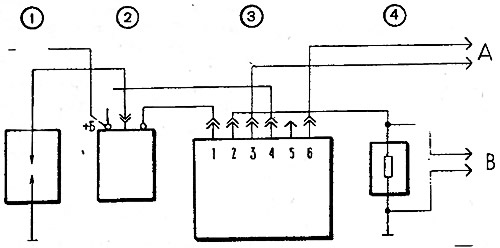
Fig. 9-25. Pulse shape on the oscilloscope screen: I - commutator pulses; II - generator pulses; A - current accumulation time; B - maximum current value
For switch 3620.3734 with supply voltage 13.5+0,1 The current value (V) should be 7.5-8.5 A. The current accumulation time (A) is not standardized.
For the HIM-52 switch with a supply voltage of (13.5±0.2) V, the current value should be 8-9 A, and the accumulation time 8-10.5 ms at a frequency of 25 Hz. For the BAT10.2 switch with the same voltage and frequency, the current strength is 7-8 A, and the accumulation time is 5.5-7.5 ms.
If the shape of the commutator pulses is distorted, then there may be interruptions with the new formation or it may occur with a delay. The engine will overheat and not develop the rated power.
Ignition coil
For ignition coil 27.3705, used in a contactless ignition system, the resistance of the primary winding at 25°C is (0.45±0.05) Ohm, and the secondary winding is (5±0.5) kOhm.
Spark plugs
The contactless ignition system uses spark plugs of the A17DVR, or FE65PR, or FE65CPR type (the last two types are Yugoslavian production). The spark plugs have a built-in interference suppression resistor with a resistance of 4-10 kOhm.
The gap between the spark plug electrodes is 0.7-0.8 mm. The spark plug is considered defective if spark formation between the spark plug electrodes begins at a pressure below 0.3 MPa (3 kgf/cm²).
High voltage wires
The contactless ignition system uses high-voltage wires of the PVVP-8 type (red color) with distributed resistance (2000±200) Ohm/m or PVPPV-40 (blue color) with distributed resistance (2550±270) Ohm/m.